

How can people possibly afford to live in one of the most expensive cities on the planet? It’s a question New Yorkers hear a lot, often delivered with a mix of awe, pity and confusion.
We surveyed hundreds of New Yorkers about how they spend, splurge and save. We found that many people — rich, poor or somewhere in between — live life as a series of small calculations that add up to one big question: What makes living in New York worth it?
Ellen Hagan grew up in a small town in Kentucky, and moved to New York City as quickly as she could after she graduated from college. She arrived a few weeks before Sept. 11, and tried to get her bearings in a city turned upside down.
She found a group of fellow young artists and writers who wanted to take advantage of everything they could in the city, on very limited budgets. They went to poetry readings and dance parties, and rented tiny apartments in the East Village.
All the while, Ms. Hagan was diligent about saving money, even when she had very little of it.
“I didn’t know what I was saving for, but I knew I wasn’t going to have a job that would give me a pension,” she said. “I wanted to make enough money to live the New York existence I was dreaming of.”
Twenty-five years later, Ms. Hagan and her husband, David Flores, whom she started dating in her early years in New York, have much more money than they used to. Still, they feel more anxious about money than they hoped they would at this point in their lives.
The couple both work at DreamYard, a Bronx arts nonprofit. Last year, they made $178,135 there collectively, with Ms. Hagan, 47, directing the poetry and theater programs, and Mr. Flores, also 47, serving as the head of visual art and design.
They typically bring in another $40,000 to $60,000 a year through their freelance work. Mr. Flores is an adjunct professor, a photographer and a filmmaker, and Ms. Hagan teaches at a graduate writing program and writes books and poetry. They try to set aside about 15 percent of their income each year to grow their savings.
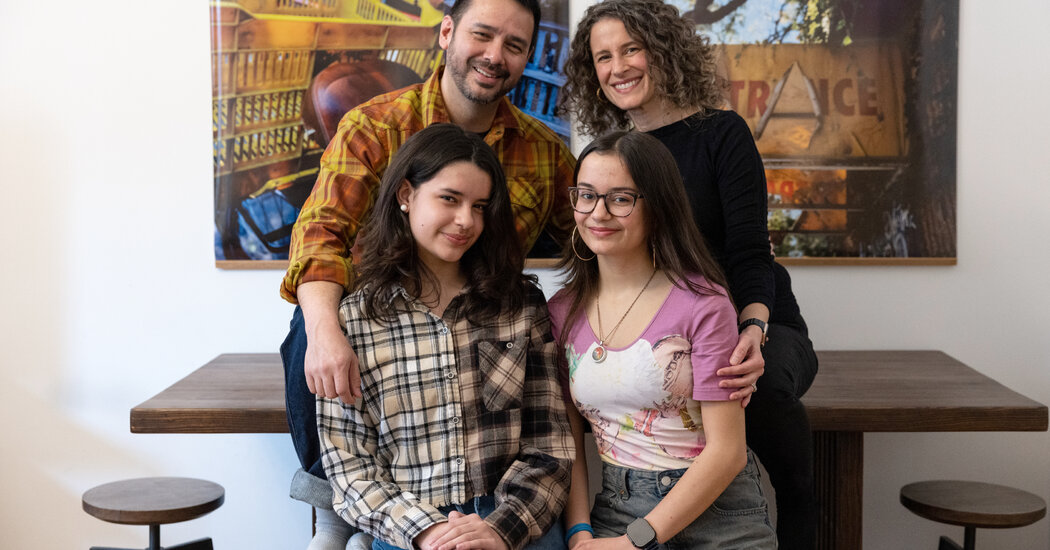
The couple live in Washington Heights in Upper Manhattan with their two daughters, who are 12 and 15.
Homeownership Doesn’t Solve Everything
As a young couple, Ms. Hagan and Mr. Flores lived in a 400-square-foot East Village rental. When their rent started to tick up, Ms. Hagan began looking for a place to buy, seeing homeownership as a buoy that would all but guarantee a secure financial life in New York.
Sixteen years ago, the couple found a perfect apartment in Washington Heights and scrambled to cobble together a down payment. They pooled their savings to put a 15 percent down payment on the $335,000 home. Once they closed, they were left with only a few hundred dollars in savings, but were thrilled and relieved.
“I had this sense that when you buy, you’re set in New York City,” Ms. Hagan said.
The reality, she has found, is more complicated.
The couple’s mortgage payment is $1,300 a month, and their maintenance fees keep rising, partially as a result of a new local law that requires increased inspections and repairs for buildings. Local Law 11 boosted their maintenance by $462 a month, at least temporarily, to about $1,900 total. And when the building’s management installed a new security system, each unit had to chip in $95 a month for three months.
Ms. Hagan loves the apartment, but she worries that they may eventually be priced out of their neighborhood.
“This building isn’t going to be for us at some point,” she said. “This feels like, uh oh, they’re imagining people who have much higher incomes than we do.”
Keeping the Kids Busy
Ms. Hagan and Mr. Flores, who each maintain packed calendars, have encouraged their daughters to adopt the same approach to city living.
“I’m definitely a proponent of, let’s fill your schedule and see what you love,” Ms. Hagan said.
The girls’ public school offers free debate and band classes before and after school, and they’ll appear this spring in the school’s productions of “Annie” and “The Addams Family.”
The girls are also enrolled in a free theater academy at the People’s Theatre and writing workshops at Uptown Stories, which has a pay-what-you-can system. Ms. Hagan and Mr. Flores typically pay the full tuition, which is $800 for each 12-week session, and donate about $2,500 a year to the organizations their daughters are part of.
The couple’s older daughter, Araceli, who wants to be both a writer and a doctor, is enrolled in a medical training program for middle and high school students. She made $2,500 for completing an internship at a cardiothoracic intensive care unit last summer.
Their younger daughter, Miriam, is going to a Y.M.C.A. camp this summer, which costs $2,600 for two weeks.
Ms. Hagan and Mr. Flores spent about $500 total on holiday gifts for both girls, and the couple doles out their daughters’ weekly allowances in two installments: $25 on Mondays and $25 on Fridays.
They shook their heads when Miriam, who is known as the most stylish member of the family, came home one day wearing a Dr Pepper T-shirt she’d bought at Target.
“We were like, ‘What are you doing with your money?’” Ms. Hagan said.
The Fun Stuff
The extra income from the couple’s freelance work allows the family to splurge on theater, vacations, books and memberships at the Museum of Modern Art and the Whitney Museum of American Art.
Sometimes, Ms. Hagan and Mr. Flores work together. A few years ago, they sold a young adult novel called “Tell Me Every Lie” they had co-written for a $35,000 advance, some of which went to their agent.
Every little bit helps. The family is spending a weekend on Long Beach Island in New Jersey this summer, which will cost about $3,500. That price tag includes a hotel room big enough for four.
The family typically travels twice a year to Kentucky, where both Ms. Hagan and Mr. Flores are from, and where the couple co-owns a home in Louisville with Mr. Flores’s parents. They put $40,000 down and spend about $12,000 annually on expenses related to the home.
The family was hoping to travel to the Philippines this year, where Mr. Flores’s father is from, but they realized it could cost as much as $15,000. The trip is now on hold indefinitely.
They spend about $700 a month on groceries from nearby supermarkets, and occasionally order grocery deliveries from FreshDirect.
Every Wednesday, when the girls come home late from theater class, someone picks up dinner at the nearby halal truck or the Dominican restaurant Malecon, which usually runs about $60.
Dinner out as a family of four can easily cost $200, so Ms. Hagan and Mr. Flores typically eat at restaurants just once or twice a month. The other night, the whole family was hungry and craved Italian food from a favorite upscale spot nearby.
They balked, and walked around the corner to a diner instead. The meal was $120, all in.
We are talking to New Yorkers about how they spend, splurge and save.
