
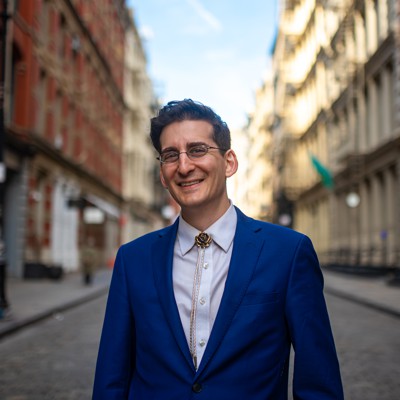
Attorney David Siffert is set to make history next year as the first out nonbinary member of the state Legislature. But their race, and plans for Albany, go beyond just their trailblazing identity.
Siffert won their race after a recount last week to replace retiring Assembly Member Deborah Glick in a downtown Manhattan district including Greenwich Village and Tribeca. It was one of the last races in the state to get called thanks to a razor-thin margin of victory. Siffert came out on top over Glick-endorsed Jeannine Kiely by a mere 15 votes. That’s a reversal from preliminary election night results from June, that initially had Kiely in the lead.
After finally winning following a lengthy post-election process of counting mail-in ballots, affidavits and curing ballots, Siffert is now set to head to Albany to represent the district including historic gay bar the Stonewall Inn as the first nonbinary state legislator. The title means a lot to Siffert, as well as keeping the seat’s representation within the LGBTQ+ community. But they also bring a long track record of advocacy and experience in drafting legislation at the state level. Siffert spoke with City & State about their priorities for next year, the impact of their experience and their historic victory. This interview has been edited for length and clarity.
How are you feeling about the victory?
I’m extremely honored and excited. To have the trust of the district really means a lot to me. And especially given how much I respect the other people I ran against, to get the support of so many people, it’s really meaningful.
You will be the first nonbinary member of the state Legislature, a historic first for New York. What does that mean to you to be the trailblazer in this sense?
I think at this moment, it’s particularly meaningful. You’re seeing trans people coming under such intense attack, to a point that I haven’t seen in my lifetime before. And you have the federal government actively trying to harm trans people. I will give credit to the New York state Legislature and New York state government for having stood behind trans people and acting to protect trans people over the last few years. But as far as I’m aware, every single elected government official in New York state history has been cisgender. And it’s meaningful for New York to say, at this time when trans people are under attack, that we will elect people of different gender identities, people who are gender nonconforming.
I know that you’re a policy wonk and have helped to draft some of the tax the rich legislation. What are your priorities for next year, and what do you think having worked bill drafting already will help you bring to the Legislature?
The first is figuring out how to make housing more affordable, especially within our district, and figuring out ways for our district to be a diverse and thriving place where it’s not just a playground for the rich. But that’s a problem that’s happening citywide and even statewide, and figuring out ways to reverse that problem – especially at the housing front – is really important. A thing that I’ve been talking about increasingly is the need for the government to take a really active and direct role in that process.
Then immigration, we actually did a fair amount of important work in the budget this year on immigration, but we didn’t pass New York for All. We didn’t make New York a sanctuary state, and I think that until that happens, I’m not going to be satisfied. And then I’ve talked a lot and worked a lot before I was a candidate on regulating AI and big tech. We’re at a really critical moment with tech development right now, and big tech has a really powerful influence in Albany. If we don’t do something to regulate it, if we let them run roughshod over us, then I think that we will see a lot of extremely concrete harm that we’re already seeing become exacerbated.
And on your bill drafting experience?
I think it’s going to be more important than a lot of people think, especially given the way the Assembly runs. You can even put this as sort of a priority for me too. We have a really overworked and underpaid staff in the Assembly, and that’s true for the member staffs, and that’s true for the central staff through the (Program and Counsel staff). And as a result, people are really busy. You’ve got 10,000 bills that are introduced every session, and we don’t have the staff capacity to deal with it necessarily. So one of my priorities would be to increase that capacity, which means increasing staff budgets. The way legislation often works is that you prioritize a bill and you hear nothing, you hear nothing, you hear nothing, and then the staff comes to you and says, “OK, here are the problems with the bill.” They might even have some recommended language, and you might only have that one phone call to work out the details, or else your opportunity’s gone. And to be able to work out the language on the spot, I think is really helpful. So I do think that’s really important.
The last thing about being a policy wonk is definitely true, but it’s something that the longer I’m involved, the less I feel that the policy wonk in office is necessarily the answer. When I was younger, I felt like I was like a real ideas person. And now, I still have all sorts of ideas, but I feel like my personal ideas are so much less important than listening and working collaboratively to implement what I’m hearing from people in the district and people who are impacted.
Going back to the election, why do you think it turned out as close as it did, winning by just 15 votes?
I think there’s a few things that happened. A lot of people on the outside viewed this as sort of an ideological fight. There was what was viewed as an establishment candidate, what was viewed as sort of a maybe mainstream progressive candidate, and people had sort of trouble placing me. The reality I think was relatively different. If you actually looked at the policy positions of Jeannine (Kiely), Ryder (Kessler) and me – and even Ben Yee – a vast majority of issues we overlapped. The reason it came down to Jeannine and me is because – there’s two reasons I think, and the reason it was close were the same with the same two reasons. One is that we were both really local, grassroots candidates. We both have done a lot of work in the district for a long time, and ran a campaign in a really grassroots way. We both went person to person and built out really a local campaign with people on the ground. The other reason it was close is because we’re both extremely experienced people in terms of state and local politics, and we have very different experiences. Jeannine’s experience is amazing on the local level. She was a community board chair, but she was a really knowledgeable community board chair. She knows the district so well. But I focused more on you know state legislative policy. Those are both important sets of experiences I think, and we both campaigned on our experience. I think that people split on what experiences they valued. I was very unsurprised that it came out this close.
Have you had a chance to speak with Glick, or have plans to?
I have plans to. We exchanged some brief text messages, and I hope to talk to her. I think she’s going to be out of town, so I hope to sit down with her maybe later in August or something like that. But I definitely would really like to talk to her and learn as much as I can from her.
You said that Kiely has invaluable local experience as well. Do you expect to remain in touch with her while you’re in office to collaborate on issues affecting the district?
I would be a real idiot not to try to work with her as much as possible because she has such useful experience and such good knowledge. So I will do everything in my power to keep her voice in the mix as much as possible.
I reported last week that there’s some talk of creating the Legislature’s first LGBTQ+ caucus. Is that something you’re interested in joining or see happen in your first term?
Yeah, definitely. And there’s already been talks that I’ve already been looped in on. I don’t think there’s anything concrete yet, but yes, I’m excited about the prospect, and would love to be part of it.
There was some conversation during the campaign about keeping “the Stonewall seat” queer. Was that something you thought about during the campaign, and what does it mean for you to keep this particular district represented by a member of the community?
It’s definitely something I was thinking about, and it’s definitely something that means a lot to me on a personal level. It’s one of the reasons I really love and value this district, and seeing that the district is continuing to push forward in queer rights, I would say, is important to me on a personal level. I don’t like to tell other people what they should be valuing, so I’m not the type of person who wants to run demanding that a seat looks a certain way. But it means a lot to me personally that the voters decided to keep queer representation in the seat.
