

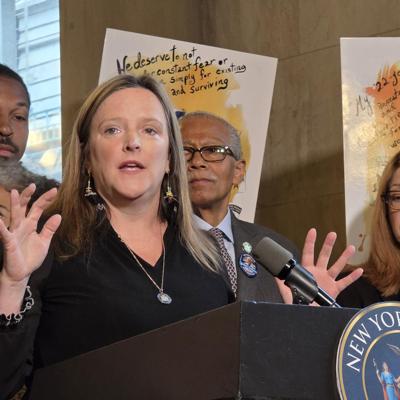
As issues like auto insurance, immigration and delaying climate mandates continue to monopolize state budget negotiations, policymakers are demanding legislative leaders not forget a key affordability issue that’s yet to be discussed: childcare.
In January, Gov. Kathy Hochul announced a plan for a pathway to universal childcare by expanding universal pre-K statewide and funding free care for 2-year-olds in New York City – increasing funding by $1.7 billion in the new fiscal year, including $1.2 billion in subsidies for low-cost childcare assistance programs.
Childcare providers around the state said the governor’s proposal is historic, but fails to properly address the workforce shortage and waitlist backlogs. They’re urging legislative leaders not to accept Hochul’s plan as-is and instead to include an extra $500 million for the workforce to ensure the system doesn’t collapse under its own waitlists. The Senate included that money in its one-house budget, but the Assembly did not.
“While our wages have seen a recent increase from $3.65 to $6.02 an hour, this remains insufficient to sustain a livelihood,” said Doris Irizarry, a childcare provider in the Bronx. “Many providers are being forced to leave the field for other employment.”
Thousands of children across the state in need of care are languishing on waitlists, Irizarry said – burdening New York families already struggling to make ends meet.
Demand for the Child Care Assistance Program has far surpassed existing funding, forcing New York City and at least 35 counties to close enrollment or maintain massive waitlists, said Dede Hill, vice president of policy at the Schuyler Center. Providers said the program’s current reimbursement model fails to cover basic operational expenses like rent and livable wages, and if the budget does not include the additional $500 million for the workforce, the promise of universal childcare will not become reality and will remain a political talking point.
“(We need to) move away from the current setup, which is like a block grant to counties,” said Pete Nabozny, director of policy at The Children’s Agenda based in Rochester. “If one county has extra money and another county has a waitlist, there’s no real way to allow the funds to flow to where they’re needed.”
Providers said the state must give more aid to stabilize the Child Care Assistance Program and create a permanent workforce compensation fund. About 64% of New Yorkers live in a childcare desert, which means between three and nine children are in need of care for every available slot, according to the Empire State Campaign for Child Care. Fulltime childcare costs for families with an infant or preschooler average $35,000 per year.
Policymakers are also putting pressure on Hochul to commit millions more to childcare, competing with the Legislature’s lengthy wishlist for the minimum $263 billion spending plan, now one month late.
New York City Council Members Jennifer Gutiérrez and Althea Stevens, along with Speaker Julie Menin and 21 other council members, sent Hochul a letter last week warning that her current plan won’t address voucher shortfalls and the existing waitlist. New York City’s voucher waitlist has surpassed 17,000 children, a more than 1,000% increase since last July, and is growing by approximately 1,500 children per month – putting it on track to exceed 30,000 families by next year, according to the letter. Council members said the city needs another $1.14 billion in Child Care Assistance Program funding through fiscal year 2027 to clear the waitlist and meet the projected demand.
“These numbers will continue to grow as the affordability crisis grows,” Menin and other council members wrote in the letter. “These are working parents, many of them low-income, who cannot access the care their children need and who may be forced to leave the workforce as a result.”
Assembly Speaker Carl Heastie told reporters in Albany on Wednesday that leaders have finally started working out the numbers to determine table targets for the minimum $263 billion budget, which is now a month late. But it’s unclear when childcare will come up in ongoing spending discussions.
“We need $1.2 billion for our childcare workforce, funds and policy change to end all waitlists statewide, and to provide a minimum 30% rate differential above the market rate for children with a diagnosed developmental delay,” said Assembly Member Andrew Hevesi, chair of the Assembly Children & Families Committee. He would not answer other questions about ongoing budget negotiations.
Assembly Member Sarah Ann Clark, who sponsors legislation to create a centralized early childhood fund, agrees the existing block grant model creates a geographic lottery that exacerbates the number of families stranded on waitlists.
“When the logjam breaks on the policy, we all need to be ready to be advocating for this,” Clark told City & State. “If we don’t fix this, we’ll continue to have these issues where even when people qualify for help, they just can’t find spots.”
Clark said she’s pushing her colleagues in the Legislature to insist on the extra $500 million for the workforce so that people eligible for the assistance program can actually access the childcare they need.
“I don’t have a sense yet where everyone is on this, but I keep beating the drum in case anyone’s listening and ready to go,” she said.
