

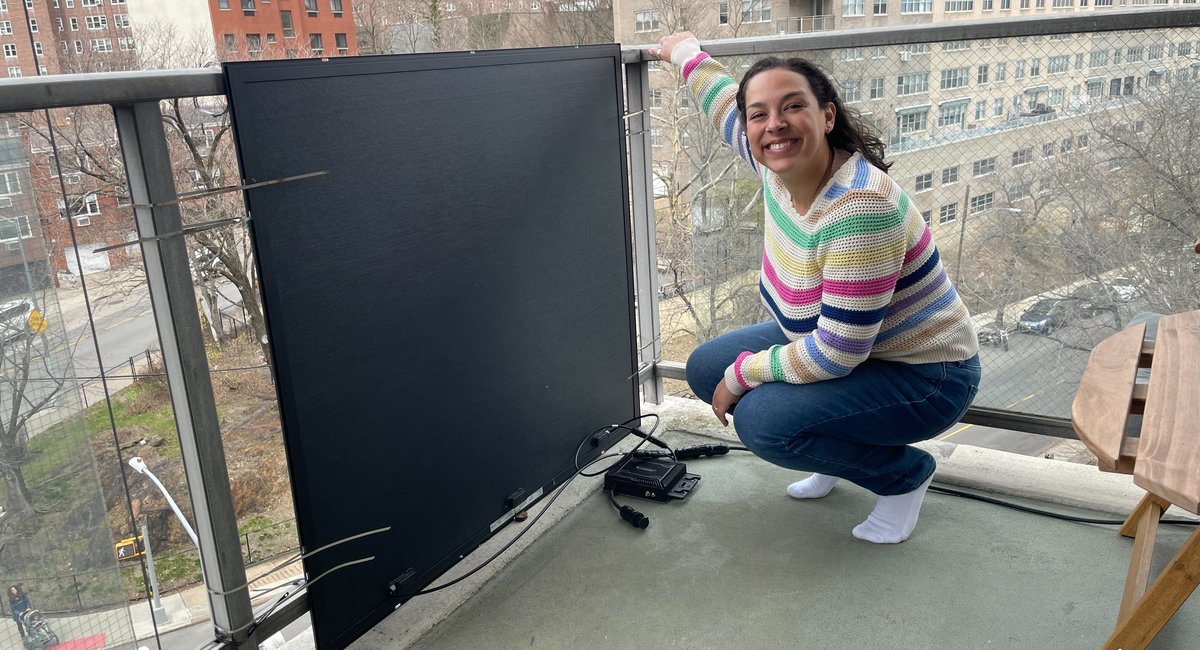
Lauren Phillips of the Bronx can say something that most New Yorkers can’t these days: She has managed to lower her monthly utility costs in 2026.
In January, Phillips installed a relatively lightweight solar panel on her Spuyten Dyvel balcony that overlooks the Hudson River. She used zip ties, and it took her a matter of minutes. The small device has shaved about $30 in costs so far this year.
“It’s generating power that goes right into my apartment, and that’s money that I’m not spending,” Phillips said. “As a mom who has two kids and a big daycare bill, that makes a big difference.”
Phillips’ solar panel is not exactly street-legal in New York. Current laws are designed for large solar panels, the type often found on roofs. Those must be professionally installed and connected to the broader electric grid. Phillips’ plugs into the wall and doesn’t leave her apartment.
The Sunny Act, a bill that the state legislature could vote on this spring, would allow apartment dwellers, whether renters or homeowners, to use easy-to-install and affordable solar power like the type Phillips is trying out. According to plug-in solar advocacy group Bright Saver, the panels can offset power usage by 10% to 25%, depending on the panel’s capacity.
”Most New York City residents live in rental apartments and multi-family dwellings, so up until now, they really haven’t had a way to take any advantage of solar options,” said state Sen. Liz Krueger, the bill’s sponsor. “This really is a game changer because frankly, anybody who’s got about $300 can go by one of these.”
Con Edison, the city’s biggest utility, has already signed on in support of the bill.
The technology is a common sight in Berlin, Germany, where it is seen on balconies, around windows and even on roofs. The German government in 2019 enacted regulations that have led to its adoption.
Phillips is participating in a pilot program from Bright Saver. Her solar panel weighs about 25 pounds and is a half-inch thick and 3.5 feet by 3.5 feet in dimension. It can harvest about 220 watts of energy from the sun each day. It’s on the smaller end of available balcony solar panels. The panels can go up to almost 2,000 watts in capacity. A 1,200-watt panel is enough to power a window air conditioner unit, according to Bright Saver.
“ You can bring it home and plug it in to a standard outlet and you’re producing solar energy that very day and cutting your bills immediately,” said Cora Stryker, cofounder of Bright Saver. “In this country, the only rules on the books are intended for much larger systems, either rooftop solar systems, or even utility scale solar systems.”
The panels can be secured on any flat surface — yards, terraces, decks or anywhere on the outside of buildings. There are units that fit on windows just like air conditioners. After a pane is installed, it’s plugged into a standard 120-volt outlet. The panel takes in the sun’s rays and converts them into electricity that goes directly into the individual home. The panel comes with an inverter box that converts the electricity to alternating current for use inside homes sent to the breaker box, instead of energy sent directly to the grid like rooftop solar.
“The consumer can just plug it into the wall and electricity is like water,” Stryker said. “This is sending electricity into the home wiring and anything you’re running off of the electricity, your refrigerator, lights, television, air conditioner, all of that will consume the electricity generated by the solar panels.”
The plug-in panels cost anywhere from around $300 to a couple of thousand dollars, depending on capacity and optional battery storage, according to Krueger and Bright Saver. Krueger said she expects the costs to decrease as adoption increases. Traditional rooftop solar installations run around $20,000 or more.
The upfront investment translates into monthly savings on energy bills. According to Kreuger’s office, an 800-watt plug-in solar system paired with battery storage could generate an annual savings of $279.
“It’s generating power that goes right into my apartment, and that’s money that I’m not spending,” Phillips said. “As a mom who has two kids and a big daycare bill that makes a big difference.”
But the cost savings isn’t the primary reason, Phillips hangs her panel. She is on a mission to reduce the use of fossil fuels in her home and reduce her carbon footprint. If the law passes, she plans to hang three or four plug-in panels, which can maximize her cost savings and reduce her dependence on fossil fuels.
“It makes me feel good that I’m emitting that much less fossil fuels into the air and heating the climate that much less,” Phillips said.
The Sunny Act was introduced in September 2025, and is currently in committee. More than 30 other states have similar legislation. In Utah, the bipartisan bill was passed with a Republican majority earlier this year.
