

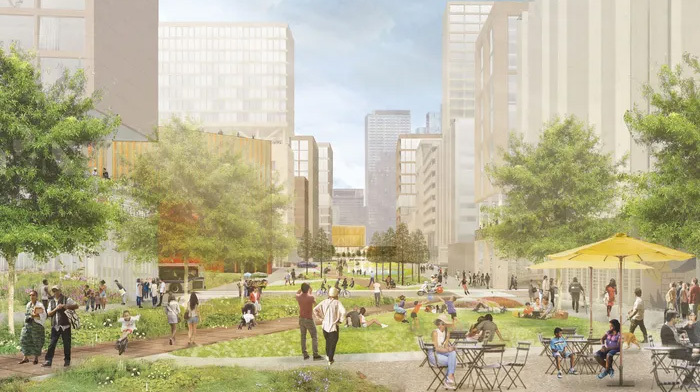
New York City might one day get an entirely new neighborhood—built not on empty land, but on top of one of the busiest rail yards in North America.
City officials have resumed talks about decking over Sunnyside Yard in Queens, a massive 180-acre train yard that sits between Long Island City, Sunnyside and Woodside. The idea is ambitious: the plan involves building a giant structural platform over the active rail yard and constructing a full neighborhood above it, with housing, parks, schools and potentially a new regional rail station.
If it sounds familiar, that’s because New York has done something similar before. Hudson Yards in Manhattan sits atop an active rail yard. But Sunnyside Yard is much larger—roughly the size of three Bryant Parks combined—and planners say it could eventually support around 12,000 new homes, many of them designated as affordable housing.
And this isn’t just about apartments. The proposal would effectively create new land in the middle of western Queens, connecting neighborhoods currently split by the rail yard. The Sunnyside Yard Master Plan describes the overbuild as a way to extend surrounding communities across the site while maintaining the trains below.
For everyday New Yorkers, that could mean something surprisingly practical: better ways to get around.
Plans for the site have long included the possibility of a new “Sunnyside Station,” a regional rail hub where Amtrak, Long Island Rail Road, Metro-North and New Jersey Transit could eventually meet. If that were built, it could allow direct train travel between parts of Queens, the Bronx, Long Island and New Jersey, which are all connections that typically require detouring through Manhattan.
The yard itself is already a critical piece of infrastructure. Built in 1910 to support Penn Station, Sunnyside Yard stores, cleans and services trains for Amtrak, New Jersey Transit and the Long Island Rail Road, with hundreds of train movements passing through daily. But that’s also what makes the project so complicated. Engineers would need to construct a massive deck above the tracks while keeping trains running underneath. Early planning work suggests that nearly 80% of the yard could be covered, while some sections would remain open due to rail operations.
Then there’s the price tag. City officials have suggested the deck alone could require more than $20 billion in federal funding and the project would also need approvals from Amtrak, the MTA and local politicians.
The proposal is still years (if not decades) from becoming reality. But if it ever happens, Sunnyside Yard could turn one of New York’s biggest infrastructure sites into something the city rarely gets anymore: an entirely new neighborhood built from scratch.
