
The Mamdani administration has pulled controversial plans to open an artificial intelligence-focused high school and close or relocate middle schools on the Upper West Side.
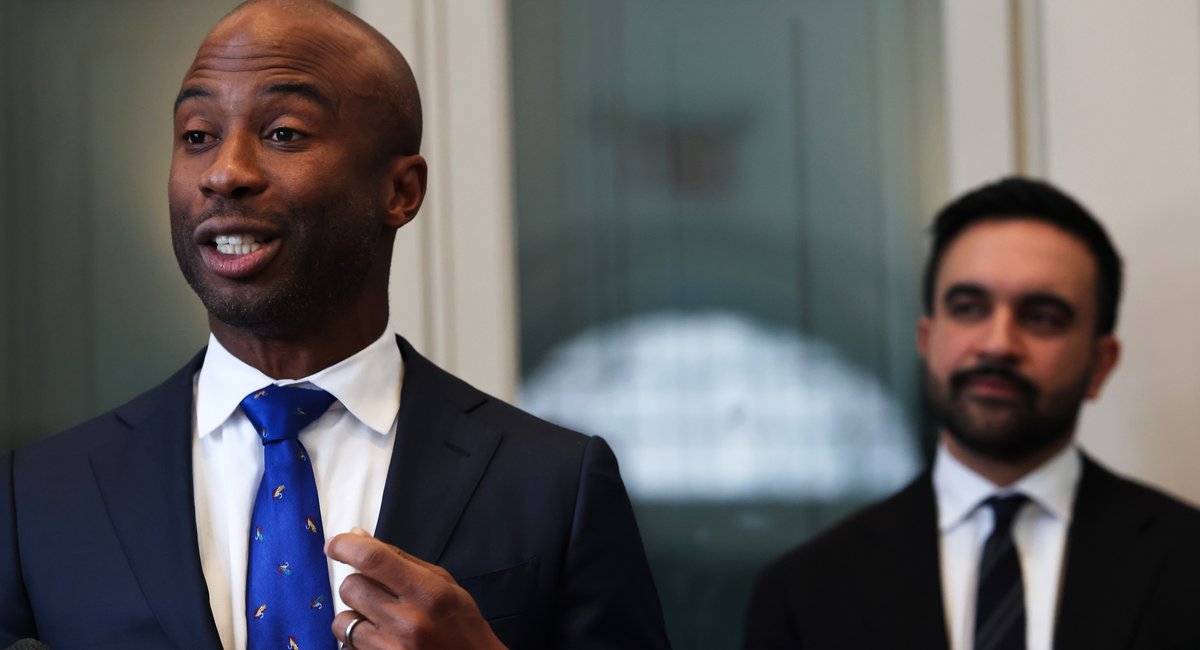
Schools Chancellor Kamar Samuels helped shape the Upper West Side proposals as superintendent there before stepping into his new role in January. He acknowledged in an interview with Gothamist that the frustration from parents and students about the proposals had been a learning experience.
“Transitions are sometimes opportunities for us to reflect and rethink, and if I could have predicted that I was going to be the chancellor rather than the superintendent [who] was shepherding these proposals through, I certainly would have approached this a little bit differently,” he said.
Upon taking office, Mayor Zohran Mamdani and his new schools chancellor had promised a new era of family engagement and democratic decision-making. But many parents said they felt railroaded by the proposed closures, relocation and AI-school without sufficient time to provide input.
The proposals tapped into some of the most divisive issues in education.
School closures often touch on issues of race and equity. The role of technology in schools is also polarizing, as some parents mobilize against screens and others seek to prepare their children for a job market that will be upended by AI.
Samuels said all of the plans might be revived, revised or replaced, depending on additional feedback.
“The overwhelming pieces of feedback that we heard were that school communities felt like they needed more time to really discuss and process these proposals,” he said.
The education department had proposed closing several Upper West Side middle schools to address declining enrollment, and relocating another because of the new state law limiting class sizes.
But families at the schools selected for closure — the Community Action School, Manhattan School for Children and I.S. 191 — fiercely lobbied to keep them open.
Parents at The Center School, which the department wanted to move to create space for the overcrowded P.S. 9, said the new site was inadequate and would hamstring its popular theater program.
Many parents slammed the entire process, calling it opaque and rushed.
“People will not trust the public school system to work for them if we behave this way,” Panel for Educational Policy member Naveed Hasan said.
The issue exploded when a white parent was caught on a hot mic making racist comments about a Black student during a public Zoom meeting.
Parents at the Upper West Side schools on Monday cheered the news that officials had backed down from proposals that had roiled the community.
Center School parent Deranie Henderson said she was “ecstatic” to learn the popular school would not be forced to move next fall and the other middle schools slated for closure would remain open.
“This is truly the right decision. It gives all schools and families the time and space to thoughtfully and effectively explore solutions that work best for everyone involved,” Henderson said.
The proposal for a new technology high school had become a lightning rod for debate over the role of AI in education.
The education department had proposed creating Next Generation Technology High School, a new selective school by Bowling Green, as a replacement for the Urban Assembly School of Business for Young Women, which is being considered for closure.
But advocates for a moratorium on all AI in city schools railed against the proposal, which had been dubbed “the AI school,” over concerns about the new technology’s impact on cognition, mental health and the environment.
Parents at a colocated middle school, Lower Manhattan Community School, had also been eyeing the space the AI school would have occupied.
Panel for Educational Policy chair Gregory Faulkner wrote to the chancellor on Sunday that he was concerned about the selective admissions policy for the new AI-focused school. He said he worried the admissions process would serve as a “barrier for entry” to the school dedicated to an important emerging technology.
Faulkner called for officials to pursue a school that balances “academic rigor with inclusive access.”
Anne Hager, a parent at the Lower Manhattan Community School, applauded the move Monday.
“This is a win for families, our schools and our city as well as a first step toward a more democratic process for major decisions that relate to New York City public schools,” Hager said.
Samuels said challenges related to shifts in enrollment and the class size law remain. But he said withdrawing the proposals would allow all stakeholders “to take a deep breath” and move forward together.
