

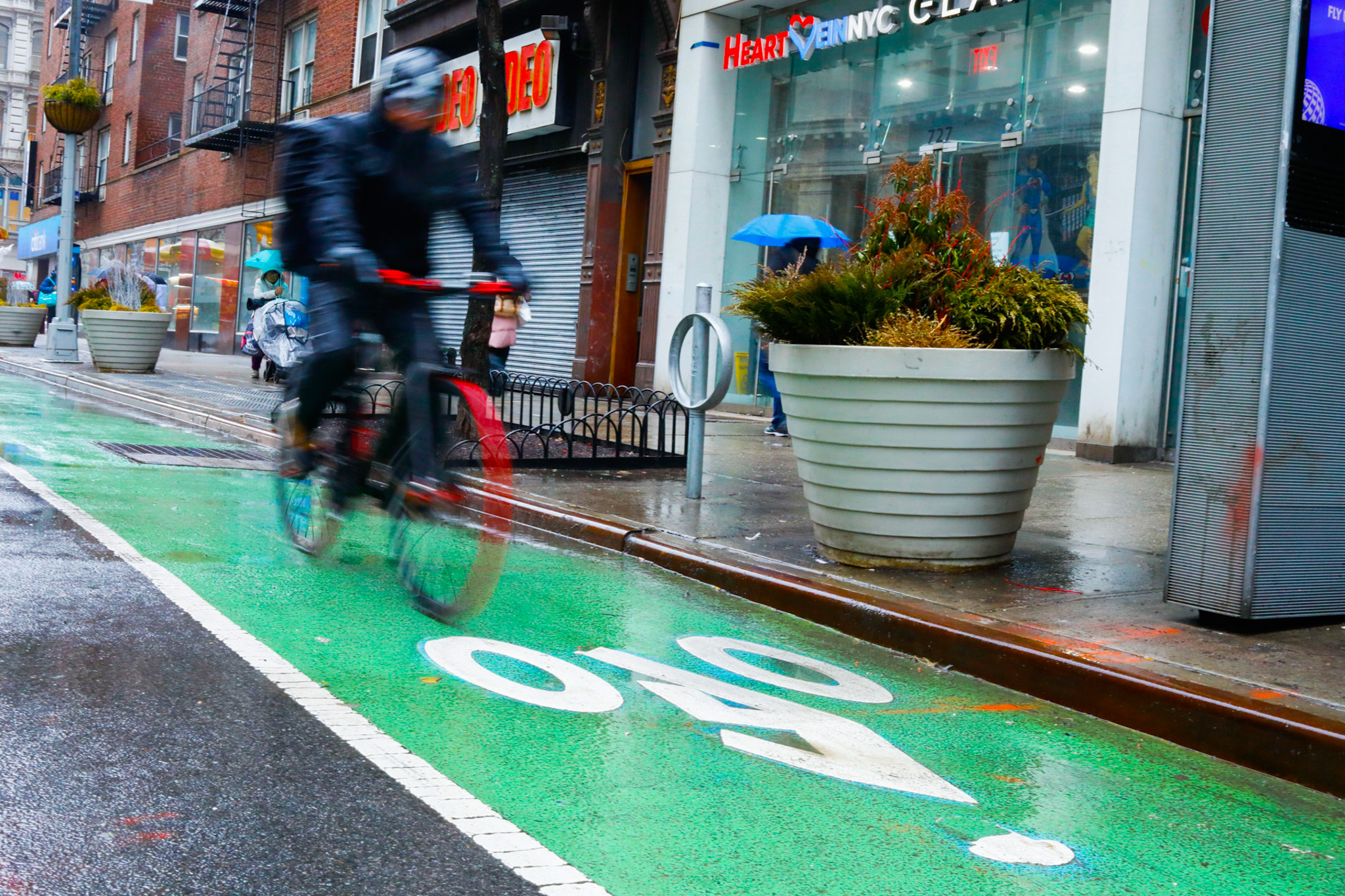
The city’s woeful attempts to expand the number of lanes reserved for buses and bicycles earned failing grades Tuesday from members of the City Council.
Established in 2019, the NYC Streets Plan set mandates for the city to build at least 150 miles of protected bus and 250 miles of protected bike lanes between 2022 and 2026. But Department of Transportation numbers show the agency fell short of its targets repeatedly under Mayor Eric Adams.
Council Majority Leader Shaun Abreu (D-Manhattan) said the city is “trying to make up for lost time” after two years of hovering near the halfway point of its mandate for new bus and bike lanes.
“A 50% is a big, fat F,” he said.
New DOT commissioner Mike Flynn and his top lieutenants were called on the carpet in front of the committee and badgered over what one councilmember called an “uninspiring” record on street redesigns that are supposed to prioritize the safety of cyclists and accelerate slowpoke buses.
“The way things have been working is not good enough,” Councilmember Lincoln Restler (D-Brooklyn) said. “And I hope that you are hearing that clearly from this City Council, that we want to see significant improvement.”
In his first official move at the start of 2026, Mayor Zohran Mamdani named Flynn head of DOT, a priority hiring that pointed to his administration’s focus on speeding bus service that averages 8.1 mph — among the slowest in the country, according to a February 2025 Independent Budget Office report.
Mamdani made the delivery of “fast and free” bus service a key component of a mayoral campaign that featured other transportation proposals.
Advocates said that is in contrast to Adams, testifying that the improvements mandated under the NYC Streets Plan did not bear much fruit under the one-time “bus mayor.”
“It was a long four years fighting for bus riders under the Adams administration,” said Jolyse Race, of Riders Alliance, an advocacy group. “And for four years, the streets plan was ignored and bus riders were completely disrespected by the elected officials.”
Flynn inherited a backlog from the previous administration on bus lane projects, with the city completing just 20.8 miles toward its 30-mile goal for 2025 — which was an actual improvement from the 13.5 miles built out the previous year.
“The mayor has been clear that we can and must do better, and that safe and livable streets are a priority for this administration,” Flynn said.

The DOT chief also cited Mamdani’s recent revival of bike and bus-lane projects that had been put on ice due under the Adams administration.
“Our most important steps have been to resume important street redesign projects that stalled due to political considerations or legal challenges,” Flynn said.
Those include putting in protected bike lanes along McGuinness Boulevard in Brooklyn and extending a double bus lane along Manhattan’s Madison Avenue from 42nd to 23rd streets and redesigning long-planned bus lanes on Fordham Road in The Bronx.
The McGuinness Boulevard project faced opposition from the “Keep McGuinness Moving” campaign. THE CITY reported in 2023 that the effort appeared to have significant ties to the politically wired Argento family that owns a film production company and several other businesses in the area.
The Fordham Road bus lane project, meanwhile, was scrapped after running into powerful opposition from the likes of Fordham University, the New York Botanical Garden and the St. Barnabas Hospital Health System, a move that the then-head of New York City Transit called “perplexing” and “disappointing.”
Earlier this month, Mamdani announced the revival of the Fordham Road bus lane project while standing alongside the head of the MTA, who said the city needs to follow through on “long-overdue commitments.”
“The bottom line is this: The buses can only move as fast as conditions at the street level allow,” Janno Lieber, MTA chairperson and chief executive, said Feb. 13.
For the bike lanes, Chris Sanders of Transportation Alternatives testified that the city is lagging far behind cities such as Barcelona, London and Zurich in prioritizing space for those who travel on two wheels.
“It is a global city, it’s not competing with the rest of America,” said Sanders, of the organization’s Manhattan activist committee. “It’s competing with the rest of the world and we need to bring our streets up to that high, high, high standard.”
Councilmembers put the DOT leaders on notice that they need to follow through on the commitments laid out in the next five-year streets plan.
“We don’t want to be coming back to you in six or nine or 12 months with failures again on not building enough bike lanes, not building enough bus lanes, not building the pedestrian space we all need to make our communities safer and to make it faster for all of us to get around,” Restler said.
