

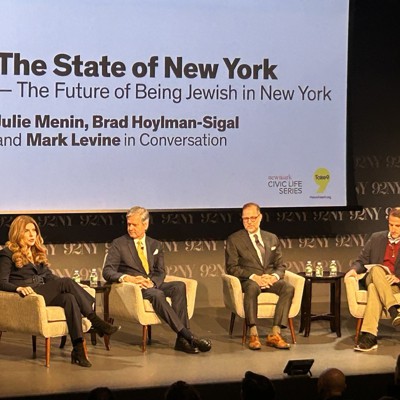
At a conversation about “the future of being Jewish in New York,” three of New York City’s most prominent Jewish elected officials raised alarm bells about antisemitism and hate in the city while still trying to make the case that the city can be a beacon for Jewish New Yorkers.
The conversation, convened by the 92nd Street Y, included city Comptroller Mark Levine, City Council Speaker Julie Menin and Manhattan Borough President Brad Hoylman-Sigal.
“On the one hand, I believe that the Jewish community of this city is, without a doubt, one of the strongest and largest and most dynamic and most culturally rich and most important that we have had anywhere in 3,000 years. We’ve built something miraculous here,” Levine said Wednesday. “On the other hand, we’re facing challenges that I think most of us thought we would not need to be confronting in 2026,” he said, mentioning the disproportionate number of anti-Jewish hate crimes reported to the New York City Police Department.
While the conversation spanned sweeping questions about Jewish identity and the leaders’ own experiences with antisemitism, it also delved into the leaders’ assessments of Mayor Zohran Mamdani so far. The panelists were not directly asked about whether they plan to run for mayor in the future, but both Menin and Levine are considered to be mayoral contenders waiting in the wings, keeping a close eye on Mamdani.
The event occurred as a piece of the City Council’s “Five-Point Action Plan to Combat Antisemitism” is facing a potential veto by Mamdani.
Two bills in that package, passed last month, would require the NYPD to develop policy to consider security perimeters (sometimes called buffer zones) around houses of worship and schools that proponents said will protect congregants or students from harassment or injury during protests while protecting constitutional rights to free speech and assembly.
Critics of the bills, including some left-leaning politicians and civil rights groups, have argued buffer zones would infringe on those constitutional rights, however. Mamdani has yet to say if he will sign the bills, with a spokesperson saying last month that he “wants to ensure both the right to prayer and the right to protest are protected.”
The first bill, concerning security at houses of worship, was sponsored by Menin and passed the council last month with a comfortable veto-proof majority. But the second bill, concerning security at schools and sponsored by Council Member Eric Dinowitz, passed with five votes shy of a veto-proof majority and as a result is seen as more vulnerable to a veto.
With the mayor facing a deadline of Saturday to either veto the legislation or let it pass into law, Menin gave a passionate defense of the legislation on Wednesday and warned against such a move. “I really hope that there is not a veto of that legislation, because I think that will lead to more divisiveness when we need less divisiveness,” Menin said.
Two City Council members speaking on the condition of anonymity told City & State they expect Mamdani will issue a veto. A City Hall spokesperson did not immediately respond to questions about the legislation or other remarks shared at the forum on Wednesday.
Mamdani, the city’s first Muslim mayor and most prominent Muslim elected official, has also faced his share of hate. In early March, white supremacist protesters gathered outside Gracie Mansion, calling his mayoralty an “Islamic takeover.” The mayor was the focus of much of the conversation on stage Wednesday, particularly his criticism of Israel. Mamdani has resisted questions about whether Israel should exist as a Jewish state, answering it should be “a state with equal rights.” He has diverged with some of the leaders on stage on issues like the city investing in Israel bonds – a policy Levine defended Wednesday, calling it an important “financial instrument” despite his own criticisms of the government of Israel.
Hoylman-Sigal urged Mamdani to visit Israel as other mayors have done. But the Manhattan borough president also drew some boos from the crowd when he defended the mayor during a question about how he would advise Mamdani to address the many Jewish New Yorkers who did not vote for him. “I know his heart is in the right place,” Hoylman-Sigal said over audible protest from the audience. “He represents a generational change, which we have to acknowledge as Jews,” he continued, noting millennials are more skeptical about the “current state of Israel” and that “we need as Jews to help educate him about the history.”
“I think we have to take the mayor at his word that antisemitism is of serious concern until we’re shown otherwise,” Hoylman-Sigal added.
