

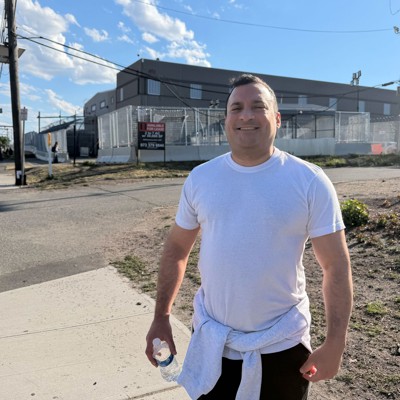
In January, City Council staffer Rafael Rubio was detained by immigration authorities at an asylum appointment. For more than five months since then, he’s lived behind bars.
He was a former lawyer from Venezuela with a stable job and no New York criminal history, yet now he was behind bars in Orange County and suffering. It took three weeks to get consistent access to his blood pressure medication, he says, so his hands were red and he felt like a heart attack was coming. He never got a clear explanation for the delay.
He was behind bars and hearing strange taunts from the officers detaining him. They’d say, “are you a socialist,” or “is your position political,” or “why isn’t your boss coming to rescue you?” The officers were talking about Zohran Mamdani. Rubio was confused. He was a back-office employee. As far as he was concerned his boss was a nice woman in the council personnel services division, where he’d done data and compliance in the bowels of New York City bureaucracy before his vanishing. “I wasn’t elected by anyone,” he’d say.
He didn’t know that New York political leaders were calling for his release, that City Council Speaker Julie Menin was backchanneling with the Department of Homeland Security, with Congress, with the Trump administration. Yet it wasn’t making him free. “Everything was falling to some extent on deaf ears,” Menin said.
Rubio was behind bars thanks to the opaque bureaucratic force that is President Donald Trump’s deportation regime, and he saw little chance for anything but staying there. Soon, he was moved to the Metropolitan Detention Center in Brooklyn, the same infamous and overcrowded building that was also home to Nicolás Maduro, former president of Venezuela and leader of the regime Rubio himself had fled. They never crossed paths, but it cheered him in a grim way that Maduro was eating the same food all the other detained immigrants ate. The same boiled eggs with no salt.
It was one of few bright spots. “I thought it was over,” Rubio said. It seemed to be. He was behind bars in March when a judge ordered him deported back to Venezuela, and he was behind bars in April, while a new set of lawyers recommended by Menin worked on the usual uphill legal maneuvers. Even for these hearings he did not escape the bars. He made his appearances virtually, from a special room that an officer would lead him into, where he would wait. Cameras beamed in judges and lawyers and other immigrants on a screen.
The practice allows judges to see (and often decide to deport) detained immigrants in rapid succession, but it can be startling, as for one man whose hearing came just before one of Rubio’s. The man’s lawyer beamed in via a different box. With the lawyer was that detainee’s partner and 4-year-old daughter. The daughter made butterfly hand motions at the camera while the judge denied bond. Then it was Rubio’s turn and he explained politely that he didn’t need interpretation.
“I can tell you speak a lot of English, sir,” the judge agreed.
Yet that hearing was just setting the calendar, and Rubio was still behind bars in May, for another appearance before another virtual judge. In his plain blue uniform shirt Rubio rubbed his eyes and hands while the judge got her bearings. “This case has been going on for a minute,” she said, accurately. Still, there would be more waiting. Memorial Day was coming. The Immigration and Customs Enforcement attorney on the call joked about Monday being a holiday and how she didn’t want to be here then. Rubio gave a slight smile to the screen and looked down. He was behind bars on Memorial Day too.
By the spring, the place where he was behind bars was a new facility, New Jersey’s Delaney Hall, run by the notorious private prison operator GEO Group under a $1 billion, 15-year contract. He was behind bars at this facility while a hunger strike spread. Detainees complained about awful bathrooms and bad access to lawyers. A Dominican woman was denied prenatal care and a Guatemalan man missed two months of leukemia treatments, according to The City Reporter. (“This is the best healthcare many aliens have received in their entire lives,” ICE has said in multiple statements.) And bad food. “Food with worms,” said Jorge Torres, organizing director for the National Day Laborer Organizing Network, who was in contact with other detainees.
For Rubio it was the water. It wasn’t always available. So people would make a huge line with their plastic cups from the commissary to grab water for the day, water to drink or cook instant soup in, a cup of water. Sometimes the line would take an hour.
He said his unit mates decided to join the strike for one day to be supportive, and they did, refusing to go to the lunchroom. But then they stopped. They saw officers taking notes of who was refusing to eat. They feared they’d be transferred to some facility farther away, down south. There are bars and then there are bars.
He was behind bars at the end of May, when he went in front of the camera again for yet another virtual hearing, and yet another immigration judge, who, this time, listened to his plea for political asylum. His lawyers from The Bronx Defenders argued that he had been a government employee in Venezuela and refused to participate with the regime, and was persecuted for that reason. Then a strange thing happened behind that virtual stream. The judge agreed. The 45-year-old was granted asylum. At a time when that path is all but blocked for most people, when the Supreme Court is making life for asylum-seekers even harder, he’d won.
Yet still, Rafael Rubio remained behind bars. Waiting to see if the government would appeal his grant of asylum. Fighting for his habeas corpus petition. Waiting for his bond to go through and still waiting more.
So he was behind bars as the situation at Delaney Hall deteriorated, as protesters and journalists outside were pepper sprayed and kettled and sometimes injured or arrested. He was behind bars as Congress member after Congress member visited, and also when House Minority Leader Hakeem Jeffries toured for more than an hour. Jeffries emerged to say that conditions within “shock the conscience,” and that not a single detainee that Jeffries spoke with “falls into the category of the worst of the worst.” Instead, like Rubio, the vast majority are law-abiding individuals, according to ICE’s own numbers, accused only of immigration violations. Jeffries mentioned a few of Rubio’s neighbors behind bars, including “several tax-paying small business owners and an 18-year old DREAMer who was ripped away from her family just months from her high school graduation.”
Jeffries called it “unacceptable.” And there were times when Rubio felt the same. In South America, he says, “a lot of us have an ideal opinion of the system in the United States, so it was very heartbreaking for me to see that that thing was happening to me.” He met detainees who’d been behind bars for more than a year. And what were the alternatives for someone in their situation? Deportation back to a country they’d fled? Or being sent to another strange country entirely? Currently, the Trump administration is deporting hundreds of people every day.
Rubio’s path would be different – and more complicated. On June 19, only after a federal judge ordered him released “immediately,” according to court records, he emerged from behind bars. It was a journey encompassing nearly 160 days and a prodigious amount of advocacy and resources, including five attorneys and one legal advocate from The Bronx Defenders working directly on his case across multiple courts. This is what it takes to release one immigrant, plus careful planning and coordination and the perfect threading of a legal needle.
And even still: his ordeal goes on. As a legal deadline approached this week, the government filed to appeal Rubio’s asylum. Once again Rubio is in immigration limbo. His lawyers expect to defend his asylum grant at the Justice Department’s Board of Immigration Appeals and, if it is reversed, take the case to a higher court.
In a statement on Friday Menin called his release a victory and said “We will continue to stand by him every step of the way as he fights the unfair appeal to his asylum application.”
Rubio remains anxious. “I believe that there is a little bit of PTSD in me still,” he said by phone in an interview during his first days of freedom. He looks over his shoulder now when he goes out to buy groceries, blood pressure spiking at the sight of a big SUV. He remembers how agents took one of his cellmates, at 3:40 a.m., from his own apartment.
But he expects to be fighting his case while at liberty. Consequently, some normalcy is returning. He’s scheduled to return to in-person work on Monday.
“It’s been such a relief to be out.”
