

Pete Seeger would have been proud.
And so would other songwriters whose music was performed, along with newer, original songs, as Porch Stomp turned Governors Island into an all-day music marathon June 20 with more than 250 performers.
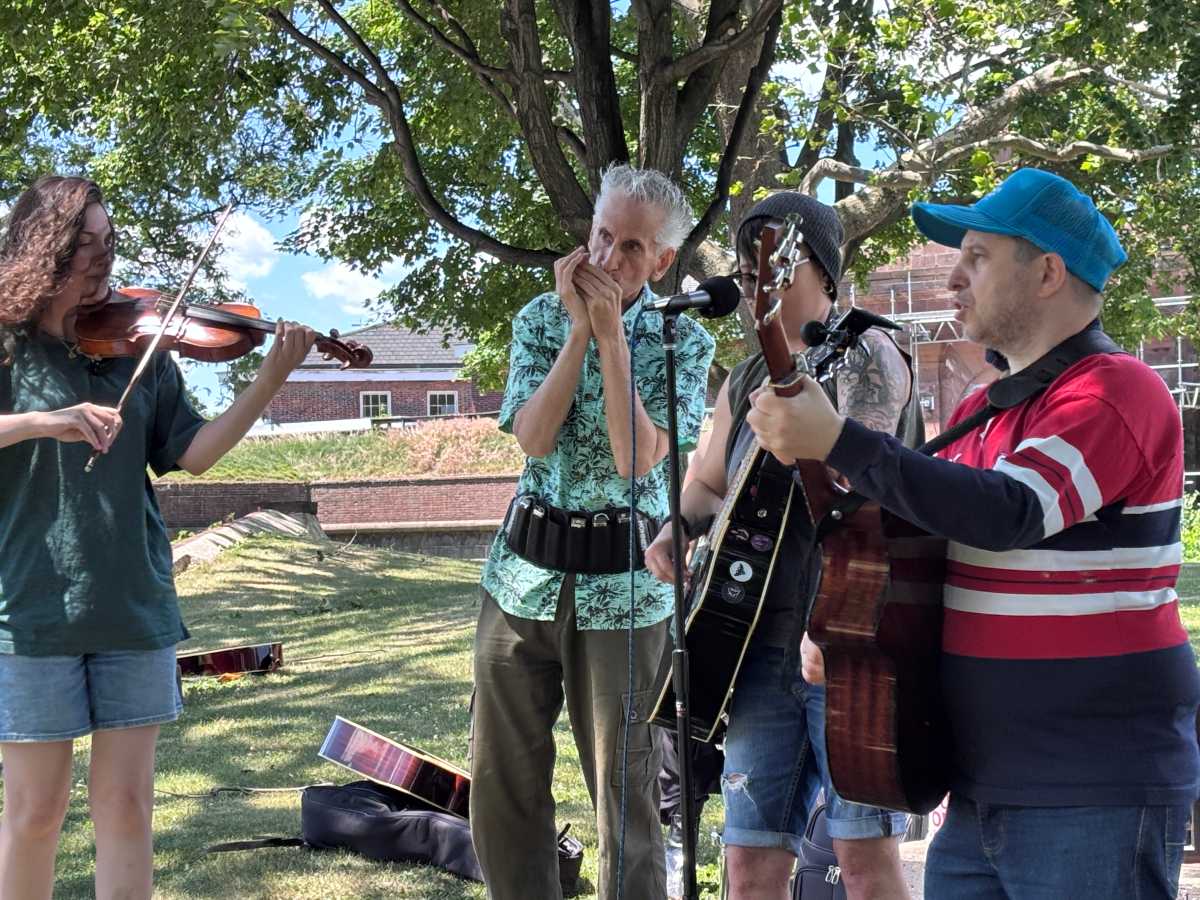
The 13th annual festival unfurled on a sunny day, beneath blue skies, as performers in front of and sometimes under open tents played folk, bluegrass, country, blues, cajun, Irish music and a little bit of rock and roll.
Porch Stomp was founded in 2014 by Theodora Boguszewski and the annual Make Music New York festival.
Pete Seeger didn’t help found this festival, but instead founded the Hudson River Music Festival, held today, June 21, at Croton Point Park, with Tom Chapin, David Amram and the Guthrie Family Singers performing.
But Porch Stomp brought together hundreds of performers in New York City for a free, volunteer-run music celebration, produced in conjunction with Make Music New York, a not-for-profit that connects musicians, fans and New York City public places.
The sound of fiddles, banjos, mandolins, guitars, harmonicas and accordions and the spirit of folk music turned the space into a huge outdoor concert hall as crowds lay back on the grass or in folding chairs in the open air.
“It’s a classic reinterpretation and celebration of the music that healed really America,” Val Kinzler, a musician who curated one stage, said. “You know the music that brought people together in times of struggle and strike so here we gathered together to celebrate survival through folk, rock, blues.”
While most people came from New York, others traveled for this free outdoor festival with hundreds of performers and concert goers under blue skies.
“We don’t have tickets so it’s hard to know where people are coming from,” said Shane Walton, volunteer coordinator of a crowd of around 700. “I think most are local, but I know people there are some people that have come in for this.”
Performers converged on the festival that, because of the sheer scale in terms of the number of musicians, stands out as a summer showcase.

“We’ve been pretty fortunate with the good weather in the recent years,” Walton added. “The weather was great. I think we had a really good turnout this year.”
Performers like the setting and being part of a huge outdoor festival that attracts audiences from across New York and beyond.
“Porch Stomp is one of the highlights of our year,” said Joe Rinehart, from Brooklyn Contra, which took part. “There are always a million talented musicians, so many friendly faces, plus the beautiful setting.”
While the festival originated on the porches of Governors Island buildings, most performers now perform on the grass, in front of audiences in folding chairs and on blankets.
The atmosphere was permeated by not only music appreciators, but musicians in a crowd with a higher percentage of guitars, fiddles, mandolins, harmonicas and banjos per capita than any other place you’re likely to find.
“This festival is mostly folk, but people will tell you it’s also bluegrass,” said Windsor Terrace resident Christian Apuzzo. “Some people will tell you that it’s got some country, some Irish, old time, but it’s mostly folk.”
Musicians in the audience often joined in jams with performers, singing along during choruses.
“I’ve been a part of this organization since year one. Year after year there’s just more and more people, more and more bands,” Apuzzo said. “It’s just a beautiful day. There was a year that it rained and a year that was too hot.”
The sprawling festival has grown to cover Governors island, centered in Nolan Park, but also in Colonels Row, and Liggett Terrace, including bluegrass, Irish music jams, contra and square dances and more.
“It’s unique, because it’s completely acoustic,” Kinzler said. “We do use slight amplification only for vocals, because there’s a lot of wind.”
Each “stage” or porch is curated and produced by an arts organization or local venue including partners such as The Jalopy Theater and School of Music, Brooklyn Contra, Cowgirl Seahorse, The Folk Music Society of New York, Peoples’ Voice Cafe, and others.

“We used all the porches of the houses that are here around Nolan Park up until 2020,” Walton said, noting they changed after the pandemic. “We spaced it out and expanded as the festival has grown back. We’re actually continuing to use both halves of the island.”
The lack, or low use of amplification, also makes the festival different than most performances.
“It’s mostly acoustic and we do have some amplified stages,” Walton said. “We need to be respectful if someone says it is too loud, they need to turn it down so we do manage it that way.”
Others talked about the pleasure of wandering from stage to stage, with different performers at each one in a musical merry-go-round with a stream of new voices and musicians.
“My favorite part is wandering from stage to stage in the summer sun,” Alexandra Deane said, “catching folk musicians from so many different styles and traditions, and stopping when one catches my ear to lay on the grass in the shade and listen.”
The festival ended with singing and dancing, as performers sang a Pete Seeger classic after other stages had closed.
“This land is your land, this land is my land,” musicians sang. “From California to the New York islands.”
While the festival already includes a wide range of music, they’re looking at embracing even more variety.
“We are continuing to try to expand it,” Walton said, “but some genres are hard to accommodate without the electricity.”
