

Times Insider explains who we are and what we do and delivers behind-the-scenes insights into how our journalism comes together.
In several decades working as a reporter, I’ve received tips in all kinds of ways from all kinds of people: emails from sources, letters from strangers and in-person suggestions from people at dinner parties, birthday parties and in political parties.
But last December, I got one from someone I didn’t expect, though I knew him well: my son, Jake.
Jake, 21, was on a Christmastime trip to London, where he had attended a hit play that I’d never heard of, with a title that I initially thought I was mishearing: “Kenrex.”
“Dad, you should see it,” Jake said. “It’s all about Missouri.”
Being a good kid, Jake knew that I grew up in Kansas City, Mo., before leaving for New York at 18. The tip, however, was more elaborate than mere geography. Jake also knew that, as a former theater reporter who sometimes still dabbles in the subject, I would probably be interested in the unique setup of “Kenrex”: a one-man show whose star, Jack Holden, plays nearly three dozen different characters, single-handedly carrying the narrative alongside a guitarist and composer, John Patrick Elliott.
Finally, there was the true story behind the play, which had enthralled Jake, and soon enough, me: the fatal shooting in broad daylight of an infamous small-town bully, Kenneth Rex McElroy, in July 1981. Many townspeople had seen the killing, along the main drag of a small Midwestern town — Skidmore, Mo.
But none of those witnesses had stepped forward about who pulled the trigger, and the authorities were repeatedly unable to secure an indictment.
I’d never heard of Skidmore, a tiny farm community in Missouri’s northwest corner, about 90 miles north of where I’d been raised. (“A wide spot in the road” is the way we used to refer to towns like that.)
But after “Kenrex” transferred to New York earlier this year, I saw it. And then, I wanted to visit Skidmore, to find out more about that still-unsolved murder and the place where it had happened. My article was published earlier this month.
Of course, a tip often only gives you a little bit of the story; the reporting that comes after is what makes an article. And coming back to a part of the world where you grew up can be tricky, like finding your way without your glasses on: You might recognize the outlines of things, but the details are tougher to discern, or to recall.
Indeed, driving through Nodaway County toward Skidmore spurred thrumming memories in me: I knew this place. The late-afternoon light, spreading across the sky from the horizon. The two-lane highways and the isolated farmhouses. The soybean fields and the family cemeteries.
But there were new elements, too: wind turbines on the hillsides, languorously spinning, and ads for cannabis outlets, something that a teenage Jesse could have only dreamed of.
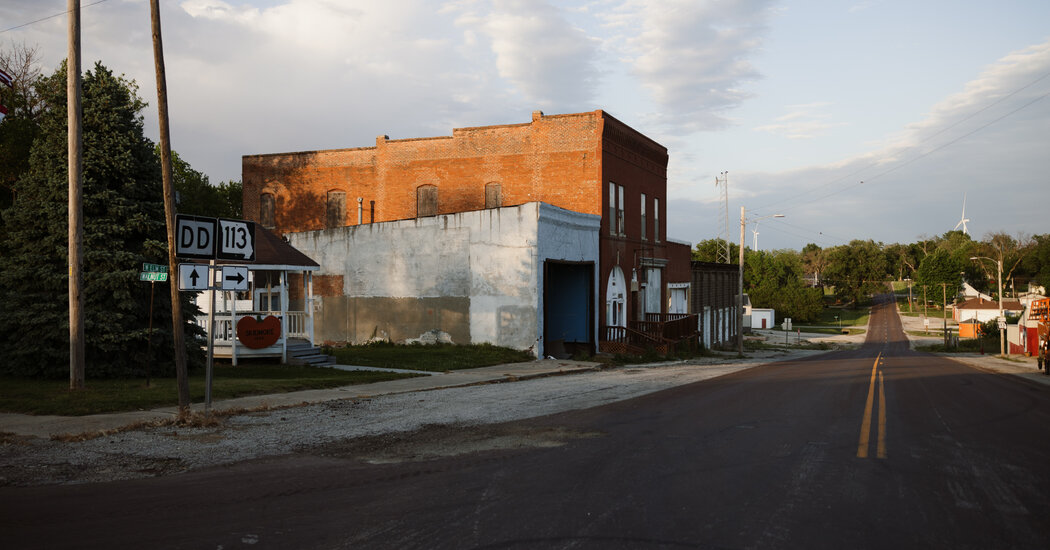
Arriving in Skidmore, I was struck by the sadness of a town that seemingly couldn’t quite shake off its past, or maybe just couldn’t keep up with the present day, with big-box stores in larger neighboring towns robbing its main street of shops, restaurants and other hangouts.
That included the D & G Tavern, the bar where Kenneth Rex McElroy often drank and menaced people. It was where he was shot, while sitting in the parking lot in his pickup truck. Nowadays, the tavern is abandoned, as is much of the town’s crumbling main drag. Skidmore, it seems, has hit the skids.
But looking at a place is different than knowing it. And the more I talked to the people around town and the players in the real-life drama of McElroy and his murder, the more that initial impression of defeat faded.
That included an interview with Cheryl Huston, who had watched the shooting from the back window of her family’s grocery store in 1981, when she was a young mother of two. Huston, 68, uses a walker now, but she seemed as tough as a new saddle, eagerly showing me a former homestead of hers where she said she’d once sat with a shotgun across her knees, for fear of McElroy driving up and harming her family.
She had cause: Huston’s father, Bo, had been shot in the neck by McElroy and nearly killed. And not surprisingly, Huston wasn’t exactly heartbroken about his killing, telling me that she’d gone to check if McElroy was dead after he was shot.
“If he’s not dead,” Huston recalled thinking, “They’re going to have to shoot him again.”
That same feisty spirit infused an 80-year-old man who gave me a grand tour of the spots where McElroy had once roamed, often beyond the reach of law enforcement. (At the time of his killing, McElroy had been found guilty of second-degree assault, but was free on bond. He’d also been investigated for numerous other crimes, including sexual assault, arson and child molestation, though he had always evaded prosecution.)
The man didn’t want his name used, he said, out of respect for the community. He was protective of Skidmore, like several other people I met during my reporting.
After several days of interviews, I came back to Skidmore one more time before heading back to New York. As I looked around, I saw things a little differently: There on top of the hill where the water tower loomed, for example, was a lovely little ball field, with a nearby pavilion devoted to the town’s Punkin Show, an annual festival (Holden does a lively, one-man re-creation of it in “Kenrex”). A local boy happily rode an A.T.V. Chickens clucked in someone’s backyard.
And there are still plenty of people with hometown pride, including a couple — Greg and Andrea Dragoo — who had recently moved back to the area from Georgia, and who were planting a rose bush under the boughs of a silver maple. They loved Skidmore, they said, and thought people made too much of a killing 45 years ago.
“It’s a good story now,” said Ms. Dragoo. “And that’s about it.”
