

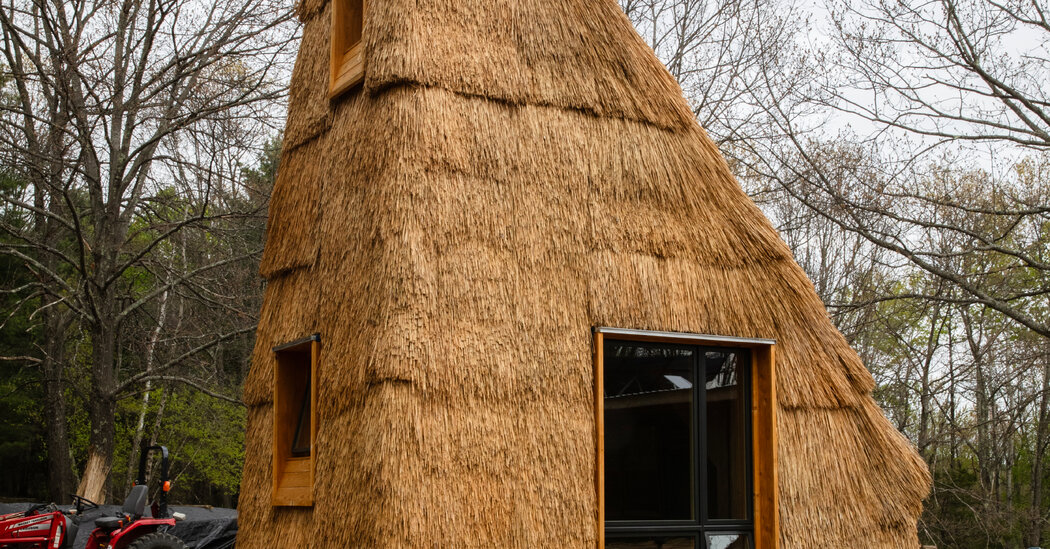
The straw house is 28 feet tall and has a sleeping loft, a daybed, five windows and a kitchen. It will be used as a guesthouse by five families, including Mr. Lewis’s, that jointly own the land.
A heat pump, powered by a battery system on the premises and solar panels atop a trailer next door, provides heating and cooling. It is the culmination of three years of research, manual labor, and trial and error. The materials cost a little more than $50,000 (a hefty portion of that — $18,000 — went toward the house’s thatch roofing).
Straw has been used as insulation for years, but usually within a wooden frame, with the straw bales hidden, as part of a hippie-chic style known as the straw-bale house. In Nebraska, prairie settlers used straw bales as load-bearing building blocks and then coated them with mud or plaster. But the straw house near Hudson features compressed straw — where the loose and airy stalks are packed tightly together using heat — as both insulation and building block, without hiding the material behind plaster or wood.
Inside the home, in other words, the straw remains visible, like exposed brick, illustrating how Mr. Lewis’s team built the structure by stacking its components together. On the exterior, the house looks like the perfect domicile for a fairy-tale witch, or three bears. But inside, its clean lines and layers of cut-up straw panels, many of them stacked on an angle, evoke modern minimalism, with custom lighting and large windows with views of the land.
Chris Magwood, a manager of carbon-free buildings for RMI, a sustainability nonprofit, had heard of the project. “It was a cool thing to try,” he said. But he noted that adding a simple wooden frame or using entire sheets of strawboard instead of cutting it into pieces would have made the whole exercise much easier and still would have minimized the use of wood.
