
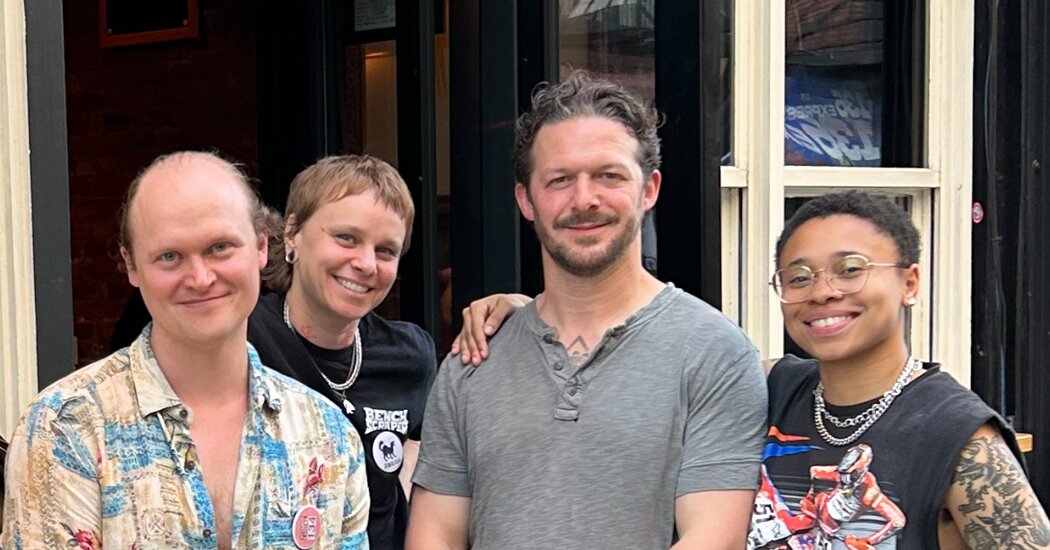
One by one on Tuesday, some of the best bartenders in the country filed in through the unmarked front door of Attaboy, a boutique speakeasy on the Lower East Side of Manhattan. Each dropped a secret paper ballot into a box, marched out through the side door and gathered at a nearby bar, awaiting the results.
They were 21 mostly young workers voting on whether to form a union, the latest in a string of recent micro-unionizing efforts in the city. The staff at Attaboy were aware of the successes and the many failures of their predecessors, but the time felt right, and with a sympathetic mayor urging them on, it was their turn.
After a tense couple of hours waiting for the result, word finally came down. The union won, 13to 8. After several months of D.I.Y. organizing, the staff at the cozy bar — once voted the best cocktail bar in North America — could exhale before facing even harder work ahead.
“It’s a relief,” said Hannah Chouinard, 32, who joined Attaboy about six months ago, but has worked in the food and beverage industry for 13 years. “We put a lot of effort into this and it means so much to us.”
Attaboy’s owners, Sam Ross and Michael McIlroy, said they did not oppose the fledgling union and pledged to negotiate a collective bargaining agreement in good faith. But even many bartenders acknowledge that small bars and restaurants in New York often operate on very thin profit margins.
“We are dedicated to keeping Attaboy alive,” said Mr. Ross, who with his partner has been instrumental in the craft-cocktail revolution. “But we cannot predict the future.”
Few expect it to close, but other establishments in New York have shuttered in the face of recent organizing efforts, as workers — many of them young and college-educated — seek to form unions at small bars, restaurants, coffee shops, museums, bookstores and even board game cafes.
The appeal of organizing niche storefront unions appears to have grown since the Covid-19 pandemic, spurred by the success of union efforts in roughly 30 Starbucks franchises in the five boroughs.
“The last few years we’ve seen an upsurge in union activity at small establishments like this,” said Kate Andrias, a professor of labor and workplace law at Columbia Law School. “There is a lot of interest among younger workers.”
Still, this is not the age of unions. While almost 70 percent of Americans approve of labor unions, only 5.9 percent of the national work force in the private sector is unionized. In New York City, that percentage, while almost double the national average, has actually declined slightly in the past five years, from 12.8 percent five years ago to 11.6 percent last year.
But those numbers do not reflect the desire to unionize. The stunning victory of Mayor Zohran Mamdani, a pro-labor democratic socialist, is seen as both a reflection of expanding union sentiment in the city, and a buttress to labor’s cause.
“There’s definitely something in the air,” said Zack Gelnaw-Rubin, 41, an Attaboy bartender for about 13 years and one of the union’s organizers. “Mamdani specifically said, ‘Whether you are organizing a museum or a bar, we’ve got your backs.’”
But the landscape has been risky for workers looking to form these type of unions. The Attaboy workers took their vote knowing that She Wolf, a Brooklyn bakery, had successfully unionized. But several other efforts ended in failure.
About two years ago, workers at Death & Co., a high-end East Village cocktail bar in the Attaboy mold, were shocked to lose a close vote to unionize. Earlier this year, two small Brooklyn joints, the once-popular Achilles Heel bar and a pizzeria called Barboncino, shuttered after workers formed unions.
Many owners of similar bars and restaurants worry that unionization efforts could force them out of business. Barboncino cited “rising costs and diminished sales” for its decision to close after its employees created a union. Achilles Heel pointed to financial difficulties when it closed three days after the union announced its formation.
Attaboy, which earned first place in North America’s 50 Best Bars list in 2022, is somewhat of an institution. It is part of the lineage of the craft cocktail bar movement that started in the same location, at 134 Eldridge Street, with Milk & Honey more than 25 years ago. There are no signs outside and no menus inside, but patrons rave about the mixologists behind the bar and their hand-shaved ice cubes.
Mr. Gelnaw-Rubin, one of the Attaboy union leaders, said his 68-year-old father still works in the kitchen of a diner in New Jersey, which informed his outlook. He is part of a small group of food and beverage workers who met regularly in Manhattan over the past three years, usually twice a month, to discuss labor matters in general and to learn the law.
“It was a self-education group,” said Aiden Majewski, 30, who works at a small bar in the West Village. “We talked about a range of issues.”
Until a few months ago, these labor salons were theoretical, and Mr. Gelnaw-Rubin never saw a need to unionize at Attaboy. But last fall, he said, some abrupt management decisions about staffing and scheduling raised frustrations among the workers. At that point, he and his colleagues began studying how to form a union.
As the vote indicated, not everyone agreed. But within hours, news of the result sifted through the local labor community.
Chris Smalls, the leader of a successful campaign to form a union at a large Amazon shipping facility in Staten Island, with over 5,000 employees, said no workplace is too small to unionize.
“This should provide motivation for other small businesses to unionize as well,” he said Wednesday, just hours after he was released from jail after protesting against Amazon’s owner, Jeff Bezos, amid the glitz and excess of the Met Gala.
The Attaboy union — known half-ironically as Attaboy Local 134, a reference to its street address — does not expect such antagonism with its owners. It has decided not to affiliate with a larger union, and the next step is to establish bylaws, elect officers and prepare to negotiate a contract with the owners. The union at She Wolf, the Brooklyn bakery, and its owners have been negotiating for over two years and there is still no first contract.
The Attaboy union said its primary concerns are not about wages but workplace conditions, decision making, the rights of immigrant workers and health care.
Mr. Ross noted that he and Mr. McIlroy, as former bartenders in the same space before they opened Attaboy, have always tried to be attentive and transparent to the staff. “Many of the topics raised by union were news to us,” he said, “and we only learned about them through the union’s public postings.”
For their part, the union organizers say their demands are reasonable and that they seek collaboration.
“It doesn’t benefit anyone to put them out of business,” said Samaiyah Patrick, 28, an Attaboy bartender. “We want them to thrive and we believe a union partnership will help them do that.”
