

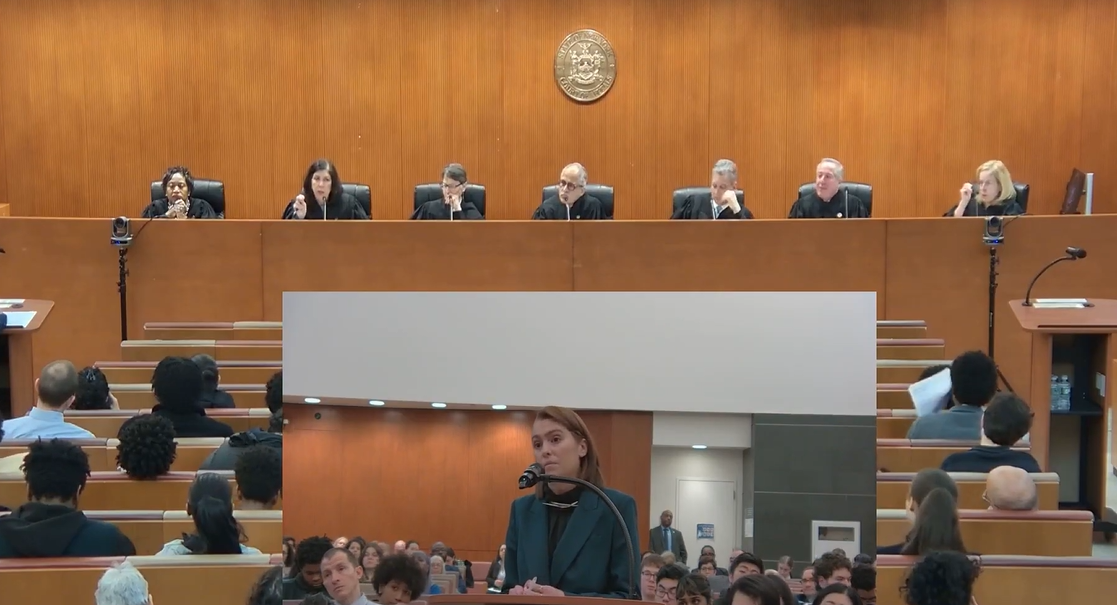
When Nicole Hudson’s ex-boyfriend allegedly jumped on top of her, punched her and banged on the windows of her car, she feared for her life, according to a statement from her cited in state court records.
As Hudson tried to speed away to escape the violent confrontation at a Brooklyn block party in 2019, she ran over her sister’s girlfriend and dragged her body down the street, paralyzing her, court papers state.
Hudson was charged with attempted murder and assault, and faces up to 25 years in prison if convicted of the most serious charge. Brooklyn prosecutors offered her an alternative to a decadeslong sentence: She could plead guilty to reckless assault and face only five years in prison, followed by five years of post-release supervision.
But there was a catch. By taking the deal, Hudson would have to waive her right to a special hearing where a judge could consider a less severe sentence. Since 2019, a New York law has allowed domestic violence survivors who commit crimes related to their abuse to ask judges for more lenient punishment.
New York’s highest court ruled last month that Hudson’s plea agreement undermined that landmark state law, which intended to prevent domestic violence survivors from receiving excessive sentences. The Court of Appeals said forcing survivors to waive their right to one of these hearings as a condition of a plea deal would “eviscerate” a path to lower sentences for the “vast majority” of domestic violence survivors charged with crimes.
The decision ordered a lower court to reconsider Hudson’s case.
“I know that I caused great harm, and I take full accountability for that. I also know that my actions came from my years of abuse,” Hudson said in a statement. “I am very glad that other survivors will now have the chance to be heard in court about how their histories of abuse have affected their lives and their cases.”
Advocates for domestic violence survivors said the ruling will remove a barrier that has prevented victims across the state from sharing their experiences of abuse with a judge. But prosecutors expressed concern that the ruling would prolong an already painful process for the victims of the crimes the domestic violence survivors commit. They also point out that, like in Hudson’s case, the person a domestic violence survivor harms is not always the person abusing them.
“Basically, it boils down to us having to go back to a victim and letting them know that the sentence that was imposed, that they have come to terms with, is at risk of being reduced,” said Mary Pat Donnelly, President of the District Attorneys Association of the State of New York. “It can be very traumatizing to victims.”
Oren Yaniv, a spokesperson for the Brooklyn district attorney’s office, echoed that sentiment.
“We respect the court’s decision but are concerned it will make it harder to resolve appropriate cases early, even where prosecutors have thoughtfully considered the survivor-defendant’s circumstances,” he said.
Shifting power from prosecutors to judges
The Domestic Violence Survivors Justice Act was first proposed in 2011 and took eight years to pass, following a groundswell of support from women’s advocacy groups, domestic violence organizations, attorneys, judges and houses of worship, according to a brief filed by lawmakers. New York was the first state to pass such a law, prompting similar proposals in several other states.
State lawmakers said in their brief to the court that allowing prosecutors to use these hearings as a “plea-bargaining chip” would go against the Legislature’s intent and take away power that they intended to put in the hands of judges.
“ This case is so important, because it gets back to what the New York Legislature was trying to do,” said Ross Kramer, director of the Incarcerated Gender Violence Survivors Initiative at Sanctuary for Families.
State Sen. Roxanne Persaud, who sponsored the legislation, declined to comment while the decision is under review.
The district attorneys association recognizes the need for the law and supports it, Donnelly said. But the new Court of Appeals ruling will complicate how prosecutors navigate what concessions to offer in a plea deal.
“For case law to come down that’s going to basically give a second chance to roll things back after we’ve already done so is frustrating,” she said.
Donnelly, who is the district attorney in upstate New York’s Rensselaer County, said prosecutors already take many factors into consideration when offering a plea, including the age of the defendant, their criminal history, their mental health background and any victimization they may have endured. She said prosecutors also consider whether the victim acted as an aggressor in the situation or whether the defendant could argue that their own actions were justified.
“We feel that we are doing everything we can to examine these mitigating circumstances,” she said.
Prosecutors have more “intimate knowledge” of cases than judges, Donnelly said.
“I do think that it makes sense that we have some input when we’re approaching this. But, she said, “we will do what we always do and follow the directives of the law.”
The ‘whirlwind’ of plea negotiations
Hudson had a young daughter when she was arrested and was desperate to reunite with her while she was still a child, said her attorney, Paris DeYoung. She didn’t want to turn down the prosecution’s offer and risk spending decades behind bars.
“In her mind, that’s not really a choice,” said DeYoung, a supervising attorney in the Legal Aid Society’s criminal appeals bureau.
The Survivors Justice Project has received letters from people like Hudson in jails and prisons across the state, who said they were similarly pressured to give up a Domestic Violence Justice Act hearing in exchange for a plea deal, according to the group’s legal and policy director, Kate Mogulescu.
“ It’s almost an impossible situation,” said Mogulescu, who is also a professor at Brooklyn Law School.
She said domestic violence survivors often struggle to navigate these plea negotiations in the “chaos” of a criminal prosecution.
“They have just committed harm to a loved one,” she said. “It may have been a loved one that also was abusing them and causing them harm. But still, there’s grief, there’s guilt, there’s loss in that moment.”
Mogulescu said many survivors have never discussed the domestic violence they experienced before that moment. The plea bargaining process can mimic the powerlessness they felt in their relationship, she said.
“ They understand viscerally the overwhelming control and power that prosecutors have,” she said. “In many instances, that is similar to the coercive control they’ve experienced in their domestic violence relationships.”
Donnelly said she would “hate to think that anyone’s being coerced into taking a plea.” She said prosecutors don’t interact directly with criminal defendants and that she hopes defense attorneys protect their clients from feeling pressured. District attorneys, she said, offer pleas based on the facts, the proof, and the experiences of both the victim and the defendant.
“The goal is, obviously, public safety and rehabilitation,” she said.
But Michele Evans said she felt like she had no other choice when she accepted a plea deal after she hit her then-husband with her car while she tried to flee an argument in the East Village in 2017. He survived, and she was charged with assault.
Unlike Hudson, Evans had a Domestic Violence Survivors Justice Act hearing. In her case, she said, she felt pressure from the judge to plead guilty if she wanted to have a hearing.
“I hated making the decision,” she said. “But my lawyer, everything she was telling me [was], ‘You gotta take it, you gotta take it. You could end up with 25 years in prison.’”
After the hearing, a judge sentenced Evans to three years, according to incarceration records. She said she met many women on Rikers Island and in prison who felt pressured to take plea deals because they lacked evidence to prove they had experienced domestic abuse.
“It’s the path of least damage,” she said.
Evans said it was “unconscionable” that prosecutors were trying to prevent people from having the opportunity to argue in court that they were trying to defend themselves when they committed a crime.
“What kind of system would not want an accurate picture?” she said. “What kind of system would want to punish people for surviving?”
