

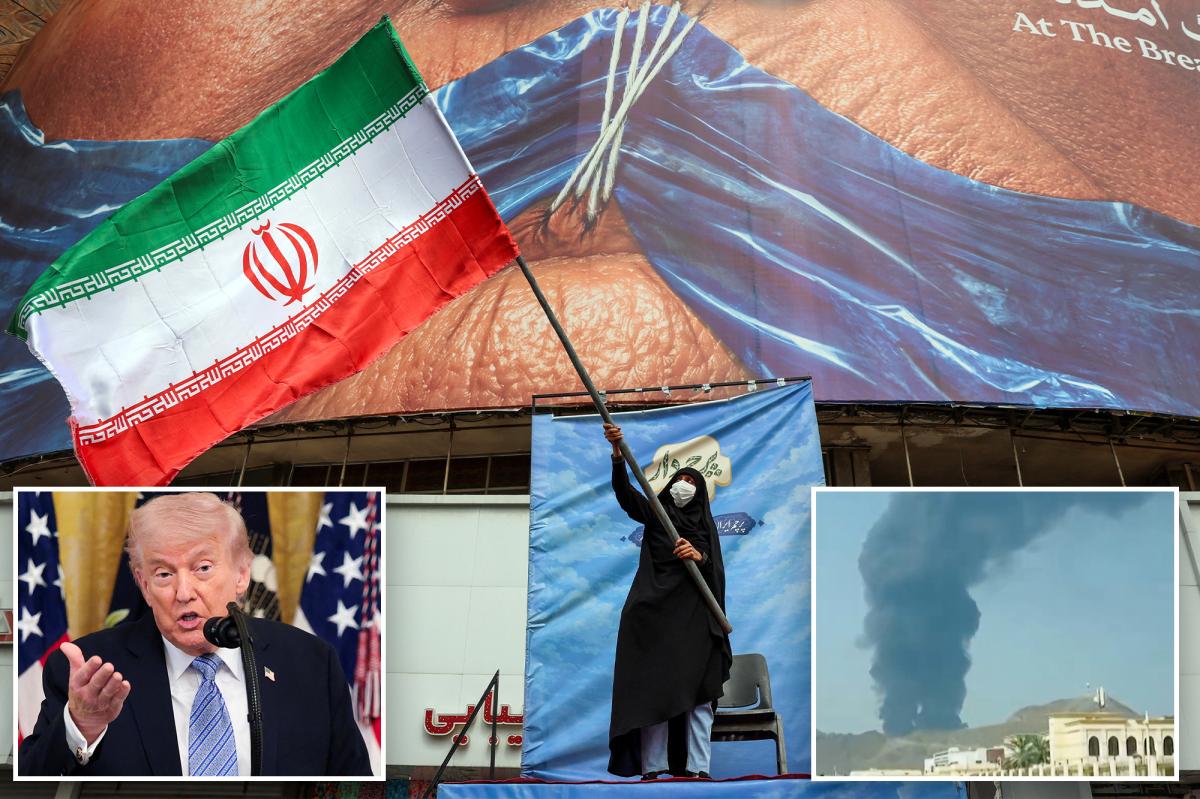
President Trump claimed in an interview Monday evening that US hostilities with Iran could last another two or three weeks while refusing to say whether a cease-fire between the two countries remained in effect.
“We’ve taken out much of what we’d have to do, probably another two weeks, two weeks, maybe three weeks,” Trump told conservative radio host Hugh Hewitt. “And time is not of the essence for us.”
Soon after the US and Israel began attacking Iran on Feb. 28, Trump estimated the war would last “four weeks or so.” This past Saturday marked the conclusion of nine weeks of fighting, though a nominal cease-fire has been in place since April 8.
“One way or the other, we win,” Trump added. “We either make the right deal, or we win very easily. From the military standpoint, we’ve already won that. You know, you’ve heard me say it a million times, and other people say it. They had 159 ships, Hugh. Now, they have none. They’re all at the bottom of the sea. Today, we took out eight of their, you know, they’re reduced to these small, little, fast ships.”
Earlier Monday, US Central Command (CENTCOM) reported two American-flagged merchant ships successfully transited the Strait of Hormuz on the first day of a Trump administration initiative to force shipping traffic through the vital waterway. Adm. Brett Cooper, the commander of CENTCOM, added on a press call that the American military sank six small boats that were targeting commercial vessels.
In response, Iran fired nearly two dozen missiles and drones toward the United Arab Emirates. The UAE’s defense ministry said it had intercepted 15 missiles and four drones, with authorities in the eastern emirate of Fujairah reporting one drone sparked a fire at a key oil facility, wounding three Indian nationals. The British military also reported two cargo vessels ablaze off the UAE’s coast.
When asked by Hewitt whether the attacks by Iran would lead to a resumption of strikes by the US, Trump said: “Well, I can’t tell you that.”
“If I answered that question, you’d say this man is not smart enough to be leading the United States of America.”
The president also shrugged off high oil prices caused by the near-total halt to traffic through the Strait of Hormuz, telling Hewitt that when the war began, “I thought maybe the [stock] market would go down 20 or 25%. And I was OK with that, because I know it would come back up. But I thought it would go down, and I thought oil could hit $200-$250 [per barrel]. Oil’s at $100, $102.”
As of Tuesday morning, the benchmark Brent crude price was hovering around $112 per barrel.
“You know, the genius of the whole thing is people have found ways around the Hormuz Strait,” the president claimed. “They’re heading up to Texas. They’re heading up to Alaska. They’re heading up to Louisiana. And you see it. We see it through satellite … So it’s just really sort of an amazing thing. They find ways of getting it done. So [oil’s] not going to be at $250 and $300. And the stock market, again, the stock market’s at a record high.”
Meanwhile, Mohammad Bagher Ghalibaf, the speaker of the Iranian parliament who led Tehran’s delegation during failed peace talks last month in Pakistan, taunted the US on X early Tuesday, writing: “The new equation of the Strait of Hormuz is in the process of being solidified. The security of shipping and energy transit has been jeopardized by the United States and its allies through the violation of the ceasefire and the imposition of a blockade; of course, their evil will diminish.
“We know full well that the continuation of the status quo is intolerable for America,” added Ghalibaf, “while we have not even begun yet.”
