
Grand Army Plaza, the iconic Brooklyn hub famous for its towering arch and hectic traffic, is getting a major makeover.
Mayor Zohran Mamdani announced last month that the southern end of the 14-acre oval would be permanently closed to car traffic.
The plan would effectively reconnect Prospect Park — Brooklyn’s spiritual backyard — with the plaza’s best known feature: the Soldiers’ and Sailors’ Memorial Arch. It could also help untangle the flow of traffic for cyclists, pedestrians and drivers on a loop so hazardous it once had an unofficial “Death-O-Meter.”
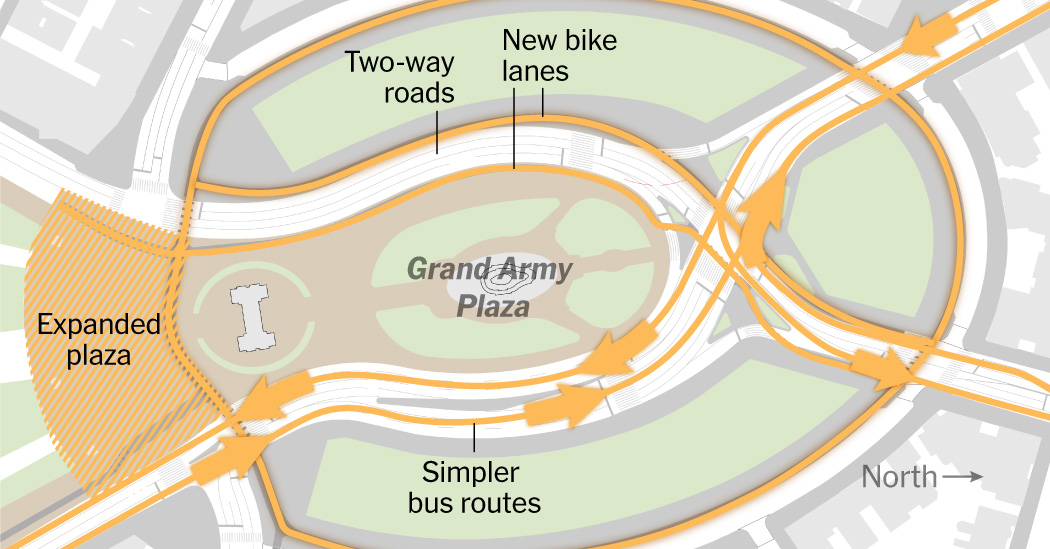
The biggest change involves closing the four lanes of car traffic, from Union Street to Eastern Parkway, that currently divide the arch from Prospect Park.
The redesign would add about three-quarters of an acre of public space to the plaza, which is home to the Grand Army Plaza Greenmarket, one of the city’s biggest farmers’ markets. The expansion would allow for more vendors, outdoor performance space and other seasonal events, according to the Department of Transportation.
Pedestrians
Walking between the plaza and the park today can feel chaotic, because of multiple lanes of merging traffic. By closing a section of road on one end, the new design creates a horseshoe pattern of traffic, rather than a full loop. The plan calls for reducing the total number of crossings for pedestrians and cyclists to 24, down from 39.
That means an uninterrupted walk from the arch to the park, and fewer crosswalks to get there. The city also plans to raise 10 crosswalks, which would make them level with the curb and act as speed bumps for cars.
And visitors to the public library on the plaza would no longer have to crowd onto tiny pedestrian islands with cars whizzing by around them.
Bicycles
The plan calls for the creation of protected bike lanes in and around the plaza, adding to the existing but incomplete network of painted lanes. Some design elements are still being decided, but the lanes would be protected by a combination of parked vehicles and landscaping.
Protected bike lanes have been shown to reduce traffic injuries by 15 percent for everyone on the road, including drivers and pedestrians, according to a 2022 Department of Transportation study.
Buses
Closing part of the traffic loop to automobiles would alter some bus trips. The inner ring of roadway around the plaza would be converted to two-way traffic, slightly rerouting the B41, one of the city’s busiest bus lines, and the B69.
The B69, which currently circles around the plaza, would instead turn sooner, avoiding the jumble of traffic closest to the arch. The B41 would stick to the east side of the traffic loop, instead of making a more circular trip around the plaza. Nearby changes on Flatbush Avenue, like the creation of center-running bus lanes and pedestrian islands, could also help speed up service.
Cars
There could be some trade-offs for drivers. Those approaching the plaza from Union Street, for instance, would no longer be able to cut straight across to Eastern Parkway. Instead, they would loop around a two-way street in the plaza’s inner ring, a slightly longer trip.
Critics of the plan argue that the reroute could delay some emergency vehicles or divert more traffic to local side streets.
But the Transportation Department has said the redesign could actually make driving around the plaza smoother, because the detour means fewer cars would bunch up and cause congestion around Union Street. The agency also said the detour affects a small share of drivers overall, because most traffic travels via Flatbush Avenue.
Residents in the area have been pushing for safety improvements at the plaza for decades. From 2021 to 2025, there were 219 traffic injuries along the plaza’s central roadways and outer ring, according to the Transportation Department.
Still, there are a number of unanswered questions about the plan. The city has not provided a timeline or budget for the project, or committed to completing the work before the end of Mr. Mamdani’s first term.
