

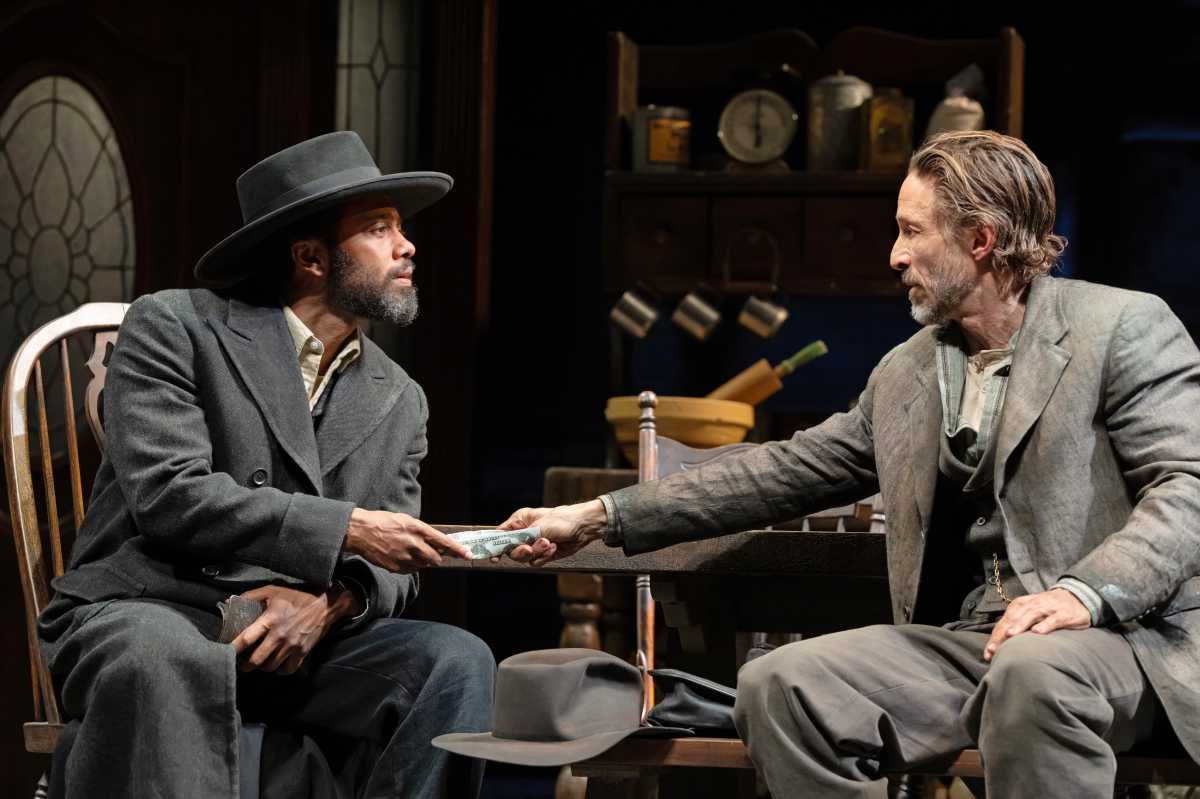
The new Broadway revival of “Joe Turner’s Come and Gone” gets a lot right. Scene by scene, it often captures the richness of August Wilson’s writing. But it never quite builds into a fully satisfying whole, and several key performances remain a work in progress.
Among the 10 plays that make up Wilson’s Pittsburgh Cycle, this 1910s-set drama stands as one of the most dramatically complete. Set in a Pittsburgh boarding house in 1911, it follows a group of Black travelers navigating the aftershocks of enslavement and the upheaval of the Great Migration. The title refers to the real-life Joe Turner, brother of a Tennessee governor, who abducted Black men and forced them into years of peonage and labor, a fate that defines Herald Loomis, the play’s central figure.
This is not a plot-driven work. It unfolds gradually, through conversation, memory, and the rhythms of daily life. Residents come and go. Stories overlap. Meaning accumulates. Threaded throughout is a spiritual dimension, most clearly expressed through Bynum Walker, who believes he has the power to “bind” people to their true selves. At its best, the play feels both grounded and mythic at once.
The last Broadway revival, directed by Bartlett Sher in 2009, found that balance. This new staging, directed by dancer-choreographer Debbie Allen, only intermittently does. It has atmosphere, and at times real dramatic force, but it struggles to maintain a consistent tone. It is also difficult not to question how Allen, whose Broadway directing résumé is relatively limited, came to helm this revival, given the number of directors deeply versed in Wilson’s work.
The production’s central problem is not any single misstep but a lack of cohesion. Scenes often land on their own terms but do not always connect. Musical underscoring intrudes where silence would be more effective, and transitions break the flow rather than carry it forward. The result is a staging that feels assembled rather than shaped. The play’s delicate balance between everyday realism and spiritual awakening never fully settles, leaving its most charged moments less grounded than they should be.
The cast reflects that unevenness. Cedric the Entertainer is the clear standout as Seth Holly, delivering a performance that is relaxed, funny, and fully lived-in. He understands the character’s rhythms and never forces them.

Ruben Santiago-Hudson brings a quieter, more introspective quality to Bynum Walker than Roger Robinson did in 2009. His interpretation is thoughtful, though less commanding.
Taraji P. Henson lends warmth and ease to Bertha Holly, but the role itself offers limited dramatic range. She is primarily reactive, tending to others rather than driving the action.
The most significant challenge lies with Herald Loomis. Joshua Boone creates a striking visual presence, but the performance does not yet tap into the role’s full emotional depth. The climactic moments that should feel overwhelming instead register as muted, which undercuts the play’s central arc.
Among the supporting cast, Abigail Onwunali brings welcome clarity and emotional grounding as Martha Pentecost, while Tripp Taylor is appealing as the easygoing Jeremy Furlow.
Visually, the production leans into an industrial aesthetic. The scenic design by David Gallo frames the boarding house against a backdrop of smokestacks and steel, a reminder of the larger forces shaping these lives. A small garden space downstage offers a softer contrast.
This is not a failed revival. There are stretches where it works very well. But it never quite locks into the rhythm that makes “Joe Turner’s Come and Gone” so powerful. For now, it is back on Broadway. It just has not fully arrived.
Barrymore Theatre, 243 W. 47th St., joeturnerbway.com. Through July 26.
