

In Noël Coward, everything depends on timing, tone, and razor-sharp delivery. “Fallen Angels” has the setup, but not quite the execution.
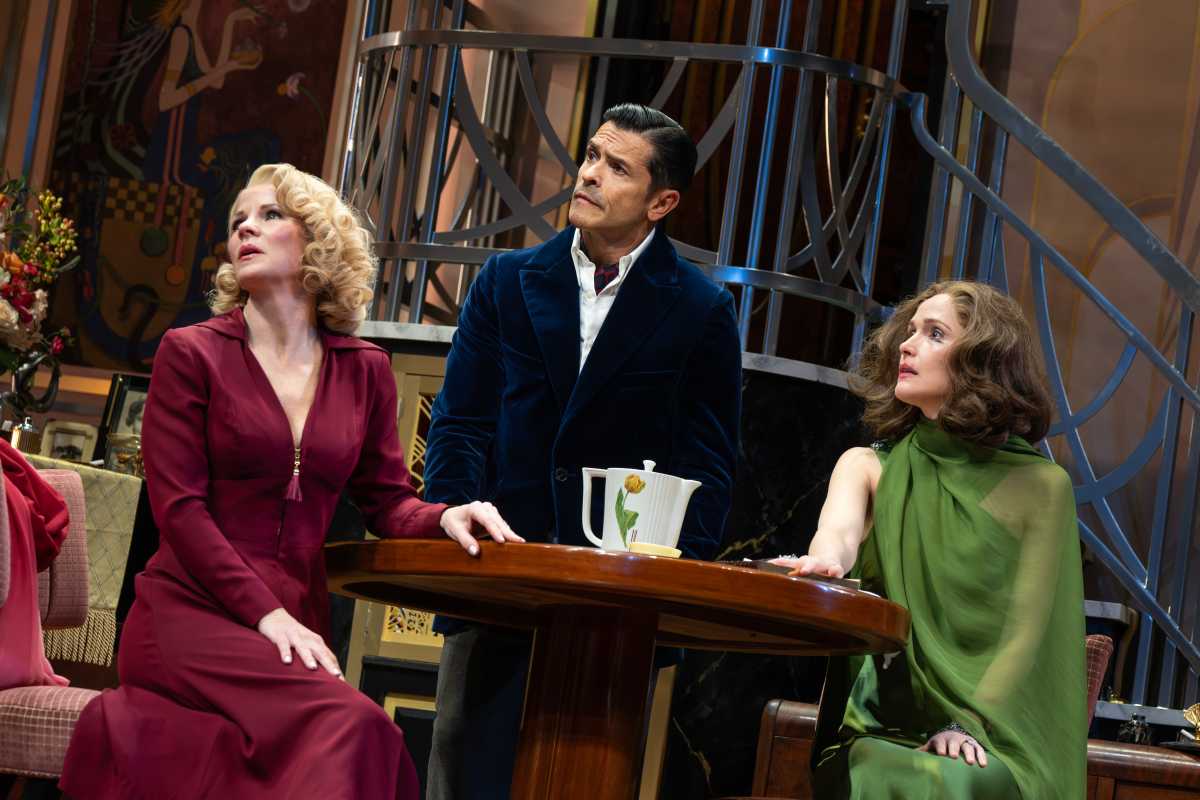
The play arrives on Broadway with an intriguing pedigree: a rarely revived early comedy by Coward, a glamorous pairing of Tony Award winner Kelli O’Hara and screen star Rose Byrne, and a production mounted by the Roundabout Theatre Company at its newly refurbished Todd Haimes Theatre. When the curtain rises on David Rockwell’s gleaming Art Deco drawing room, with its curved lines, polished surfaces, and geometric symmetry, it seems poised to deliver a polished, entertaining evening.
Written in 1925, when Coward was just 24, “Fallen Angels” was once daring enough to draw the ire of the Lord Chamberlain’s Office for its frank discussion of women’s sexual pasts. Unlike Coward’s more durable works, “Private Lives,” “Blithe Spirit,” and “Present Laughter,” this early play has long lingered on the margins and proves difficult to make fully satisfying today. Its once-scandalous premise now feels thin, and without a sharply defined directorial perspective, the piece risks seeming more decorative than dramatic.
The story turns on a deceptively simple premise. Julia (O’Hara) and Jane (Byrne), close friends and respectable wives, learn that Maurice, a charming Frenchman with whom they both had premarital affairs, is returning to London, a setup that quickly turns friendship into rivalry. Their husbands conveniently depart for a golfing weekend, leaving the women to drink champagne, make vows of moral resistance, and gradually unravel in anticipation. Coward structures the play in three acts, morning, evening, and the following morning, charting a careful escalation from composure to hysteria.
Director Scott Ellis, however, compresses the action into a brisk, intermission-less 90 minutes, pushing the material at such speed that its rhythms collapse entirely. Lines that should land with epigrammatic precision, such as Julia’s distinction between loving one’s husband and being “in love” with him, are rushed past or swallowed. Instead of savoring Coward’s wit, the production hurries to the punchlines, often leaving them blurred or inaudible.
As a result, the emphasis shifts to physical comedy. O’Hara and Byrne commit fully to the escalating drunkenness of Julia and Jane, generating easy laughs as their polished façades dissolve into giddy chaos, with hair loosening, posture collapsing, and gestures growing exaggerated. There is genuine audience pleasure in watching them cut loose. Yet the performances rarely locate the sharper edge of Coward’s comedy, the tension between social decorum and barely suppressed desire.
Without that tension, the evening begins to feel weightless. The women’s arc, from self-assurance to anticipation to jealous infighting, ought to build toward something combustible. Instead, it plays as a series of increasingly broad antics. To be fair, much of the audience at my performance seemed content to simply take in the spectacle.
Among the supporting players, Tracee Chimo stands out as Saunders, the unflappable maid whose odd digressions and musical interludes are delivered with crisp comic timing. Christopher Fitzgerald, as Jane’s husband Willy, is perfectly capable but largely sidelined, the role written and staged so quietly that it leaves him little opportunity to make a strong impression. As Julia’s husband Fred, Aasif Mandvi is serviceable but muted; his delivery can be difficult to catch, and he never quite establishes a convincing rapport with O’Hara.
Mark Consuelos, making his Broadway debut, has the smallest assignment of all as Maurice. Adopting a French accent, he arrives late, appears briefly, and just as quickly departs with the two women, leaving their husbands and the audience hanging on what, if anything, comes next. It’s more of a cameo than a performance.
Visually, however, the production proves far more assured. The sleek Art Deco set, paired with pastel-toned costumes, including silk dresses in blush, champagne, and powder blue, creates a glossy, old-Hollywood elegance, something out of a Fred Astaire–Ginger Rogers film, a level of polish the performances rarely match.
“Fallen Angels” looks handsome and sounds promising on paper, but in execution, it proves curiously insubstantial, a revival with style to spare but little reason to exist.
Todd Haimes Theatre, 227 W. 42nd St., roundabouttheatre.org. Through June 7.
