

How can people possibly afford to live in one of the most expensive cities on the planet? It’s a question New Yorkers hear a lot, often delivered with a mix of awe, pity and confusion.
We surveyed hundreds of New Yorkers about how they spend, splurge and save. We found that many people — rich, poor or somewhere in between — live life as a series of small calculations that add up to one big question: What makes living in New York worth it?
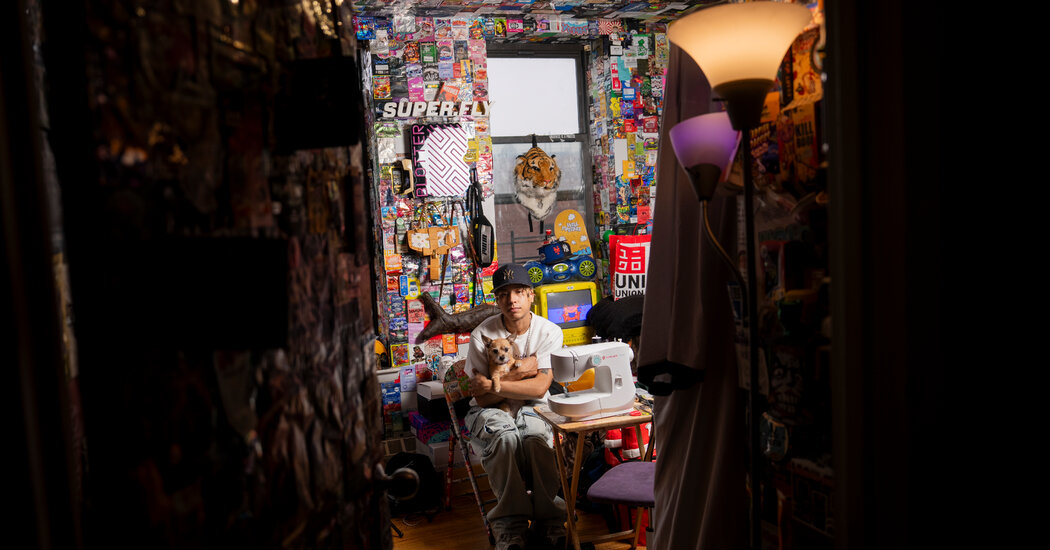
“Wanting to transform something into something else is kind of my thing,” Ari Serrano said.
During the coronavirus pandemic, he went viral on Instagram for taking a Yankees cap and deconstructing it so part of the hat could slide down and convert into a protective face mask.
Since then, he’s turned a Louis Vuitton duffle bag into a jacket, created a Louis Vuitton plague-doctor mask, fashioned a jacket out of dollar bills, fabricated a pair of pants from durags, sewed a Yankees cap and a Mets cap together and put a tiny train on top to create a Subway Series hat, and so much more. He spends $15 to $20 a month on materials — zippers, thread, trim.
But Mr. Serrano, 34, often doesn’t sell the one-of-a-kind things he whips up on his sewing machine or crafts by hand. When people inquire about buying his designs, they balk at the prices, or don’t follow through, he said. “Sometimes I rent things,” he said, “and just make a hundred dollars for a photo shoot.”
He estimates that he cobbled together $50,000 last year, thanks to some brand deals and a few sales.
Repurposing Discarded Goods
The deals and sales pay enough to cover Mr. Serrano’s rent, $1,200 a month for a bedroom in a three-bedroom apartment in the Bronx, but he would love to be able to design for a living. He thinks of his one-offs as portfolio pieces — proof of his talent.
In the meantime, his knack for finding ways to repurpose and reuse items is part of how his living expenses stay low.
For example: His colorful bedroom, which doubles as a design atelier, is not adorned with paint or wallpaper. Instead, the walls are covered in discarded mylar bags that have been used as marijuana packaging.
“It’s horrible for the environment,” he said of the mylar, “but the material is sturdy.”
He wants people to see what can be done with the bags, instead of treating them as garbage. Mr. Serrano has also made a backpack and a duffel bag from discarded bags. They’re not for sale. “It just shows you that it’s not just trash,” he said. “It could be turned into something completely different.”
He and a friend founded a cannabis waste management program that installs receptacles in dispensaries to collect the mylar bags so that they can be repurposed. He thinks it is the first program of its kind in New York, and described the work as “picking up the community, one bag at a time.”
Opportunities in the Influencer Economy
His phone bill is $150 a month, and the phone is integral to his work, since he shares his designs and ideas with over 67,000 followers on Instagram.
“I don’t make money through Instagram,” he said, “but brands are always hitting me up on Instagram. So I am making the brand deals through Instagram.”
Recently a liquor brand sent him a message and paid him $3,000 to make three videos showing the product and adhering to a specific theme.
Having a following online also helps him save money. He estimates he spends about $100 a month on food, but often eats free because of apps like Inplace and Invyted, which connect influencers to restaurants in need of exposure.
“You have to take a 10-second video, add music, show the product and then tag,” he said, “and then you get a free meal.” He just pays a 20 percent tip to his server. Relying on free food has been a crucial way for him to survive at times, he said.
To make a little extra cash, he will work one or two days a week at a dispensary as a brand ambassador for $35 an hour.
A Deal to Deal to Lifestyle
Mr. Serrano has a little Chorkie, a Chihuahua-Yorkie mix, named Alien, who sometimes models his designs. Her food costs about $20 a month.
But he is living in an economy where bartering, exchanging, upcycling and recycling is key. Friends help him with his videos by filming or modeling.
When he does shop, he visits thrift stores, as well as resale platforms like eBay and Whatnot, where he gets used items to repurpose. “I probably spend like $50 to $100 every time I go thrifting,” he said.
He usually looks for an item with a recognizable logo, like Gucci or Louis Vuitton, “because I know that I can flip it,” he said. The eye-catching brand recognition helps people understand what he’s done to transform the piece. “I’m doing it because people are going to gravitate toward it.”
Ultimately, though, he is living check to check and deal to deal, but he hopes to be able to leave the brand deals behind.
“I’m not an influencer, I’m a designer,” he said, “but unfortunately I’m not in a position to mass manufacture my designs or start a collection.”
But he is clear about the goal: “My dream is to collaborate with major brands and create small capsule collections that the brand would normally never create because they stay safe.”
We are talking to New Yorkers about how they spend, splurge and save.
