
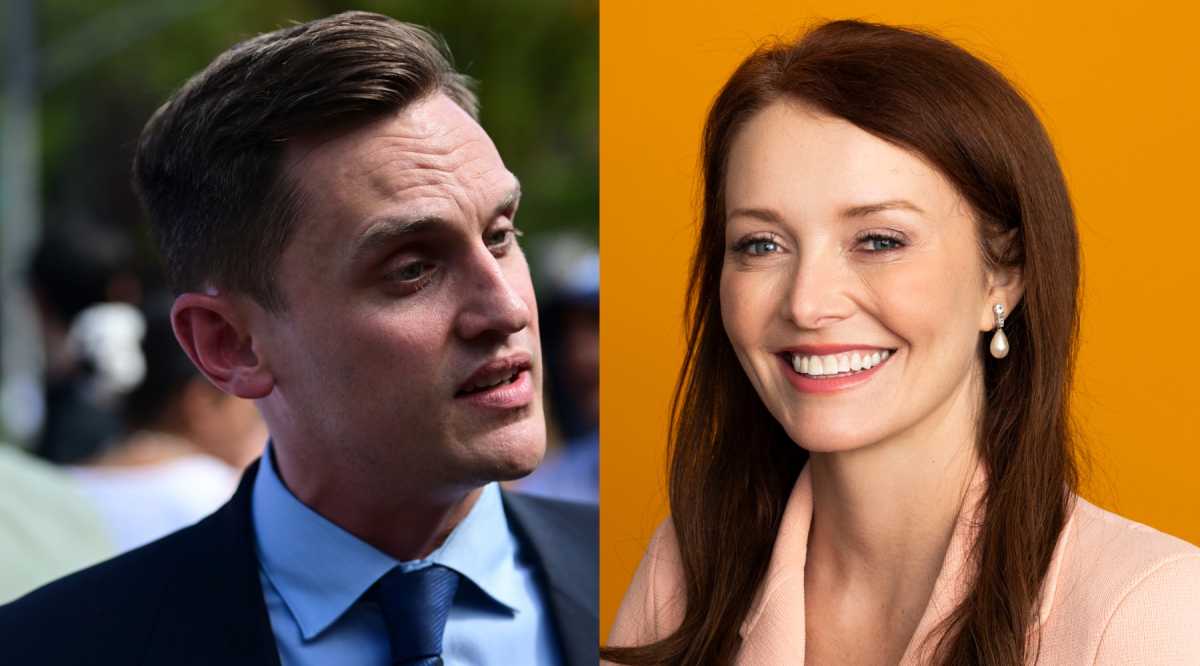
Mayor Zohran Mamdani jumped into a closely watched Manhattan City Council special election on Friday, endorsing Lindsey Boylan and jolting a West Side race just as early voting begins Saturday.
“Lindsey speaks hard truths, challenges power, and stands up for working people when it counts,” Mamdani said in his endorsement. “That’s the kind of leadership this moment demands.”
The endorsement lands in a race that had already been shaping up as a contest between two different Democratic lanes in District 3, which includes Chelsea, Hell’s Kitchen, and the West Village.
Boylan has lined up support from left-leaning elected officials and advocacy groups, while rival Carl Wilson has assembled backing from City Hall leaders, Manhattan power brokers, and neighborhood figures. Other candidates in the field include Leslie Boghosian Murphy and Layla Law-Gisiko.
Writer and political analyst Michael Lange told amNewYork the race had looked like Wilson’s to lose before Mamdani stepped in, but that the endorsement dramatically tightened the contest.
“These are really hard races to handicap,” Lange said, pointing to the late-April timing, nonpartisan format, ranked-choice voting, and uncertain turnout. “It’s probably a toss-up, 50/50, I’d say,” he said.
Boylan welcomed Friday’s endorsement as a sign that her campaign is aligned with the mayor’s agenda on affordability and labor issues.
“This endorsement is a major milestone in our campaign,” Boylan said in a statement. “In office, I will work with the Mayor to advance our shared priorities and build a city that works for all of us.”
Boylan said those priorities include higher wages, universal child care, affordable housing, tenant protections, and passage of the Secure Jobs Act. Her supporters include City Council members Tiffany Cabán, Alexa Avilés, and Shahana Hanif; state Sens. Julia Salazar and Gustavo Rivera; and groups including PSC-CUNY, Sunrise Movement, Met Council Action, the Working Families Party, and other progressive allies.
She first drew wide public attention after accusing then-Gov. Andrew Cuomo of sexual harassment, allegations she detailed publicly in 2021. Cuomo’s administration denied the claims at the time.
Mamdani’s endorsement of Boylan carries an added layer of political symbolism because he and Cuomo were bitter rivals in last year’s mayoral race.
Cuomo stayed in the race as an independent after losing the Democratic primary, attacked Mamdani repeatedly in the general election campaign, and lost to him in November. In February, Cuomo launched a weekly 77 WABC radio show, “The Pulse of the People,” on which he continues to criticize Mamdani’s leadership and proposals.
The mayor’s move also places him opposite Council Speaker Julie Menin in the race. Menin is backing Wilson, who is also endorsed by U.S. Rep. Jerry Nadler, Comptroller Mark Levine, Manhattan Borough President Brad Hoylman-Sigal, State Sen. Erik Bottcher, and former Council Speakers Corey Johnson and Christine Quinn.
Wilson, a longtime West Side organizer who served as Bottcher’s chief of staff when Bottcher represented the district on the Council, has cast himself as a neighborhood candidate focused on affordability, quality-of-life issues, transit, the arts, and LGBTQ+ representation.
Asked Friday about Mamdani’s endorsement of Boylan, Wilson declined to turn the contest into a proxy war between the mayor and Council leadership.
In an interview with amNewYork after a rally in Hell’s Kitchen, he said he would work with both Menin and Mamdani if elected, adding that voters want leaders who are not “caught up in squabbles between power centers.”

He also argued that District 3 should continue to have LGBTQ+ representation on the Council. “This is really about the future of the West Side, and it’s about the future of having an LGBTQ representative of this district, the birthplace of Stonewall and the modern gay rights movement, at a time when we are under immense threat from Washington, D.C.,” Wilson said.
Wilson enters early voting with a financial edge, outraising Boylan in private donations and benefiting from more than $128,000 in labor-backed independent expenditures.
Through April 13, prior to Mamdani’s backing, Boylan reported almost $244,000 in total receipts, including roughly $193,000 in matching funds and about $51,000 in private donations.
Wilson reported $282,643 in total receipts, including $206,889 in public funds and $75,754 in private contributions.
Boylan had spent $134,900 by the latest filing date, compared with $122,945 for Wilson. Wilson’s donor base also included $4,940 from Bowie, Maryland, where he grew up before moving to New York, plus another $3,975 from elsewhere in Maryland, for a total of $8,915 from the state.
Wilson is also getting help from outside labor-backed groups. Carpenters for Progress, a super PAC affiliated with the New York City District Council of Carpenters, has reported $69,000 in spending to support him, and United for NYC’s Future, an independent expenditure committee tied to the teachers union, has reported about $59,000 more. Together, those two groups have spent a little more than $128,000 backing Wilson via mailers, social media and other digital ads.
A district of nuance
Lange said the district’s internal politics are more layered than a simple progressive-versus-establishment frame might suggest. “Him [Mamdani] and Brad Lander both did quite well, but [Former Governor Andrew] Cuomo still hovered around a solid 30% in the first round and 40% the final round, 40% that he carried through to the general election,” Lange said of last year’s mayoral contest in the district.
Lange estimated, based on a composite of exit polls, census data, and election-district analysis from last year’s mayoral primary, that Mamdani ran strongest there among voters ages 18 to 34, renters, and college-educated Democrats. Lange also estimated the district’s electorate is roughly 74% white, renter, and college-educated.
“The district has a lot of nuance to it,” he said. “Hell’s Kitchen is super young, tons of renters. So, a relatively higher-income area, but not as high as Chelsea or Greenwich Village. The farther south you go, the more affluent it gets, and also the older it gets.”
That geography, he said, shapes both the campaigns and the electorate. “Hell’s Kitchen is super renter dense, while you have many more owner-occupied units in the West Village,” Lange said.
“Some of these homes and apartments are valued in the multiples of millions, and those folks are also the most civically engaged.”
He also noted that the district includes “the highest density of gay residents of anywhere in the city,” and said that for the last 40 years the seat has been held by someone who is gay — another piece of the race Wilson is trying to appeal to.

He also described the race as a test of local institutional power versus citywide progressive energy. “You have WFPs and Brad Lander supporting Lindsay, but you have all the local elected officials and their clubs basically supporting Carl,” Lange said. “It’s a fascinating test here of what matters and what doesn’t.”
Boylan first drew wide public attention after accusing then-Gov. Andrew Cuomo of sexual harassment, allegations she detailed publicly in 2021. Cuomo’s administration denied the claims at the time.
Lange said turnout could be decisive. “I think if you’re Lindsay, the more turnout, the better for you,” he said. “If really no one votes, I would imagine that benefits the person with all the local and institutional support.”
He added that Mamdani’s late endorsement of Boylan made strategic sense because she had supported him in both the primary and general election, giving the two an existing political kinship.
He also argued that the race offered Mamdani a relatively low-risk chance to help install a close ally on the City Council, especially because the winner of the special election could remain in the seat for as long as 12 years, since the partial term would not count against term limits.
On the campaign trail
Wilson spent Friday on the West Side trying to reinforce the closing message of his campaign: that the race is about district identity as much as ideology, and that affordability in District 3 includes whether artists, performers, and LGBTQ New Yorkers can still build lives in the neighborhoods they helped define.
Speaking to amNewYork, Wilson said he was focused less on the late endorsement fight and more on a campaign he described as rooted in years of local organizing and service. He also argued that the district, which includes Stonewall and some of the city’s best-known LGBTQ neighborhoods, should continue to have LGBTQ representation on the Council. “This is really about the future of the West Side,” Wilson said.
That argument was on display Friday afternoon outside Rialto West, where Wilson appeared with backers Bottcher, Assembly Member Keith Powers, Manhattan Borough President Brad Hoylman-Sigal, Broadway performer Sydney James Harcourt, and leaders from arts and labor organizations to call for an artist housing pilot at the site.
The rally gave Wilson a concrete way to connect his biography to a policy issue with deep resonance in the district: the shrinking ability of artists and cultural workers to afford life near the communities and institutions where they work.
Bottcher framed Wilson as a candidate whose support for artist housing stems from personal experience. He said Wilson came to New York to pursue acting, understood what it meant to piece together rent while waiting tables and chasing auditions, and would bring that kind of lived knowledge to elected office.

Bottcher also said he and Powers planned to introduce state legislation to open the way for artist housing in New York, casting Wilson’s candidacy and the policy push as part of the same broader effort.
Wilson used the event to tie those concerns back to his broader pitch to voters. Closing the rally, he said he wanted to be “a champion for the arts and culture community,” but also for working New Yorkers who need housing they can afford, transit they can rely on, and public spaces that are “clean and safe and build community.”
Boylan’s campaign is set to answer Saturday with its own first-day-of-early-voting rally at Chelsea Park featuring Boylan, Brad Lander, Council Member Cabán, and Working Families Party State Director Jasmine Gripper, a show of force meant to underscore her standing with the city’s progressive coalition as voting gets underway.
The race will be decided in a nonpartisan ranked-choice special election on April 28. Early voting runs from April 18 through April 26.
