

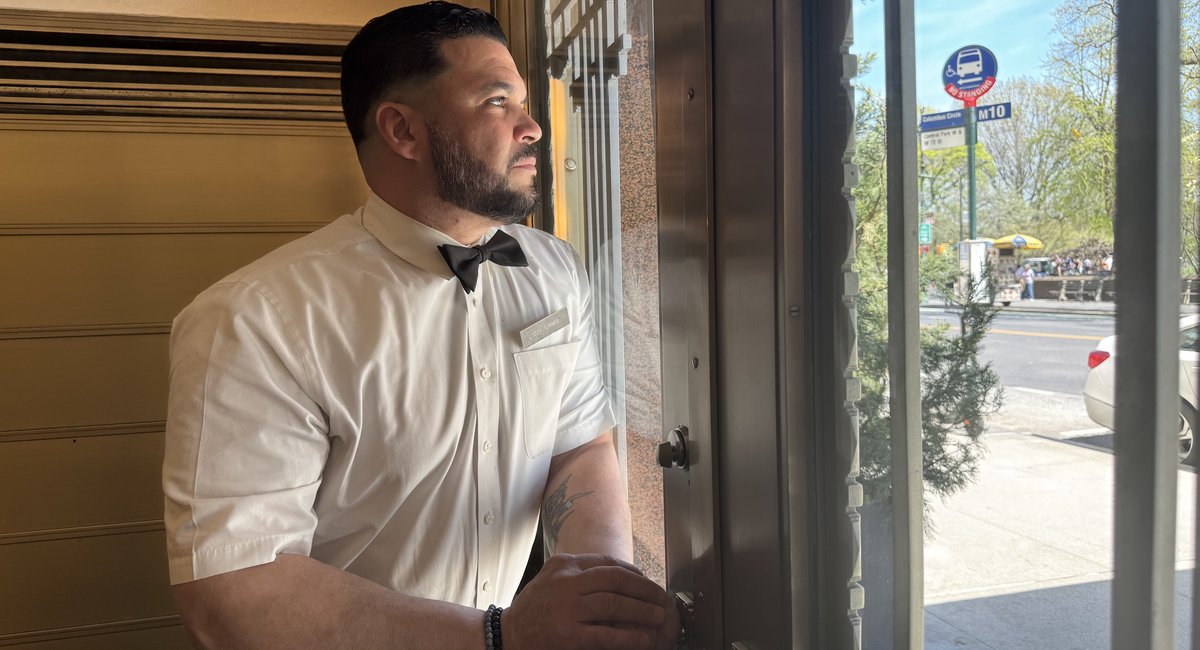
Israel Torres says his hourly pay has barely budged, after accounting for inflation, since he began work as a doorman at a luxury Upper West Side co-op overlooking Central Park in 1995.
He makes about $30 an hour, which has about the same buying power as the nearly $13 he earned just starting out. Torres, who’s 52 and has three adult children, says he’s feeling the effects of rising milk, egg and gas prices, and he tries to cut costs by eating out less, among other things.
“It’s very tough out here right now,” said Torres, who lives in Lodi, New Jersey. “It’s tough to manage, but this is something that we have to do.”
Torres is among the 34,000 doormen, concierges, building cleaners, superintendents, handymen, property managers and other building services workers who could walk off the job as soon as 12:01 Tuesday, following the expiration of the workers’ current contract with building owners. Members of 32BJ Service Employees International Union, or SEIU, approved a strike authorization Wednesday, by voice vote, in a rally on the Upper East Side, if contract negotiations fail to yield a new agreement.
It would mark the first strike by building workers since 1991, union leaders said. The workers serve some 600,000 co-ops, apartments, and condos in 3,500 buildings across the boroughs except the Bronx, according to the union. A strike would leave an estimated 1.5 million residents to mind their own doors, take out their own trash, accept package deliveries and otherwise tend to their own building needs.
The authorization also comes amid renewed attention to affordability issues in New York City and across the country, including service worker wages and rising living costs. Mayor Zohran Mamdani, a democratic socialist, has already signaled his support for the building workers in their negotiations with building owners, after aligning himself with delivery workers and striking nurses in his first months in office.
“Under our administration, New York is, and always will be, a union town,” Mamdani said in a statement ahead of a planned rally Wednesday with 32BJ SEIU. “We are sending a clear message to every building owner that the hardworking members of 32BJ will not be pushed around by anyone. They deserve a fair contract that values their contributions to our neighborhoods and to our city.”
Union leaders say they are seeking higher wage and pension benefits, along with improved work conditions and paid leave. On the other side of the bargaining table is the Realty Advisory Board On Labor Relations, or RAB, which represents about 3,000 building owners. The board is asking union workers to share in the costs of their health insurance and also seeking the introduction of a new “Tier II” workforce, for those hired after April 20, who would make less money than previously hired counterparts — measures also opposed by union leaders.
“The New York City residential real estate industry is facing mounting pressures, including the likelihood of 0% rent increases on stabilized units for years to come, overregulation, and rising operating costs,” Howard Rothschild, president of the RAB, said in a statement. “Without meaningful movement to address costs, including healthcare contributions and the establishment of a Tier II structure, the long-term sustainability of the industry and its workforce is at risk.”
The RAB estimates that the average doorman or porter under the union contract earns approximately $62,000 annually. With the cost of health insurance and other benefits included, that compensation equates to $112,000, according to the board.
The union has cast the contract negotiations as a battle over affordability and economic security in New York City, where 90% of the union members live. The union contract covers workers at most of the city’s residential buildings, except in the Bronx.
“ These are the folks that cleared all the snow this past winter, worked through the pandemic, show up every single day to take out the trash, clean the buildings, take care of the residents,” 32BJ SEIU President Manny Pastreich said in an interview. “What we’re asking for is to ensure that they can keep up with the cost of everything. Just fair wage increases that allow them to continue to live in the city.”
Pastreich called the RAB’s claims about a potential rent freeze on rent-stabilized apartments a “distraction,” adding that rent-stabilized units comprise only a small fraction of the residential buildings with workers represented by the union. Pastreich said two-thirds of the unionized building workers are based at condos or co-ops and a third are in rented apartments, with just 3% of all the workers based at rent-stabilized apartments.
After the building workers’ last strike in 1991, which lasted 12 days and affected 2,800 buildings, workers and building owners “essentially split the difference on wages, the chief issue in the strike,” according to the New York Times. Roughly 30,000 building workers — including doormen, elevator operators, handymen, and porters — won a three-year-contract with annual wage increases averaging about 4%.
During the strike, some affected residents signed up for shifts as security guards and others struggled to figure out what to do with their trash, as their garbage rooms were closed, according to the New York Times.
Pastreich said the union is also pushing for contract provisions ensuring training for front-door buildings staff and concierges about how to handle interactions with U.S. Immigration and Customs Enforcement agents, for the safety of the workers as well as the residents. The union is also requesting that if ICE requests information about workers, that building owners not comply unless legally required to do so. Pastreich said the RAB has declined to support either measure.
Torres, the Upper West Side doorman, said he spends his days opening doors, hailing residents’ cabs and accepting what he says is an average of 120 to 300 packages per day — and sometimes over 700 around the winter holidays.
He said tenants at the 32-story luxury building near the intersection of Central Park West and 72nd Street are already preparing for the strike, signing up for potential shifts to take out the trash, handling packages, managing security, and mopping the floors.
“It’s going to be tough, but they organize a certain way,” Torres said. “We have a spreadsheet over here (where) people volunteer.”
This article was updated with additional information.
