

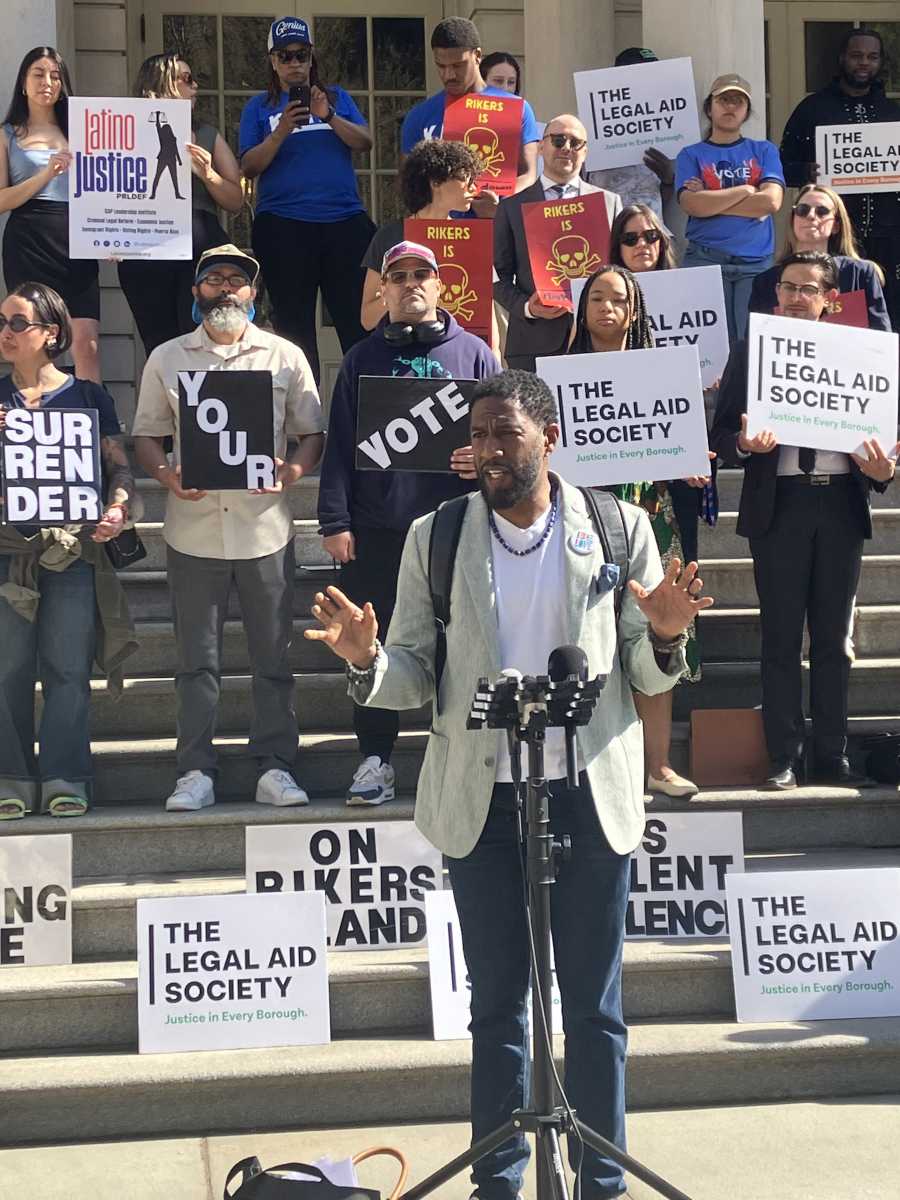
Prison rights advocates and New York City Council members say that’s because there’s no in-person polling place on the island, the absentee ballot request process is prohibitive and there’s lacking access to voter registration.
Advocates and council members are trying to change that, but the Board of Elections and Department of Correction pushed back on their proposed reforms Tuesday, saying existing state law stops them from making their desired changes at the city level.
The council is considering bills that would demand more Rikers voting data reporting and increase the Department of Corrections’ responsibility in ballot curing, the process of election officials correcting fixable issues with returned ballots. On the second point, Nell Colon, the department’s deputy commissioner of programs, said she had “concerns about the feasibility.” State law mandates the ballot curing process to be administered directly by the Board of Elections.
Michael Ryan, executive director of New York City’s Board of Elections, raised the same concern as Colon about the curing process and told council members the board couldn’t install a polling place on Rikers because it was limited by state law.
“The board is required to operate strictly within the New York State Election Law, which governs voter eligibility, ballot access and election procedures,” Ryan said. “Certain proposals, including those related to polling locations, ballot curing process or absentee voting requirements, are limited by New York State law and would require legislative action at the state level. The board is not permitted to depart from statutory authority or substitute its independent judgment for the law.”
Ryan said the absentee ballot process “remains the only legally commendable method to provide access to voting enfranchisement for those in custody.”
While the City Council couldn’t mandate that the board open a polling place on Rikers because it doesn’t have that type of jurisdiction over the state agency, advocates told amNewYork Law they “absolutely disagree” that there are any laws that forbid the board from establishing polling sites on Rikers.
Rigodis Appling, a Legal Aid staff attorney, told amNewYork Law that it was not about the state prohibiting the Board of Elections from opening a polling place, it was about the board’s will to do it. She said the Board of Elections’ argument has been that, because there is no law directly compelling them to create polling sites, they can’t.
Appling said Legal Aid and other advocates hope to convince the council and Mayor Zohran Mamdani to urge the Board of Elections to open a Rikers Island polling location.
“I would think that our mayor and our City Council would have some sway with the Board of Elections, hopefully be able to convince them to try it out,” Appling said.
Mamdani spokesperson Sam Raskin declined to answer amNewYork Law’s question on whether Mamdani would push the BOE to open a Rikers Island polling location, directing the outlet to testimony during Tuesday’s hearing, which did not touch on any potential role the mayor could have.
The state, however, could mandate the board open polling places at prisons. State Sen. Zellnor Myrie (D-Brooklyn) has introduced a bill that would require the Board of Elections to hold in-person voting at every correctional facility where more than 25 people requested an absentee ballot, something it already does for nursing homes.
Advocates say in-person voting on Rikers is critical because the current absentee voting process isn’t reaching enough people — and those incarcerated are some of the most affected by the decisions made by candidates on the ballot. Moreover, being engaged in the civic process while incarcerated helps people remain connected to their community and adjust better once they’re released, said Public Advocate Jumaane Williams.
“All New Yorkers who have the right to vote should be provided that right to vote. And if you are on Rikers Island, you are, more than likely, simply waiting to have your day in court,” Williams said outside City Hall before the hearing. “If you have folks coming back from Rikers Island, you want them as connected civically as you possibly can. But, we keep seeming to want to do the opposite.”
A logistical barrier to opening up polling places on Rikers is the technology that would be necessary, Ryan said Tuesday. Ballots have different races depending on where a person lives, and offering and counting a plethora of different ballots for different jurisdictions isn’t something the city is currently able to do in one place. (That’s why all New Yorkers must go only to their specific polling place).
Other cities, like Chicago, have been able to offer in-person voting at correctional facilities and in some states, like Texas, people are able to get a local-specific ballot as long as they vote in their county. Appling said she thought opening polling on Rikers could provide the board with an opportunity to try rolling out machines that could facilitate voting in different jurisdictions, helping modernize New York’s election equipment.
As the push for a polling place at Rikers continues, Council Member Sylvena Brooks-Powers said the council would explore all options of achieving their goal of expanding data reporting and ballot curing at Rikers, including working with colleagues in the state assembly and senate.
Appling said the bills related to transparency and ballot curing would “absolutely not” be enough to solve the voting access problems on Rikers — but they’d be important “baby steps” forward until all eligible incarcerated people are able to vote in person.
