

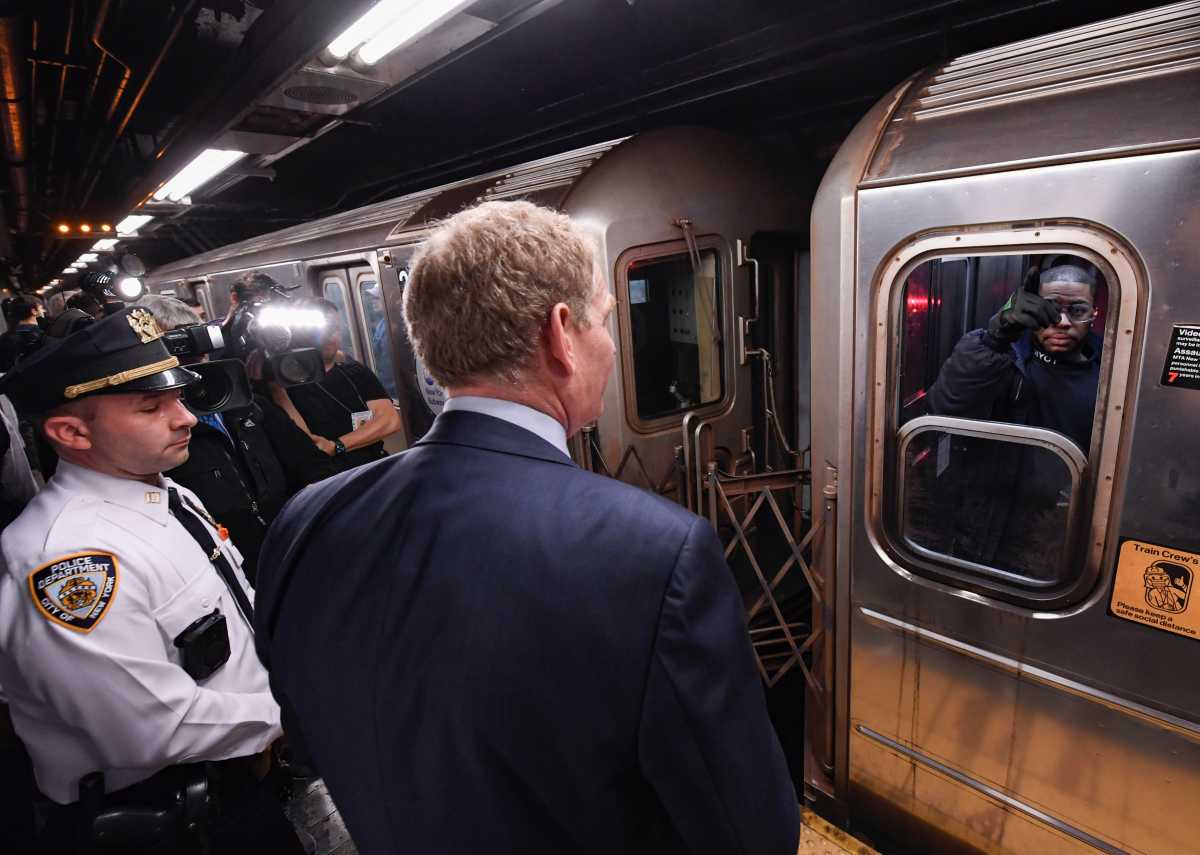
Union reps say conductors act as the eyes and ears of trains and platforms, ensuring that passengers get on and off subways safely and properly. As they scope out the station surroundings, engineers (motormen) are always in the first car, operating the train.
Marc A. Hermann / MTA
Gov. Kathy Hochul vetoed a bill on Friday that would have mandated two-person crews on NYC subways throughout the transit system.
Supporters of the failed bill, including the transit workers’ union, argued that a two-person crew is essential for public safety and operational reliability.
Critics of the bill have called two-person crews “redundant” for subway staffing.
Hochul, who vetoed the bill on Dec. 19 after it was largely supported and passed by state lawmakers in June, is up for reelection next year. She said in her veto memo that the legislation would “cost as much as $10 million annually, reducing service, and limiting the MTA’s ability to benefit from capital investments in modern rolling stock and signals,” according to Trains.com.
Conductors are ‘under attack’
John Samuelsen, Transit Workers Union (TWU) International president, told amNewYork that members were hoping to enshrine the bill into law to prevent the MTA from moving to reduce staff in the next collective bargaining agreement.
“Conductors come under attack with every single contract,” he said. “They want to reduce headcount. And in this case, they don’t really care that reducing headcount would make the system, particularly in New York for a whole lot of reasons, less safe than it is now.”
The MTA, per contract negotiations with the TWU, already has two-person crews on trains, with rare exceptions. But the bill would have essentially helped to enshrine that standard into law.
Almost all subway trains in NYC have 10 cars staffed by an operator, who drives the train, and a conductor. Some trains, however, already run without conductors because they are shorter, such as the G and Times Square shuttle.
The veto will not change anything on the ground for conductors, Samuelsen said, but added that its downside is political.
“It thoroughly demonstrates that the governor of New York State stands with the abundance bros [tech-driven progressives] and not with blue-collar New Yorkers,” he said.
Bill mandating two-person crews on NYC subways: “constraining” the MTA
Meanwhile, some advocacy groups in New York applauded the veto, citing concern that the law would have increased costs for the MTA.
Reinvent Albany, along with other civic and watchdog groups, released a joint statement on Saturday saying they “strongly support efforts” to give NYC “world-class” public transportation.
“This bill would have done the opposite by raising MTA operating costs and constraining the MTA’s ability to implement modern operating methods, adopt new technologies, and provide better service for riders,” the statement read.
A study released in November from NYU’s Marron Institute of Urban Management, a research group that was part of the joint statement, reviewed more than 400 trains in several countries, finding that fewer than 6.25% of the systems have two staffers on board.
Researchers who conducted the study criticized the bill.
“This bill, as written, does nothing to improve MTA service and will stymie the authority’s efforts to become a world leader in transit operations,” they wrote in the study.
Supporters, including those from Reinvent Albany, called one-person train operation the “global norm” used by subway systems across the world.
Samuelsen disagreed with that sentiment.
“The idea that NYC is somehow just the same as every other city in the world is ridiculous,” he said.
amNewYork contacted the MTA for its reaction to Hochul’s veto and is awaiting a response.
