

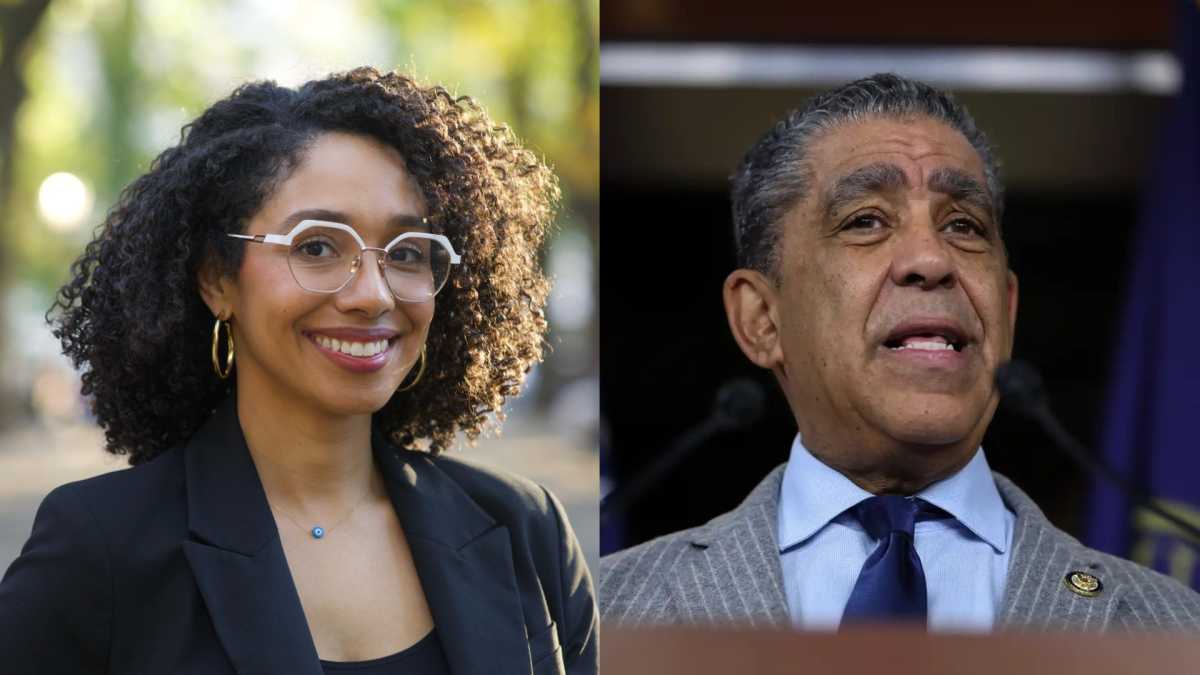
Democratic candidates for New York’s 13th Congressional district faced off in a debate during the NYC primary elections, hosted by Spectrum New York 1 on Tuesday evening, discussing the topics of Super PAC donations, public housing, the wars in Iran and Gaza and the abolition of Immigration and Customs Enforcement (ICE).
Rep. Adriano Espaillat, who has represented NY-13 in Congress since 2017, condemned challenger Darializa Avila Chevalier, a PhD student at the City University of New York and political organizer, for resurfaced social media posts criticizing former Vice President Kamala Harris and the police, while Avila Chevalier denounced Espaillat’s handling of pro-Palestinian activist Mahmoud Khalil’s prominent detainment by ICE in March 2025 and his acceptance of American Israel Public Affairs Commitee donations. Both accused each other of accepting money from Super PACs and wealthy donors, a mutual charge that has echoed throughout multiple debates.
Both the incumbent and the newcomer have received endorsements from prominent political leaders and organizations. While Espaillat hails support from Gov. Kathy Hochul, Attorney General Leticia James and additional state and federal officials, Avila Chevalier has been backed by Mayor Zohran Mamdani and the New York City Democratic Socialists of America (DSA).
Trump, the DSA and controversial social media posts
Co-moderator Errol Louis asked Avila Chevalier whether she would choose between the DSA or the Democratic Party, to which she stated that she has felt “abandoned” by past Democratic leadership and that NY-13 constituents “deserve representation that’s going to fight for the needs of our community.”
When asked about his willingness to fight against President Donald Trump, Espaillat, the first Dominican and formerly undocumented immigrant to serve in Congress and chair of the Congressional Hispanic Caucus, doubled down that he has “fought Trump and won.” He noted his efforts to impeach Trump during his first presidential term, his work to ensure representatives could enter and evaluate detention centers, and the implementation of his Sensitive Locations Bill, which prohibited ICE agents from entering schools, hospitals, and places of worship.
Avila Chevalier challenged Espaillat’s position to face Trump, calling out his acceptance of donations from organizations that have backed the president.
Espaillat responded by digging into controversial tweets Avila Chevalier posted between 2020 to 2022, which he said were “irresponsible.” During the cross-examination, in which each candidate could pose one question to the other, Espaillat asked Avila Chevalier to apologize to Harris, to which she apologized and said Harris “did not deserve that language.”
“I deeply regret my tweets, I regret them, and I regret that it has taken away from a conversation where New Yorkers deserve someone who is fighting for the things that they want to be discussed on the national stage, something that for far too long they have not had,” Avila Chevalier said.
Avila Chevalier questioned Espaillat on why he did not meet with Noor Abdalla, Khalil’s wife, in the immediate aftermath of his detention on March 8, 2025, which took place outside of his Columbia University-owned residence in Morningside Heights. She also claimed that Espaillat has not done enough in Congress to fight against ICE.
Espaillat leaned into his immigrant roots and asserted that his office provided immigration services to hundreds of NY-13 constituents last year.
“I’m very proud of the service that we provide, and I think it’s disingenuous to say that I’m voting against him,” Espaillat said, referring to Khalil.
While both candidates denounced ICE, Avila Chevalier and Espaillat differed in their stance on whether non-citizens who commit violent crimes should be subject for deportation. Avila Chevalier argued that non-citizens who have served sentences for criminal charges should be treated equally and that the criminal system should not force “another type of punishment on the basis of where they were born.” However, Espaillat said that he agrees with what is mandated by law, stating that “these are complex things, this is not a PhD program.”
Housing and affordability
On the topics of public housing and the affordability crisis, both candidates voiced opposition to the conversion of New York City Housing Authority developments under private management rather than traditional federal funding allocated by Section 9 of the U.S. Housing Act, which distinguishes public housing as a federal program and allows for greater tenant protections.
To address NYCHA’s capital need of $78 million, Avila Chevalier emphasized that Section 9 must be protected to guarantee that low-income New Yorkers have a “dignified place to live.” She also advocated for a “green new deal” for public housing that would create union jobs for those in NYCHA communities to ensure a “pathway to the middle class.”
Espaillat similarly opposed the private developments, pointing to his efforts to secure federal funding for Marble Hill, a NYCHA community in upper Manhattan, and proposing that affordable housing be built in Inwood Hill railyards.
In addition to NYCHA developments, candidates supported Mamdani’s initiative to build a city-owned grocery store in La Marqueta and underscored the importance of protecting small businesses.
When asked about the war in Iran, both candidates denounced U.S. intervention and spending, arguing that taxpayer dollars should be used to fund programs like Medicaid and SNAP benefits.
After moderators asked the candidates about their respective experiences in the Middle East, Espaillat criticized Avila Chevalier for not supporting a two-state solution between Israel and Palestine and described her attendance at a pro-Palestinian rally on Oct. 8, 2023, the day after Hamas’ attack on Israel, as “celebrating the death of innocent people,” a characterization that Avila Chevalier called “dehumanizing.”
In the final debate topic, Espaillat and Avila Chevalier discussed public safety and policing, prompting Espaillat to reintroduce his opponent’s past tweets that denounced the police and state that she would not work well with Police Commissioner Jessica Tisch.
Avila Chevalier responded by calling for funding to be directed to programs that are “actually correlated with an increased sense of safety.”
“I really think that, when in a time where we are spending more money than we have ever spent on policing, in a time where policing is more militarized than it has ever been, the fact that we are still asking the question, ‘Do we feel safe?’ is very telling,” Avila Chevalier said.
Polls for the CD 13 Democratic primary race close June 23.
