
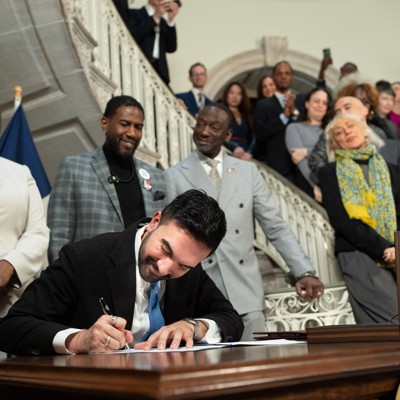
How New York City governs itself should always be evolving. But with recent mayors convening charter commissions every year, the scope of change has been limited. Mayor Zohran Mamdani’s Commission on Government Efficiency, or COGE, will likely follow this pattern. Its principal job, by the look of it, was killing the panel Mayor Eric Adams left behind, which was built more out of spite than a desire to improve government.
Motives aside, this commission should reach further than efficiency. The 1989 commission went big, dismantling the Board of Estimate and centralizing power in City Hall. We owe ourselves a serious look at how those changes have aged and what we can do better.This commission should go big too.
Reform Mayoral Succession
If the mayor is incapacitated or dies, the public advocate becomes mayor for 60 days until a special election. In practice, it makes no sense. The public advocate is a largely symbolic position with fewer than 50 employees. I worked there for three years; I know it can’t take over a 300,000-person workforce. The first deputy mayor is the logical replacement, keeping the team already running the city in place until voters pick the next mayor. The public advocate can still run in that election.
Rationalize City Power
The mayor is expected to push major legislation through Albany, serve as the city’s spokesperson, and run the country’s largest municipal government. No one is qualified for all three. Amayor’s priorities inevitably reflect the coalition that elected them which can lead to bad policy outcomes, like Bill de Blasio’s hyper-protectionism of the hotel industry in return for the hotel workers union supporting his presidential run. The same neighborhoods have lagged in education, health, and safety for more than 30 years because they’ve never been politically necessary.
The charter could require the city to allocate capital spending and agency service plans through a need-weighted formula tied to measured indicators: poverty rates, school scores, crime stats, transit access and park coverage. Eastern Queens, a longstanding transit desert, should be first in line for free, fast buses. Central and Southeast Brooklyn, which have almost no green space, should get the largest share of the parks budget and first claim on new parks.
Modernize Civil Service
Mamdani’s election inspired over 80,000 New Yorkers to apply for jobs in his administration. Most will never be hired because the city’s civil service rules are outdated and byzantine. A recent report from Work For America identifies obvious choke points: “exams, candidate scoring, eligibility lists, and rule-based selection processes. Hiring managers are forced to select from a fixed pool when additional qualified applicants are available.”
Gov. Kathy Hochul created a program letting agencies skip the exam for many roles, but the Adams administration refused to use it, making New York City one of the only local governments to opt out. As of February, only 31 of the 80,000 applicants had landed a job.
The charter can change this by mandating the city participate in any state program that lowers hiring barriers; cut the time from job offer to start from a pathetic six-month average to no more than one; and raise compensation floors for managerial titles outside collective bargaining.
The charter can also take aim at a remnant of political patronage: city marshals. Marshals are private contractors who evict tenants, garnish wages, and seize property while pocketing 5% of every dollar collected on top of statutory fees. The Independent Budget Office estimates converting them to salaried Sheriff’s Office employees would net the city $11 million a year. State law blocks full abolition, but the charter can shrink the system: route every city judgment or eviction to the sheriff; freeze new appointments at the current 28; and require Department of Investigation misconduct findings be published, referred for prosecution and used to bar reappointment.
Translate Government to More People
AI’s super power is distilling data sets into something usable in any format or language. One sample: this op-ed as an AI-generated podcast in English and Spanish. It should also be turned loose on the city’s unread reports and city datasets – from the Mayor’s Management Report, still a PDF, to Brooklyn Borough President Antonio Reynoso’s comprehensive master plan.
Josh Greenman of Vital City has used AI to make crime stats and bus speeds legible; I worked with a friend to build Smithmoses.com, translating every new bill from Albany. The positive tech applications are endless. The charter can harness them by partnering with Tech:NYC to write guidelines, define use cases, build training for incoming employees, and mandate that city government regularly modernize.
Service Utilization Over Political Goals
The Mamdani administration’s Office of Mass Engagement was framed as innovative, but de Blasio’s Public Engagement Unit pioneered the same concept. The difference is deployment. Mamdani’s team has used its office to recruit testimony at Rent Guidelines Board hearings supporting his rent-freeze pledge. De Blasio’s enrolled New Yorkers in services like Universal Pre-K, signing up 50,000 children in year one. You can measure the contrast in this year’s 3K enrollment, which fell even as Mamdani’s social channels reached an audience de Blasio could only have dreamed of.
Of course political engagement has a place. But the durable win for Mayor Mamdani is getting people to believe in city government because they’ve actually used it. The”sewer socialism” label should translate to connecting New Yorkers with existing services, not just clipping moments of government working into videos.
The charter can update the Mayor’s Management Report to track how communications staff at every city agency drive enrollment in underused programs from Fair Fares (36% of eligible signed up) to free tax prep (150,000 of an eligible 1 million). I know this gap because my friends and I make short films promoting these underused programs. Tying success to enrollment instead of press coverage redirects communications teams toward connecting people with government, not generating positive coverage of the mayor. I learned how limiting that can be serving as press secretary for a governor obsessed with his own credit.
These are starting points. No one has a monopoly on good ideas. Mamdani’s election was a mandate for change. A commission built around efficiency alone will not meet it. This one can.
