

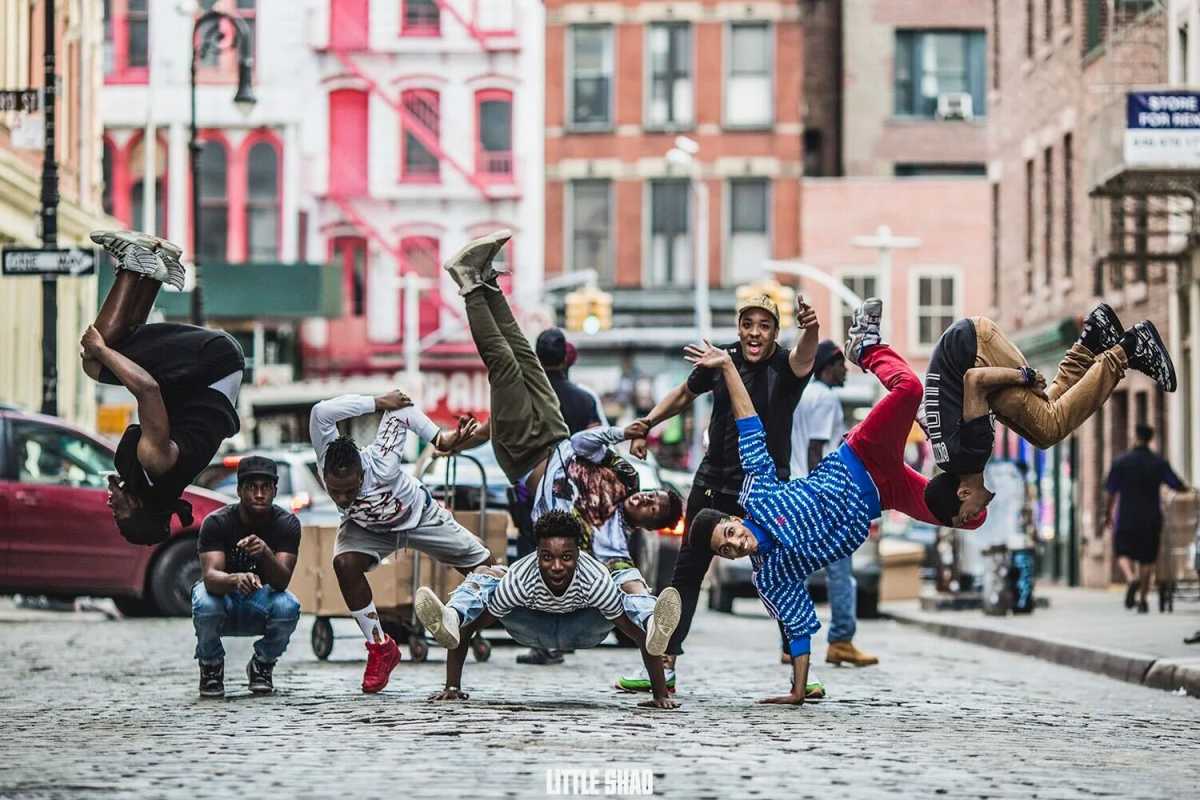
You’ve probably heard it before the beat even drops– that familiar call echoing through a subway car: “Showtime!”
But behind that moment, behind the flips, footwork, and raw electricity that define New York street performance, is a deeper story. It’s a story built on family, resilience, and a dance style born in Harlem, elevated in the Bronx, and now reaching audiences around the world. At the center of that story is the W.A.F.F.L.E. Crew.
“We Are Family For Life Entertainment.” That’s what WAFFLE stands for, as Jacob Israel, stage name known as Andrew “Goofy” Saunders, explains. It’s more than a name, it’s a philosophy that has carried the crew from subway platforms to global stages.
WAFFLE didn’t come together in a studio or through auditions. It formed organically, through battles, train performances, and long days spent moving across the city, rooted in the kind of connection that can’t be manufactured. Inspired by Sister Sledge’s “We Are Family,” the crew built itself from the ground up, shaped by the rhythms of New York itself.
“We started out literally in the growth of what Litefeet came to be,” Moe Black says, describing how early members were already part of a rising network of dance crews like Fast Food Club, Brotherhood, and Breakfast Club. What began as competitive battles quickly evolved into performance, most notably on subway cars, where WAFFLE carved out its identity.
On those trains, the crew wasn’t just dancing. They were building something out of nothing.
“We didn’t have a radio, but we still put on a show. Let’s go,” Jacob recalls. Before speakers and sound systems, there were hand claps, timing, and instinct. Over time, that evolved into makeshift setups– cassette tapes, aux cords, portable amps like the Behringer EPA 40 (known as the “blue amp”), and eventually Soundboks speakers, each step reflecting the hustle and ingenuity that define the city.
Litefeet, also known as “Get Lite”, didn’t just evolve visually, it developed its own sound. What started as movement on the trains grew into a distinct musical lane, built by the same community pushing the dance forward. The beats are fast, percussive, and intentional, designed to match the rhythm, creativity, and individuality of the dancers. While early records helped lay the foundation, today’s artists are creating something that exists on its own terms.
Within that evolution, members of the WAFFLE Crew have played a direct role in shaping the sound. Artists like Arnstar, Johno, and Kid the Wiz aren’t just dancers, they’re contributors to the music itself. Records like Johno Clap, led by Johno alongside Arnstar, have grown into worldwide moments, becoming both a global song and dance and showing how Litefeet now travels far beyond New York while staying rooted in the city.
That same momentum extends beyond the crew. Artists like Lucky Banks, who Jacob grew up closely with, have been putting in major groundwork, helping push the sound and culture forward from the inside.
Behind the scenes, producers continue to define and expand the sound. Creators like Lil Live (Skyler Live) and NYOP (Chris Designs) have helped shape the current wave, while Lady Mosofou marks an important milestone in the culture’s growth and representation. Earlier contributors like Danny D, DJ Omar, Taylor Made, Blackthebeast, SNS, and Dcole & more helped lay the groundwork for what the sound could become.
The roots of that sound can be heard in records like Chicken Noodle Soup by DJ Webstar, Young B, and AG The Voice of Harlem, along with tracks like “5000”, Aunt Jackie, and New York staples like Go Stupid by J -mackez. But what’s happening now goes beyond continuation, it’s a new lane entirely, where Litefeet and Get Lite music are evolving side by side in real time.
At the core of it all is Litefeet, a dance style deeply rooted in New York culture. Coined in 1999 by AG, the Voice of Harlem, Litefeet gave a name to a movement that was already building momentum. From there, dancers across the city helped shape and refine it, turning it into a recognizable, evolving form.
Litefeet blends hip-hop foundations with speed, individuality, and expression, emerging from Harlem, elevated in the Bronx, and shaped by contributors from all five boroughs, Long Island, and the broader Tri-State area. Its connection to the Harlem Shake, created by Maurice “Motion” Strayhorn, often described as its “big brother,” reflects a lineage that is both collaborative and contested, like much of New York’s cultural history. In some circles, Al B. (often referred to as “Albee”) is also credited in discussions around the Harlem Shake’s origins, adding another layer to the ongoing conversation around authorship, memory, and influence within the culture.

“It’s a street style grown out of Harlem and the Bronx, and it has fundamentals,” Moe Black says.
But more than technique, Litefeet is about identity. “It allows you to be yourself,” Jacob adds.
That freedom is what makes each WAFFLE performance feel alive– structured enough to hit, but open enough to surprise. Within the crew, that dynamic becomes part of the magic.
“Everybody has their superpower,” Joel Kozik says, describing how each dancer brings a distinct energy. Together, those individual styles create something cohesive yet constantly evolving– like a performance that never repeats itself the same way twice.
While many associate subway performances with the phrase “Showtime,” WAFFLE is intentional about distinguishing the culture behind it.
“Showtime became a staple from Litefeet, but it’s just a phrase that existed before us. Certain Litefeet moves would get labeled as ‘showtime,’ one being hat tricks,” Jacob says.
As Arnstar puts it simply: “Our dance style is Litefeet.”
That distinction matters. For a crew that has spent years pushing for recognition, it’s about ensuring the culture is understood, not reduced to spectacle.
That push hasn’t always been easy. Performing on trains came with real risks, from police crackdowns to limited legal opportunities.
“We had to really break barriers to be able to perform somewhere. People say we should perform outside, but they don’t understand the dynamics of needing permits in certain locations,” Jacob explains.
In a city that thrives on creativity, WAFFLE often had to create its own stage.
And they did. Long before short-form video dominated the internet, WAFFLE understood the power of visibility.

“We began to go viral at will,” Arnstar says. By posting consistently and leveraging each member’s platform, they transformed local subway performances into global moments, reaching audiences far beyond New York without losing their roots.
In the early stages, Jacob was creating and editing videos for social media, building and shaping content around the culture from his own perspective. But once he was able to see what was possible within the work itself, everything expanded. The vision got bigger. The access got deeper. And the responsibility to tell it right became real.
From being featured in over 15+ documentaries, he started learning the language of filmmaking from the inside out. But instead of only being in front of the lens or part of someone else’s story, he became inspired to build his own. Seeing a RED camera for the first time and watching playback on that level, shifted everything. That moment made it real: this wasn’t just content anymore, it was cinema.
That evolution pushed him toward ownership of his own narrative. Now he’s developing two documentary projects– one focused on Litefeet itself, and another on its “big brother,” the Harlem Shake– tracing the movement, the history, and the voices that shaped both.
As of now, both projects are in development, including collaborations with Trinidad James, continuing a mission to document the culture from the inside, through the eyes of the people who lived it.
That momentum led to major milestones, from television appearances to international tours. Jacob reflects on just how surreal that stretch became: “Being able to see your crew do the unthinkable and being invited on Ellen three times in the span of three years is crazy, and getting the Golden Buzzer on America’s Got Talent while showcasing Litefeet has been nothing short of amazing.” It’s the kind of moment that, for a crew built from subway platforms, feels both unbelievable and earned.
That momentum has also extended into film, with a short MetroCard-centered project featuring members of the crew recently selected for the Tribeca Film Festival.
At the same time, the story of Litefeet is continuing to expand on screen, with a narrative film titled Get Lite, directed by Teyana Taylor, currently in development, an upcoming project inspired by the Litefeet movement.
“People could be having a bad day, and then they see us dancing and say, ‘That’s New York,’” Arnstar says.
There’s a connection between performer and audience here that feels immediate, almost instinctive. It’s not just about performance, it’s about recognition.
“New York is in tune with the culture,” Joel adds.
That connection extends beyond the moment. WAFFLE has always seen its role as something bigger, not just entertainers, but mentors and community builders.
Litefeet itself grew from a need to create alternatives for young people navigating difficult environments. “The culture started with the idea of saving our lives through dance,” Arnstar says.
That mission continues today through classes, outreach, and creating spaces for the next generation to step in and be seen.
Within the crew, that sense of family remains the foundation.
“Communication, we’ve got a group chat,” Jacob says. It sounds simple, but it reflects years of shared experience, growth, and accountability.
“We’re still family, you fight through whatever you have to fight through,” Joel adds.

Looking ahead, WAFFLE is thinking beyond the spaces they’ve already transformed.
Their vision includes building their own performance platform, recreating the subway environment that shaped them, but on their own terms.
“I would like to build our own show, rebuild a subway in a warehouse, or even take it to a Broadway show,” Jacob says.
Alongside that are plans for classes, fashion, music, and film, expanding WAFFLE into what they describe as a full entertainment ecosystem. “We would like to be a conglomerate of entertainment,” he adds.
Still, their purpose remains grounded in impact. Whether it’s a crowded subway car or a global stage, the goal is the same– to shift how people feel, even if just for a moment.
“We have the ability to change emotion,” Moe Black says. A bad day can turn good. A good day can become unforgettable.
When asked to sum up WAFFLE’s journey, Jacob puts it simply: “From nothing to something.”
It’s a phrase that captures not just their rise, but the essence of New York itself– a city where movement becomes opportunity, where creativity builds community, and where a single call of “Showtime” can echo far beyond the train.
You can follow the team on Instagram @wafflenyc, @litefeetculture & @lionsdenfilms
