

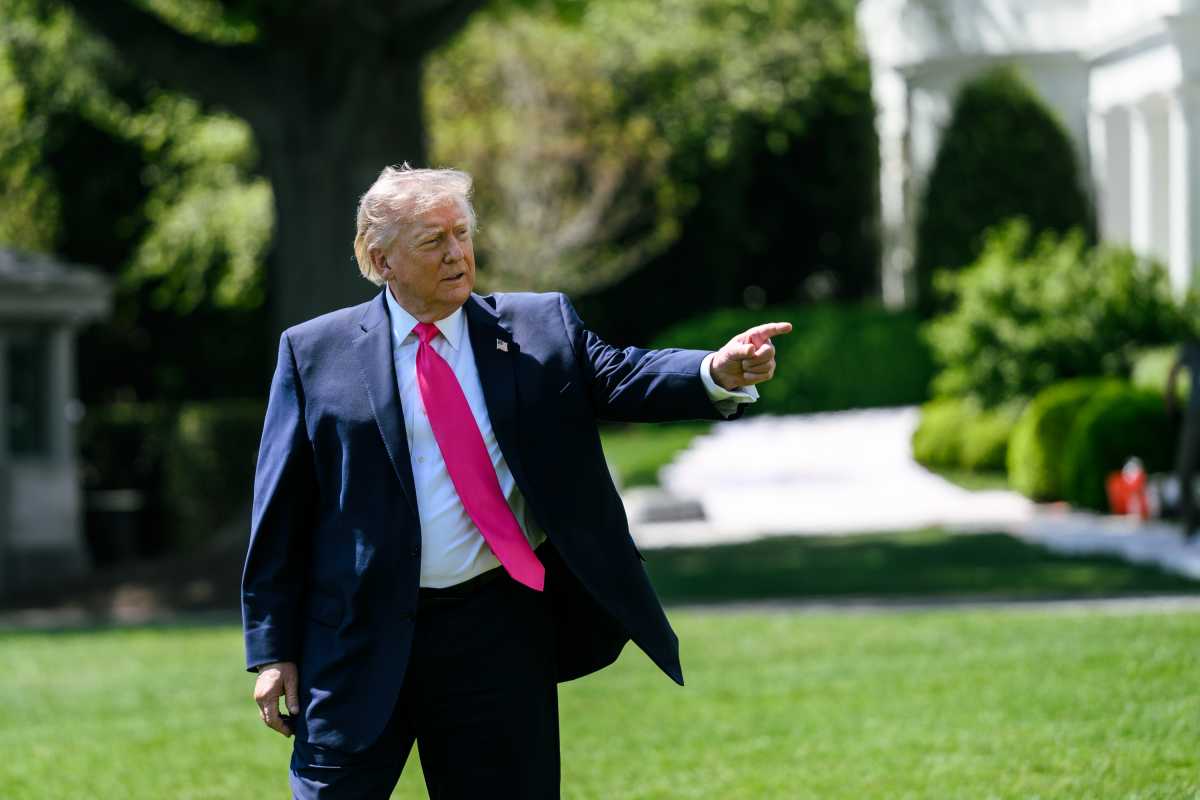
President Donald Trump speaks with members of the media before boarding Marine One on the South Lawn of the White House, Thursday, April 16, 2026, en route Joint Base Andrews for a trip to Las Vegas.
Official White House Photo by Molly Riley
A Manhattan Appellate Court granted President Donald Trump’s niece, Mary Trump, some fuel to defend herself last week against a lawsuit that the president initiated against her over her role in a New York Times investigation into his finances.
President Trump originally filed the lawsuit in 2021, claiming that his estranged niece should be held liable for breaching a confidentiality agreement when she provided financial documents to a team of Times journalists in 2016 that tracked the hundreds of millions of real estate assets the president received from his father early in his real estate career.
In her defense, Mary Trump alleged that President Trump induced her to sign the settlement agreement at the heart of this lawsuit by fraudulently valuing it. Under New York law, Mary argued, a fraudulent agreement should render the contract’s provisions null and void.
She pleaded the fraud defense in 2023, including a motion for discovery to prove that the compensation President Trump promised under the agreement was fraudulent and misleading. Trump refused to produce that discovery—which the court referred to as the “estate valuation materials.”
Manhattan Supreme Court Justice Robert R. Reed previously denied Mary Trump’s motion, but that decision has now been reversed by a panel of Appellate Court, First Department judges. The appellate court found that Reed had “improvidently exercised [his] discretion” in stopping the discovery. It ultimately decided that the lower court should have been more liberal in its interpretation of the scope of necessary discovery in the Trump family dispute.
“These principles entitle defendant to the requested discovery material to establish her affirmative defense,” the court wrote in its decision.
Neither Mary Trump’s lawyer, Lee R. Crain of Gibson, Dunn & Crutcher, nor President Trump’s lawyer, Michael T. Madaio of Madaio Eyet & Associates, responded to comment on the decision.
Prior to the appellate court’s decision, the Supreme Court had set discovery in the case to conclude by late July.
