

MTA Chair and CEO Janno Lieber on Wednesday defended the agency’s embrace of a new “European-model” of enforcement to crack down on bus fare dodgers, though he did acknowledge there may be pushback against scanning straphangers’ phones and credit cards to verify payment.
Lieber, during a news conference following an April 29 MTA board meeting, insisted that there has been widespread compliance among bus riders who have been approached by civilian fare agents with handheld devices scanning their phones, credit/debit cards, or fare cards to ensure they paid via the OMNY to-and-pay system.
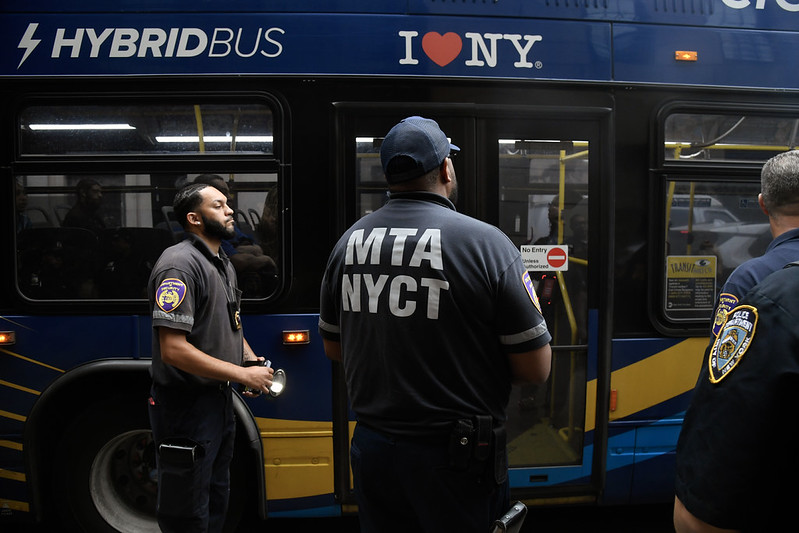
NYC Transit President Demetrius Crichlow announced on Monday that the agency would be equipping civilian fare agents — who serve on the agency’s Evasion And Graffiti Lawlessness Eradication (EAGLE) teams — on local buses, after piloting them on Select Bus Service (SBS) routes.
“We’ve been testing it out, as Demetrius has described, and it’s working fine,” Lieber said. “I think that there is a very high rate of customer compliance.”
The MTA chair did concede that some riders may not be eager to brandish their phone or bank card to fare agents on demand. But he said the system of fare enforcement is necessary for the agency to implement, as it is common amongst countries in Europe and beyond.
“We haven’t gotten a lot of pushback. It may happen,” Lieber said. “But this is the right way to validate fares in the 21st Century in the Western world. So we’re comfortable with it. We’ve been testing out the technology, and the EAGLE teams have been implementing this methodology successfully.”
Crichlow said the EAGLE teams are being trained to interact with riders who refuse to show proof of payment.
“Employees are being trained how to deal with customers, what to say in instances where they encounter a customer that may not necessarily be readily willing to present their information,” Crichlow said.
At the same time, he said the MTA is trying to educate transit users about the new fare enforcement method to avoid such situations.
“We’re also doing the work up front, having the teams go out there and do leaflets, talk to customers in advance of implementing this,” he said. “We’re having customer information screens changed to be able to tell customers. We’re adding signage to buses so that people know that this change is coming. So it is our goal to be as informative as possible. So this is not a surprise to the public.”
Crichlow also emphasized that the devices are strictly for verifying payments and do not store riders’ personal information.
The MTA is moving toward the new fare enforcement model on buses now that it has fully switched to the OMNY system and has mostly phased out the use of MetroCards, which it stopped selling at the end of last year, and coin payments.
The agency lost $568 million in revenue to fare evasion on its buses in 2024, according to a 2025 report from the Citizens Budget Commission.
Lieber has said the rollout of the scanning devices to fare agents across the system will allow the MTA to finally introduce all-door boarding on its local buses, which have had dormant back-door OMNY readers for several years.
