
We’re 116 days into the Mamdani administration, and although there has been some foreshadowing of what the next four years will look like, the state government’s imminent adoption of a pied-à-terre tax is really the first salvo in the inevitable class struggle in the city.
Gov. Kathy Hochul found an elegant and smart solution to the ongoing debate about whether we should tax the wealthy to provide essential services to the city and to plug the upcoming $5.4 billion gap in the city budget.
The tax on second homes worth more than $5 million will only affect about 13,000 non-voting homeowners who have decided to invest in New York real estate and leave those apartments largely unused for most of the year.
The governor and others have said that many of these owners are Russian oligarchs and wealthy Chinese investors who are looking for a safe haven for their money. But, of course, some Palm Beach or Miami residents will also be affected and they will be the loudest voices of opposition through their right-wing mouthpiece, The New York Post.
Asking two-mansion families to pay another surcharge on top of the property taxes they’re already paying is not a bad idea, considering that they benefit from the city’s uniformed services, even when they’re not living here.
If their building is on fire, New York’s Bravest will show up to save the out-of-towner’s precious investment. The NYPD will patrol their neighborhood to ensure that no one ransacks their homes. Why shouldn’t they pay more taxes when others in the city who live and work here pay city taxes on top of their property taxes?
There are some very smart people in the business and real estate community who think that this new levy will hurt property values and thus cause less taxes to be paid into the city’s coffers. REBNY CEO Jim Whelan and Partnership for New York City President Steve Fulop, two civic leaders whom I respect, have come out against this tax, saying it will drive away real estate investment in New York. There is a precedent in London where a number of taxes on wealthy homeowners has driven many away and led to a drop in valuations.
So Whelan and Fulop may be right; I guess we’ll know more in the next two to three years as Mamdani’s social experiment plays out in our great metropolis.
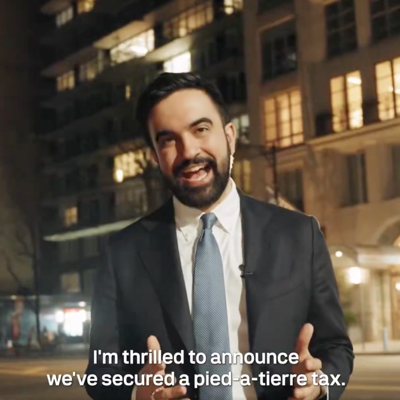
One potential misstep by the mayor was personalizing this tax and making a video in front of Citadel CEO Ken Griffin’s $238 million home. Although Griffin may not live full-time in his penthouse apartment, he has been a generous philanthropist in New York, he employs thousands of New Yorkers who pay lots of taxes and he is about to build a large Park Avenue office building for his growing company. The mayor should not be demonizing anyone or risking losing philanthropists and large employers who are investing in our city. Mamdani got his win; no need to rub Griffin’s nose in it, lest he pull up his company’s HQ and move it to more business-hospitable states like Florida and Texas.
And while we’re on the topic of economic development and attracting and retaining jobs in New York, why hasn’t the mayor filled the all-important position of commissioner of the Economic Development Corporation? It’s almost four months into the Mamdani term and this key agency still needs a leader. The optics of keeping it vacant for so long does not send a positive message to New York’s vital business community.
But I think our leaders in Albany should take the pied-à-terre tax a step further. Until 27 years ago, New York levied a commuter tax on those who worked in the city, but didn’t live in the five boroughs. It was a pittance: 0.45% of their annual income. A worker who makes $80,000 annually would pay just $360. But this tax provided more than $300 million annually to New York City’s budget, from the almost 1 million people who work in the five boroughs but live in places like Westchester, Long Island, New Jersey and Connecticut.
When the commuter tax was hastily repealed in 1999 to benefit a candidate in a special election, Upper East Side State Senator Roy Goodman said: “This will go down in the annals of this house as one of the most foolish pieces of fiscal folly ever perpetrated on the public.”
Like the real estate second homers, commuting workers benefit from our police, our firemen, our sanitation force, our parks and many other city services and amenities – and thus should pay their fair share of these urban expenses.
Next January, when the legislature convenes again, I’m hoping the governor will push to bring back this fair tax, but I’m not holding my breath. Even if the governor advocated for it, it’s unlikely it would advance in the legislature because the state Senate is led by Andrea Stewart-Cousins, whose district lies largely outside of the city.
But maybe our elected leaders in Albany will get the courage to do the right thing and spread the burden of paying for city services even more evenly.
Make no mistake, this new pied-à-terre tax would not have happened if either Eric Adams or Andrew Cuomo were elected mayor in 2025.
This was a win for the mayor and his DSA supporters. The governor wisely threw Mamdani and his base a bone in an election year when she couldn’t afford to raise taxes on either wealthy city residents or large corporations.
Raising those taxes could’ve given too much ammunition to Bruce Blakeman, the Republican nominee for governor. He will still use the pied-à-terre tax to attack the governor over the next six months, but I doubt he will sway many voters on this issue.
And it’s no great surprise that President Trump came down hard on this tax in a Truth Social post. He and his children all own second homes in New York that are likely north of $5 million in value and thus they could be subject to this new tax.
Since he took office almost four months ago, Mamdani has been laser focused on accomplishing his key campaign promises. With the help of the governor, in Mamdani’s first week in office, he got a down payment of more than $1 billion to start the rollout of universal day care, starting with 2-year-olds.
Mamdani has now achieved his tax on the wealthy, albeit those who aren’t New York City residents, and that is a symbolic victory that he and his followers can boast about for the rest of this year. But don’t think that the “tax the rich” cries will die down in 2027 because of this new tax. This will just feed Mamdani and his supporters’ push for other ways to make rich individuals and large corporations pay their fair share, and they may even find a more receptive audience in the governor once it’s no longer an election year.
Mamdani has also made plans to open up the first city-run grocery store in 2027. How that will work is still a bit of a mystery, but kudos to the mayor for following up on this so quickly.
The one area where he hasn’t made much progress is his promise of fast and free buses. He is making incremental progress on the “fast” part by trying to re-engineer traffic lanes to unclog the roads for city buses.
But the main reason why buses are a slow form of transportation is because the driver has to wait for all those who board to pay. Eliminating this requirement would surely speed things up. But at a time of fiscal scarcity, it’s hard to justify spending $700 million to enact this program.
One smart idea that seems to be gaining a bit of traction is the notion of monetizing all free parking on city streets. This might annoy car owners, but perhaps they can be pacified if this new program is coupled with the kind of relatively inexpensive residential parking permits that work so well in cities like Boston and Washington, D.C.
If we were able to monetize street parking, we would have plenty of money to pay the MTA the $700 million it gets from the low percentage of people who actually pay their fares. It is estimated that less than half of people who take the bus bother paying for their ride.
Perhaps in 2027, the mayor will make this his next priority. But for now, we get to see whether taxing wealthy second home owners who live outside the city will have any impact on our real estate market and subsequently on our tax rolls.
Electing Zohran Mamdani mayor was a revolutionary change for the city. Now that he is implementing his vision, we will see whether democratic socialism – as espoused by people like Sen. Bernie Sanders and Rep. Alexandria Ocasio-Cortez – can actually work in large cities.
So far, the mayor has skillfully worked with both the governor and the president of the United States to get some wins for his agenda.
It will be interesting to see how far Mamdani can take that agenda in 2027 and beyond. By 2029, the voters will decide whether they like the results.
If they do, this will give our democratic socialist mayor another four years to take the city in a very different direction than it’s gone in the past half century.
