

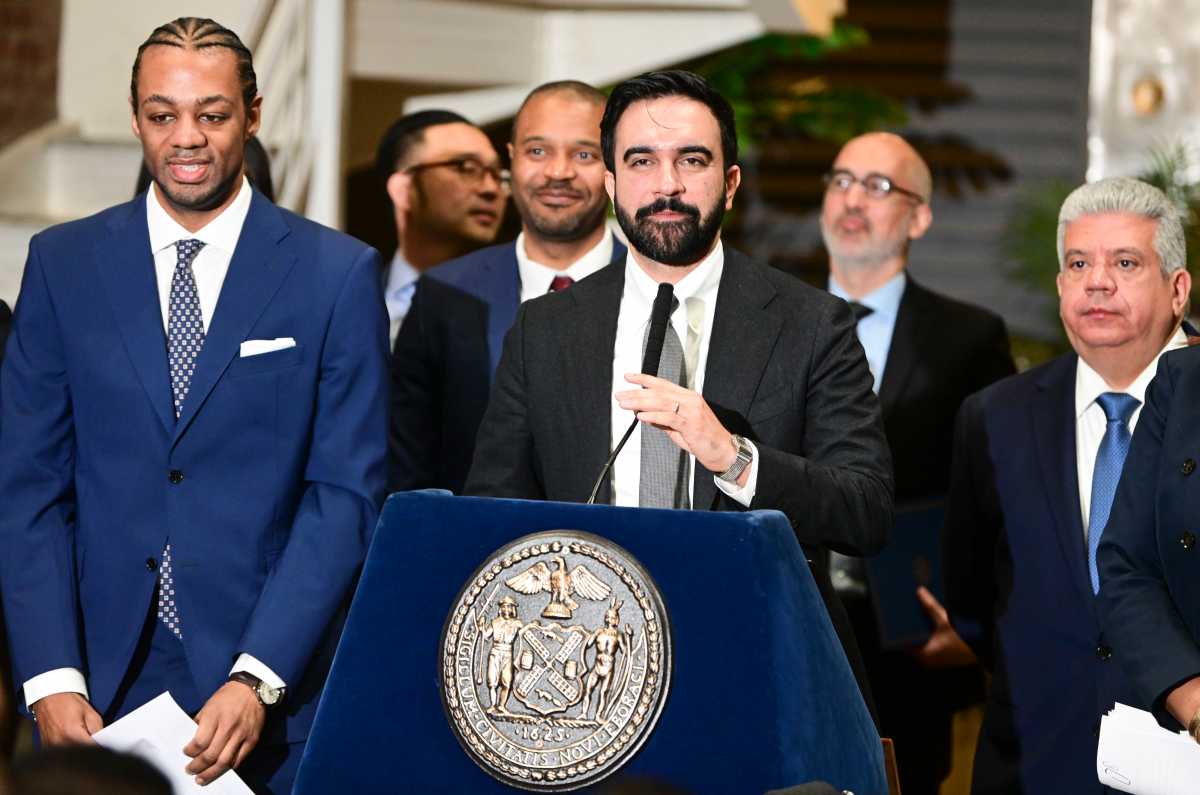
When he overturned former Mayor Eric Adams’ buffer zone executive order, Mamdani said he would embrace new legislation that would effectively accomplish the same thing. He sought to reassure prominent members of the Jewish community that he would support a law requiring protesters to keep a good distance from the entrances to houses of worship so that congregants inside would not feel threatened.
City Council Speaker Julie Menin then sought to advance two bills to do exactly that: One (Intro. 1-B) that would establish a house of worship buffer zone, and another (Intro. 175-B) providing similar protections for “educational institutions.” On March 26, both bills passed the Council with solid majorities, though Intro. 175-B did not have a veto-proof majority.
The day after the bills passed, however, Mamdani expressed reservations, purportedly about their constitutionality, and said he would examine them further before deciding to sign or veto them.
On Friday, he made his decision — and it was pathetic.
Intro. 1-B would become law, but not with his signature of approval; by law, a bill sent to the mayor’s desk becomes law automatically if no action is taken within 30 days.
Mamdani had an opportunity to show good faith to the Jewish community by signing Intro. 1-B and completely blew it.
Even if he didn’t completely agree with all the tenets of the bill, signing Intro. 1-B would have sent a message: The mayor will always protect Jewish New Yorkers at the places where they gather on sabbaths and high holy days to worship and celebrate together. And that protection would also apply to people of every other faith — Muslims, Catholics, Buddhists, Hindus, etc.
Guess that wasn’t important enough to put in writing.
And for the first time in his mayorality, Mamdani broke out the veto stamp for Intro. 175-B, saying it too broadly defined “educational institutions” and expressed concern that it would violate the constitutional rights of demonstrators at colleges, hospitals and other institutions considered academic.
Respecting constitutional rights to protest is a necessity in this country. But when people gather in large numbers to chant slogans that call for the eradication of an entire people or faith, they are not exercising free speech; they are exploiting it to harass, intimidate and instill fear into the people they target.
Nevertheless, Intro. 175-B would not have prevented angry, hateful mobs from saying what they want; it would have directed them to do it within a required distance away from people trying to learn and teach.
All this leaves us to ask once again: whose side is Mamdani on? If he cannot commit to the most basic protection of one community, then he’ll never be “a mayor for all New Yorkers.
