

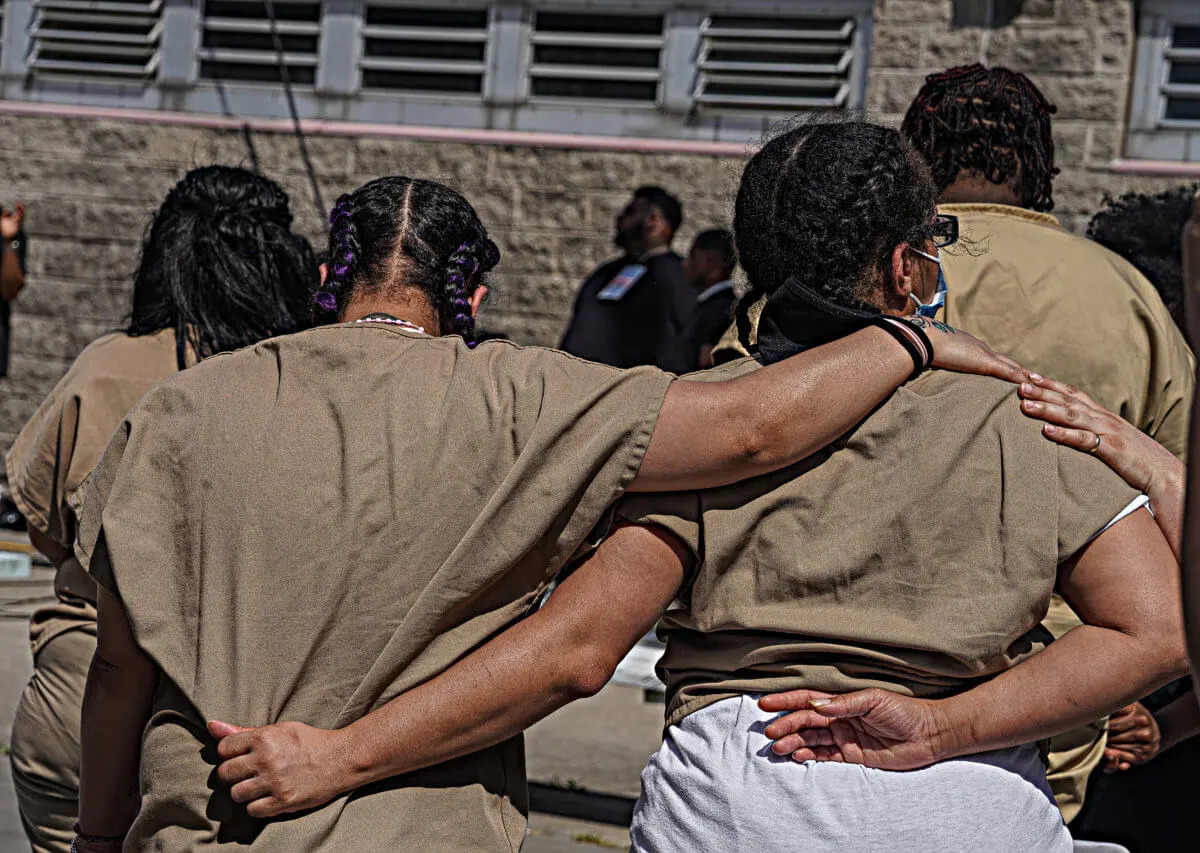
Members of the New York City Council’s Committee on Criminal Justice spent Monday morning touring Rikers Island to get a first-hand look at the conditions in the infamous and ill-fated corrections facility.
Led by committee chair Council Member Selvena N. Brooks-Powers (D-Queens) and joined by Council Members Gale Brewer and Yusef Salaam (both D-Manhattan), the trio of city lawmakers met with individuals in custody at the jail in hopes of gleaning some insight into the issues facing people held on Rikers and informing future committee agendas.
“I believe transparency and dignity must be at the center of our work,” said Brooks-Powers. “Though ultimately our goal is to see Riker’s Island close permanently, this visit was an important step in understanding current conditions firsthand so we can pursue meaningful, informed reforms that benefit both those housed and working on the Island.”
The visit marked Brooks-Powers’ first visit since taking the helm of the Committee on Criminal Justice. She told amNewYork that taking on criminal justice was a responsibility that required careful consideration and compassion about an issue that can often be divisive.
“ It’s heavy work because you’re talking about public safety and it’s not a clear path with any of these aspects when we talk about criminal justice,” Brooks-Powers said. “It’s so nuanced, and, as we continue the conversation to close Rikers and transition to the borough based jails, we want to make sure that we are keeping those in custody as well as those who are working behind the walls and returning to community—making sure that they’re safe and they have dignity— but at the same time ensuring that we have safety.”
The trio paid special attention to an often overlooked population at Rikers: mothers and soon-to-be mothers. They visited the Rose M. Singer Center, or “Rosies” as it is sometimes called. Brooks-Powers told amNewYork that when she spoke with one woman who was pregnant, she was told that the staff at Rikers was giving her regular prenatal care.
The newest chair of the Committee on Criminal Justice told amNewYork that she was concerned that pregnant women were housed in across the jail, and that she made a plea to the corrections department to move women who were pregnant into the nursery, for their own safety and for the safety of their children.
“Whatever their situation is, that is where they are, but the fact remains that the baby that they’re carrying is not an extension of the sentencing,” Brooks-Powers said. “The baby should be properly cared for. They should get the proper care that they would get anywhere else.”
Brewer echoed the sentiment.
“We spoke directly with the women at the Rose M. Singer Center, young men, and detainees with severe mental illness,” Brewer said in a statement. “It is clear that decisions affecting pregnant people in custody require close attention and follow-through. Oversight means showing up, asking questions, and making sure conditions improve now and not later.”
The abysmal conditions on Rikers Island have been on full display for over a decade after a class action lawsuit landed the city’s jail under a federal monitor. Since then, the city’s jail has consistently seen reports of rampant violence, deplorable conditions, in-custody deaths and hundreds of sexual abuse allegations.
It eventually led to Rikers Island falling into full federal receivership, with a court-ordered caretaker responsible for implementing mandated reforms at the facility in the years ahead.
Lauren Stephens-Davidowitz, a staff attorney with the Prisoners’ Rights Project at The Legal Aid Society, told amNewYork that some of the sanitation conditions at Rikers Island are especially disturbing.
“ We very often hear from clients about showers that are covered in mold and mildew,” Stephens-Davidowitz said. “Recently we’ve heard several reports about rat infestations in people’s housing areas in addition to mice and roaches and it’s these are conditions that are completely unacceptable and not only do they violate court orders, but they also violate the moral and ethical obligation of the city to provide habitable spaces for the people in its custody.”
Stephens-Davidowitz said that it was important for city officials to see these conditions in person because they represent the city’s priorities.
“ These conditions are representative of our city, and what they show is that our city does not treat people in custody with dignity and basic respect,” Stephens-Davidowitz said. “Yes, people are in jail, but of course they are still entitled to live with basic sanitation and right now they’re not being provided with that.”
