

Ricardo Arauz-Cedeno, an immigrant from Ecuador, drove from his home on Long Island to pick up his girlfriend in East Elmhurst last summer when his car was surrounded by armed men outside her workplace, according to his attorney.
The men turned out to be federal immigration enforcement agents, said Arauz-Cedeno’s attorney, Nuala O’Doherty-Naranjo. The agents shattered Arauz-Cedeno’s car window, took him into custody, and eventually put him into deportation proceedings, the attorney said.
It wasn’t clear how the federal agents located her client, who has no official connection to the girlfriend’s workplace, but O’Doherty-Naranjo, a former Manhattan district attorney, says she strongly suspects the federal agents used digital license plate-tracking technology – as has been the case by federal authorities in jurisdictions across the country.
“ It’s really amazing how far immigration will go to track down people living here,” she said.
A Department of Homeland Security spokesperson declined to comment on what tools it used to take Arauz-Cedeno, who has a pending asylum application, into custody. State lawmakers, however, are considering joining more than a dozen states considering legislation to tighten restrictions on tracking by Automatic License Plate Readers or ALPRs.
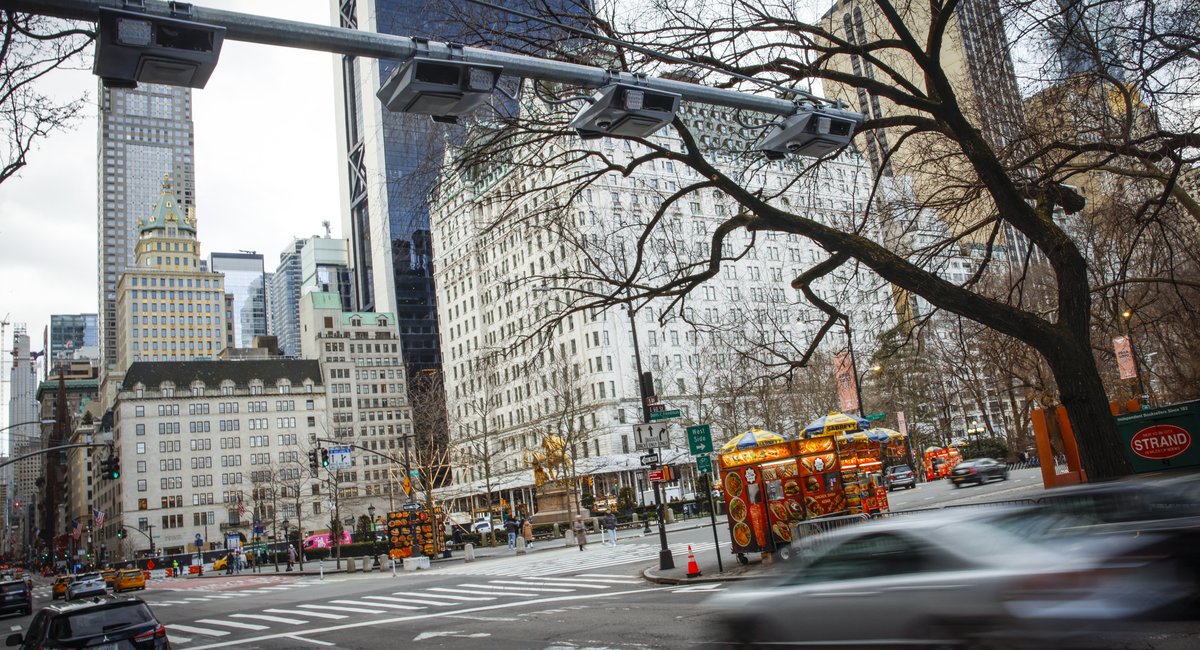
The technology, sometimes seen mounted on the backs of police cruisers or mounted to utility poles, has long been used by state and local authorities for identifying everything from drivers suspected of evading tolls to vehicles used in crimes. Immigration officers also contract with private companies to access such data.
A pending bill would severely restrict the sharing of information obtained by ALPRs, making it harder for federal agencies to track individuals. ICE would first have to secure a warrant from a federal judge establishing probable cause for gaining access to the information. The state measure would also require that any data collected by the devices be erased after 48 hours.
The bill arises as New York state officials debate law changes that would narrow the role of local and state law enforcement in assisting federal authorities in immigration enforcement.
The effort is spurred in part by concern over how the Trump administration has conducted stepped-up immigration enforcement in Los Angeles, Chicago, Minneapolis and other jurisdictions.
But the bill’s proponents said in interviews that the bill also aims to address privacy concerns stemming from the government’s use of technology to monitor other activities, including, for example, those who attend political protests or women who cross state lines to obtain an abortion, which have been severely restricted in some states beyond New York.
Pamela J. Hunter, an assembly member from Syracuse who sponsored the ALPR bill, said the concerns cut across communities and political divides due to the far-reaching implications of the ALPR technology.
The legislation comes on the heels of local efforts in several municipalities across the state to ban contracts with the manufacturers of the technology, as well as what civil libertarians said is a wider national reckoning with surveillance technology.
“ It [the ALPRs] could be collecting information that you’re in a sensitive location,” said Hunter. “Maybe you’re parked at a doctor’s office, a health clinic, addiction counseling meeting or maybe at a political protest.”
More than a dozen states have considered similar measures in the last year, according to the nonprofit news publication Stateline, including such “red” states as Arkansas and Idaho.
“We see both left- and right-leaning activists and legislators working to place limits on mass ALPR surveillance, often cooperating on commonsense reforms,” said Michael Soyfer, an attorney with the conservative Arlington, Va.-based Institute for Justice. “Across the country, many places have either reformed their ALPR surveillance programs or ended them altogether.”
DHS would not acknowledge whether it uses information obtained from ALPRs in New York, saying in a statement that it would neither confirm nor deny specific law enforcement methods. The department said that under President Donald Trump, it used all lawful tools at its disposal to remove “criminal illegal aliens” from the United States.
The NYPD did not respond to questions about the legislation.
Several municipalities across the state have canceled ALPR contracts with Flock Safety, one of the nation’s leading providers of the technology, including Syracuse, Ithaca and Scarsdale, according to the New York Civil Liberties Union.
Holly Beilin, a spokesperson for the Atlanta-based Flock, said the company currently has 12,000 public and private clients and operates in 6,000 communities across the country, in all but one state.
This includes 120 law enforcement “customers” across New York, but not the NYPD, she said. Even as the company has lost several municipal contracts, it has been adding new ones, she said, including with Utica and Hempstead Village.
Beilin said the company’s license plate readers have helped solve homicides, kidnappings and trafficking cases, including human and drug trafficking cases. Earlier this month, she said, ALPR data helped solve a burglary and home invasion case in Stephentown, near Albany.
Beilin said the company does not have a contract with DHS or any of its sub-agencies, including ICE, and said the concerns expressed about the technology largely revolved around the “ a much larger national conversation you’re seeing play out right now.”
“There’s a lot of questions around things like immigration enforcement,” Beilin said. “Regulation actually is really helpful in coming in and allaying some of those concerns.”
Daniel Schwarz, the senior privacy and technology strategist at the New York Civil Liberties Union, said much remains unknown about the information captured locally by ALPRs and the extent to which it’s shared with federal agencies.
But Schwarz said there are “numerous, maybe thousands of license plate readers across the city.” Some readers are operated by private entities while others are operated by the NYPD and the Department of Transportation, for the city’s congestion pricing system.
Jerome Greco, the director of the Digital Forensics Unit at the Legal Aid Society, said the New York legislation “ significantly” regulates and limits the use of automated license plate readers by the government.
Currently, he said, the NYPD retains information captured by the devices for five years, which would be reduced to just two days under the legislation.
“The general public has grown extremely tired of the fact that every single thing they do, within their own homes, outside of their homes, is being collected and cataloged and cross-referenced to potentially be used against them at some point,” Greco said.
Meanwhile, Ricardo Arauz-Cedeno, the Ecuadorean immigrant who was arrested by immigration agents in East Elmhurst last summer, remains in federal detention in New Mexico, said O’Doherty-Naranjo.
Although her client is originally from Ecuador, the attorney said he is scheduled to be deported to Honduras. His example should serve as a wake-up call for immigrants, she said, as well as other New Yorkers.
“ New York City has this great idea of open data and sharing data,” she said. “Unfortunately, we now have a federal government that might use that against immigrants.”
