

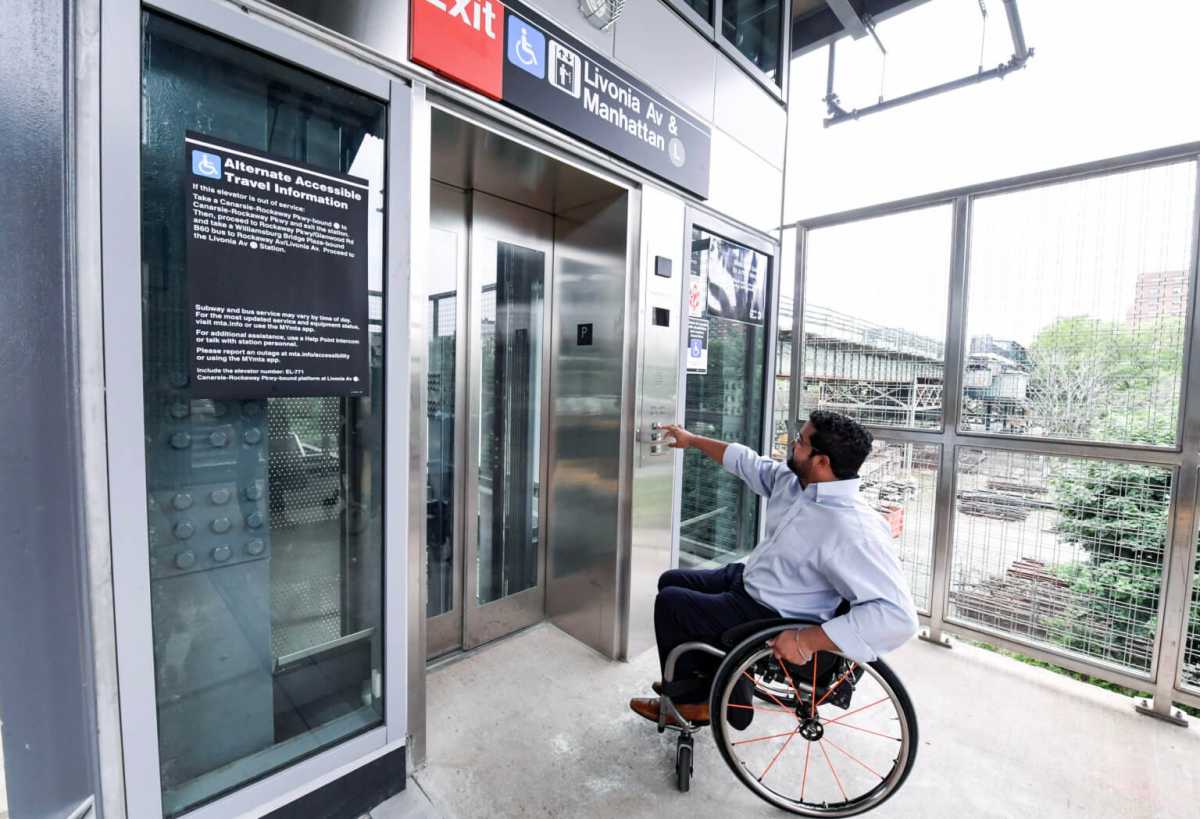
Access-a-Ride service is provided for the nearly 1 million New Yorkers with disabilities who are shut out of much of the subway system for lack of accessibility.
Marc A. Hermann / MTA
It’s our job at the MTA to figure out how to fast-track accessibility projects so that more people can take advantage of our amazing subway system. Public-private partnerships (P3s) are quickly becoming one of our best tools.
The latest example is our new public-private partnership with Columbia University, which will deliver three new elevators – and a ton of other upgrades – at the 125 St 1 station. The MTA will manage design and construction, while Columbia is kicking in $33 million towards the total cost.
Columbia needed to widen the west-side escalators to accommodate the demand from its new Manhattanville campus. The MTA needed to make the station accessible and fix the aging 121-year-old structure. There’s now one unified plan to deliver improvements more efficiently and at lower cost than if they were treated as two separate projects. This is how you deliver better, faster, and cheaper.
It’s a win-win: the MTA saves money that can be put towards other game-changing projects while making it easier for students, faculty and residents to move through the neighborhood.
We know this project delivery model works. This month, we opened a new elevator at the already-accessible 59 St-Columbus Circle station that was not only paid for but built by the developer Global Holdings. The addition of this elevator to the station helps guarantee that riders at one of our busiest transit hubs have around-the-clock access to service.
But we’re not relying solely on third parties to get things done. MTA Construction & Development has never been busier, recently knocking out elevator and escalator replacements at stations spanning two boroughs and 11 subway lines.
Since 2020, C&D has made 57 stations accessible across the MTA system — more in the last five years than in the previous 10 combined — and construction is already underway at another 40 stations. The 2025-2029 Capital Plan includes at least another 60 subway stations and six railroad stations, plus 45 elevator replacements.
By the time we’re done, we’ll be looking at 272 fully accessible stations systemwide. That more than doubles what existed in 2019 and means nearly 70% of all subway rides will take place to or from accessible stations.
These aren’t just numbers. Every project has a real impact on customers’ lives. We know because we’ve been there — as a person with mobility needs (Quemuel) and as a parent who spent years carrying strollers up and down subway stairs (Jamie). None of us should be left stranded by transit. Using every tool at our disposal, we’re working hard to make sure everybody can get on board.
Mr. Arroyo is the MTA’s first-ever Chief Accessibility Officer and Mr. Torres-Springer is the president of MTA Construction & Development.
