

“In The Heights,” my 5-year-old’s favorite movie about New York City, which I’ve now seen 30 times, opens with dual crises: It’s hot as hell outside, and the fridge where the bodega keeps its milk and half-and-half is broken.
This means that Usnavi, our hero, has to quickly find a way for his customers to cut the sludgy intensity of the piping hot cups of coffee they’re about to order.
It’s not that cold, refreshing beverages don’t exist in the world of “In The Heights.” (Another crisis in the film is that the piragua guy is getting squeezed.) It’s just a given that, even on a summer day that’ll end with a blackout, coffee is still served hot.
Or, it was!
When Lin-Manuel Miranda wrote the story — the Broadway show opened in 2008 — iced coffee had yet to take over the city.
Cold drinks now make up about 75% of Starbucks’ sales. There are lines outside the iced matcha mecca, Blank Street. The Mormon soda wave is encroaching. And even our mayor — who has some predilection for old-school flair, if partly to assure his skeptics he’s not turning the city into a Soviet skatepark — takes his coffee cold.
At this point, I wonder, what are the hot coffee year-rounders, myself included, clinging to? And I’m not talking about the single-origin pour-over variety that tastes like blueberries, which is gross. I’m talking about the stuff I like: plain, medium-roast coffee with a little cream and sugar, which doesn’t taste amazing, either. Why do we drink this, especially in the heat?
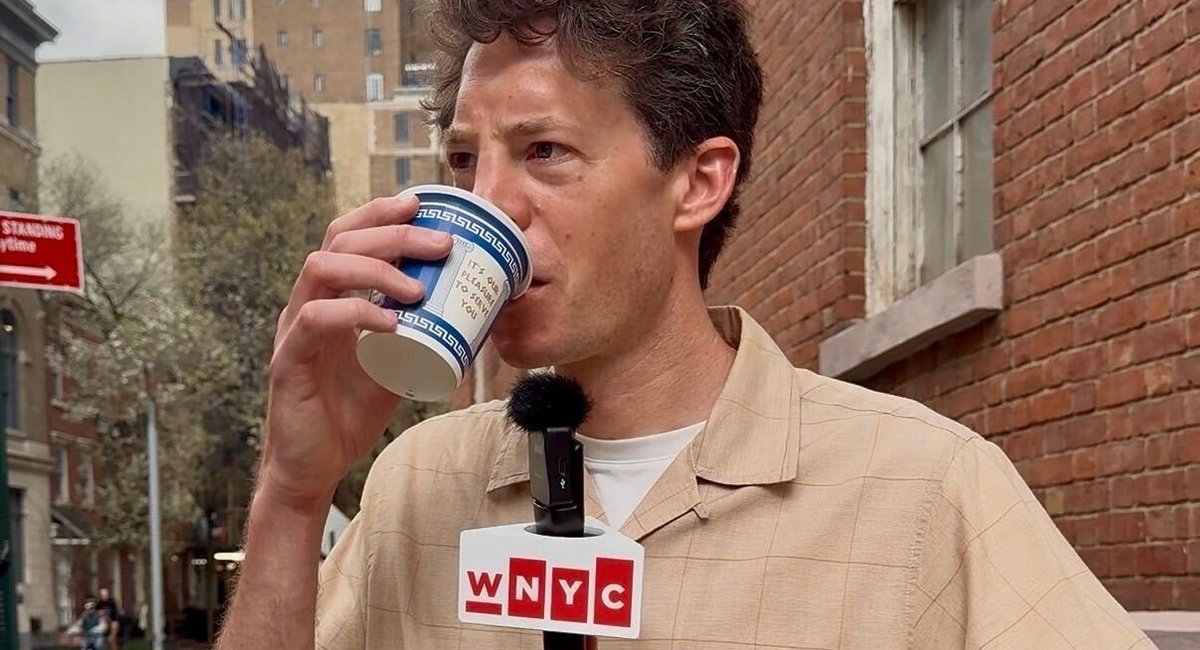
We set out on a recent sultry afternoon in Manhattan to see who, if anyone, was caffeinating with a hot beverage.
Dorian Solis, an Upper West Sider who was drinking a black cup of Dunkin’ while wearing a thick sweater (“I’m sweating,” she conceded), said she can’t break the routine.
“I tried drinking cold coffee, I always wanted to learn,” she told us. “Nah, hot coffee all the way.”
Evan Dominguez said hot coffee was just more pragmatic — he used to drink it iced until prices went up and he found himself paying a small fortune for a cup of frozen water.
“Every time I used to order an iced coffee, I’d have to say, ‘Can you please not put any ice,’” he said. “And at that point, you should just get a hot coffee.”
For some, the hot coffee is part of a ritual. We met artist Joseph A. Kaminski as he savored one of his three daily cups, which he always pairs with a cigarette. (“It’s really a combo!”)
One detail that sort of surprised me: Nobody we met said anything nostalgic about diners or automats or anything along the lines of, “real New Yorkers drink it hot and black.”
Katie Rodriguez said as far as she’s concerned, New York City is an iced coffee town.
“This is going to sound a little snobbish, but [hot coffee] feels maybe more European?” she said. (Other fond shout-outs we heard: Albanian coffee and the Costa Rican cafecito.)
For a clear-eyed take on the state of the year-round hot coffee, we met up with Jonathan Rubinstein, who founded the local chain Joe Coffee back in 2003, to ask what’s selling.
He said the hot cup of coffee is still No. 1 — followed by the iced latte. But overall, 70% of their orders are cold beverages, including seasonal novelties that don’t contain any coffee.
“Because it’s the business to stay up in terms of trends and what’s relevant, I don’t feel emotional about the change,” he said. “For my 17-year-old daughter, it’s 100% about walking into school with the iced matcha … that’s a status symbol.”
Before we left, I decided to try what he was having: a strawberry iced matcha. It tasted like a Chupa Chup, which is to say, objectively delicious. But — and maybe this is going to sound a little snobbish — I would just never order it. Hot coffee all the way.
Emily Nadal contributed to this story.
