
There was a time in New York when lunch meant something. Not a protein bar between calls or a salad at your desk, but a real break; you stepped outside, reset, and marked the day in halves. Now, that hour is disappearing.
Photo via Zoom Communications
There was a time in New York when lunch meant something. Not a protein bar between calls or a salad at your desk, but a real break; you stepped outside, reset, and marked the day in halves.
Now, that hour is disappearing.
A new national study conducted by Morning Consult for Zoom Video Communications finds 75% of knowledge workers eat lunch while working. Sixty percent shorten it to fit between meetings, and more than a third skip it entirely at least once a week.
The shift isn’t just about workload. It’s cultural.
Working through lunch has become routine for 63% of employees. In New York, where office life is rebounding and daily rhythms are returning, the midday pause hasn’t kept up. While 43% of workers say they step away from their desks a few times a week, nearly 40% still skip lunch at least once weekly.
Even for those who want a break, the setup often isn’t there. More than half say they don’t have a comfortable place to eat away from their workspace.
And despite office buildings offering more perks; free drinks, snack bars, even beer taps; what many workers say they still lack is something simpler: time. Time to run errands, meet a friend or family member, or step out for a haircut, a manicure, or a quick yoga class or shoe shine.
Research continues to show that real breaks, especially at lunch, improve productivity, performance, and mental health. But as calendars fill and expectations shift, that time has become harder to access even as workplaces offer more reasons to stay inside them.
“We see the same volume, but not the same behavior,” said a supervisor at Ole & Steen near Bryant Park. “People already know what they want before they walk in. They’re ordering, grabbing, and heading right back to their desks. The sit-down lunch crowd just isn’t as consistent.”
“I try to step out, even if it’s just to walk around the block,” said Marissa Delgado, a communications manager working near Madison Avenue. “But you’re still on your phone the whole time. It’s not really a break if you’re answering emails between bites.”
“Lunch used to be when we’d actually leave the office together,” said Andrew Feldman, a financial analyst near Wall Street. “Now everyone’s on a different schedule, or they’re just eating at their desks. It’s harder to justify taking a full hour.”
City officials say demand for space to step away is growing alongside foot traffic.
“As demand for pedestrian space increases, we are responding by expanding opportunities that prioritize pedestrians,” a spokesperson for the New York City Department of Transportation said, as officials push to add more pedestrian-focused areas across busy corridors.
Researchers are also taking a closer look at how New Yorkers move through the city. A 2026 project from Massachusetts Institute of Technology mapped pedestrian activity in detail, underscoring how central foot traffic remains to daily life.
“Places like Times Square and Herald Square may have numerous crashes, but they have very high pedestrian volumes,” said researcher Rounaq Basu.
Lunch is increasingly squeezed out by meetings, screens, and what workers describe as “camera culture.” Nearly three in four say they would rather skip lunch than eat on camera during a meeting.
The result is a workday with no clear midpoint.
That’s the gap Zoom Video Communications tried to highlight with its Midtown pop-up, the “Hard Stop Burger Shop,” where workers were encouraged in March to block their calendars and take a real break.

The concept was simple: a set time, a physical space, and a reason to log off.
Kenan Thompson made an appearance as workers stepped away from their desks — some reluctantly to eat, talk, and disconnect.
The effort ties into the company’s push around its AI Companion tools, designed to reduce time spent on routine tasks like meeting summaries and follow-ups.
According to the survey, 76% of workers using AI tools say they save at least 30 minutes a day, and 80% say they would use that time for a real break.
That reclaimed time is becoming part of a broader shift in how the workday is structured.
Zoom is betting that making that tradeoff visible in real time, in real space, can start to change behavior.
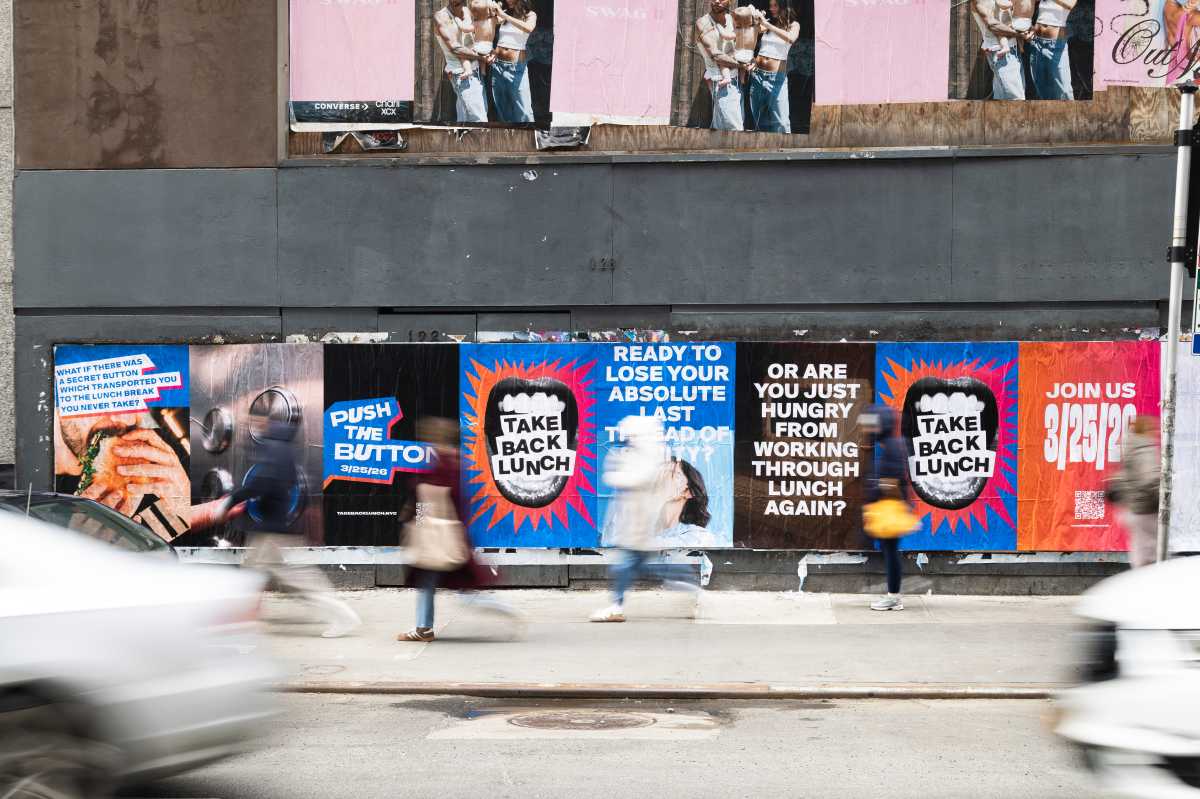
The company has also launched a campaign encouraging workers to collectively “take back” one million lunch breaks.
It’s a small idea with broader implications.
In a city built on routines, coffee runs, corner delis, midday walks, losing lunch means losing more than a meal. It means losing the natural pause that breaks the day in two.
For years, skipping lunch has been framed as productivity. Now, more workers are starting to question that assumption.
Taking back an hour in the middle of the day may be the simplest place to start.
