

Most Americans believe criminal prosecutions are built on evidence gathered by investigators and tested in court.
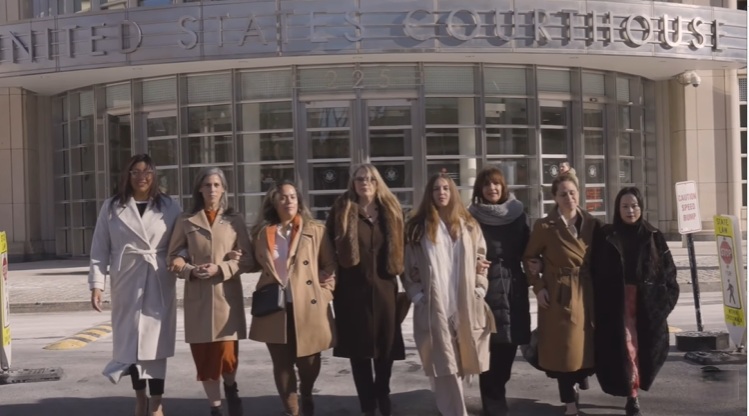
In the case of Nicole Daedone and Rachel Cherwitz, the leaders of the sexual wellness group OneTaste, the narrative that led to their prosecution in the Eastern District of New York on forced labor charges began somewhere else entirely, a highly questionable Netflix documentary, whose editors were more interested in sensationalization than accuracy.
Editors of the film used what is known in the industry as “frankenbiting,” splicing together pieces of Daedone’s interviews to create statements she never actually made in that form. Anyone who has watched enough reality television knows how easily editing can change meaning. This is especially dangerous with its widespread misuse of artificial intelligence techniques that can create uncertainty.
What should alarm every American is that this media narrative did not stay on Netflix. It entered a federal courtroom.
At trial, prosecutors showed the jury a short fragment of Daedone’s words, carefully selected and stripped of the surrounding context that would have clarified what she meant. The jury saw only the portion that supported the government’s theory. They never saw the rest. The judge didn’t allow it.
Evidence used to obtain the indictment was drawn from the same documentary. When serious questions emerged about its accuracy, including journal entries prosecutors had claimed were written in 2015 but were actually created years later for the film, the government quietly abandoned that evidence rather than defend it.
Even more troubling, an FBI agent involved in the criminal investigation appeared in the documentary itself. When the defense sought to subpoena Netflix to explore the relationship between filmmakers and investigators, Netflix joined federal prosecutors in court to block the effort.
That is not how the justice system is supposed to work. But even this troubling story about media narratives and criminal prosecutions is not the most disturbing part of the case. The more dangerous problem is the charge itself.
Nicole Daedone and Rachel Cherwitz were not convicted of sex trafficking. They were not convicted of human trafficking. They were convicted of conspiracy to commit “forced labor.”
Traditionally, that anti-slavery law is used in cases involving physical coercion: workers locked in factories, immigrants threatened with violence, people forced to labor under conditions resembling slavery. None of that existed here.
There were no chains, no locked doors, no beatings, and no threats of violence. The government acknowledged that.
Instead, prosecutors advanced a startling theory: that people in the OneTaste community felt pressure to remain because they valued their friendships, their jobs, and their belief system. According to the government, the fear of losing those things could qualify as “serious harm.” The reality is that these are common in many types of lawful and constitutionally protected relationships.
If that theory is allowed to stand, it would place countless organizations at risk.
Any community built on strong commitment could suddenly be characterized as coercive. Religious groups, spiritual movements, intensive educational programs, and even some workplaces ask members to devote extraordinary time and loyalty. Leaving such environments can mean losing friends, identity, and purpose. But that has never been a crime.
Yet under the legal theory used in this case, it could become one.
Throughout my career, I have defended the rights of individuals and communities whose practices have been misunderstood or disfavored by outsiders. The First Amendment protects the freedom to form communities based on shared beliefs and commitments, even when those communities are regarded as unconventional.
When prosecutors redefine social pressure and emotional commitment as “forced labor,” they are creating a legal weapon that could eventually be used against almost any unpopular group.
Daedone and Cherwitz ran an organization that many participants say helped them heal trauma and depression. The jury never heard expert testimony about the science underlying those practices; the court excluded it.
Instead, the jury heard a narrative shaped by a documentary, reinforced by selective evidence, and supported by a legal theory that stretches a law designed to fight slavery–like abuse into something entirely different.
These women now face sentences of up to 20 years in federal prison. Their case should concern every American.
Not because of what one might think about OneTaste, but because of what it reveals about the current justice system: a media narrative can help launch a prosecution, key evidence can disappear when challenged, and laws written to stop genuine exploitation can be stretched far beyond their intended purpose.
Ronald Sullivan is a professor at Harvard Law School and a nationally recognized criminal defense attorney. He teaches and writes on criminal law and constitutional protections, with a focus on due process and the rights of the accused. He was not part of the legal team in the OneTaste case.
