

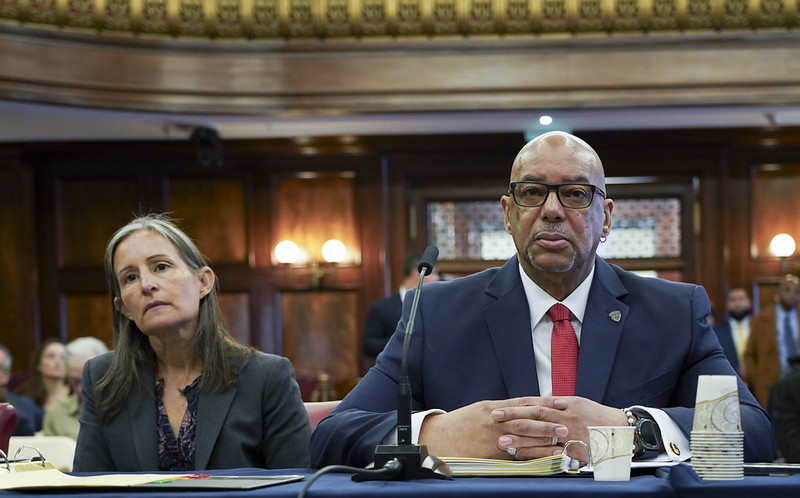
Department of Correction Commissioner Stanley Richards at the agency’s Tuesday City Council budget hearing.
Gerardo Romo / NYC Council Media Unit.
Touting a $1.4 billion plan to fill 1,300 empty positions and pay staff overtime, Department of Correction Commissioner Stanley Richards said improving jail safety requires more resources at a City Council budget hearing on Tuesday. Jail reform advocates said that’s the wrong path for the agency to take.
That’s because the agency is poised to significantly downsize when Rikers Island closes and the department moves to a borough-based jail system, a shift likely to take place in the early or mid-2030s, advocates say. Estimates show the new jails — which will incarcerate just about half of the current population on Rikers — will require only 3,240 officers, about a third of the agency’s total allowance and roughly half of its current headcount of about 7,200.
“This massive staffing increase would move DOC in the wrong direction,” said Ben Heller, a program manager at the Vera Institute of Justice. “Now is the time for DOC to deploy staff more efficiently and effectively, not hire more.”
Instead, advocates say, the roughly $174 million needed to bring the agency to its total authorized headcount of 8,811 — and the tens of millions in recruitment and overtime spending the department uses each year — should be used to fund alternatives to incarceration, community safety programs, efforts to move cases through the court system faster and reentry support. Those measures, Heller said, will in turn decrease the jail population and the need for officers and overtime.
Richards told council members more staff and overtime were critical for jail safety and operation, especially as the jail’s population continues to rise year after year.
“Despite what people may say, DOC is not operating with excess staff. We are managing an increasing population through growing staff attribution,” Richards said. “When we support staff, we improve safety. When we improve safety, we can focus on rehabilitative programs.”

Heller, however, told amNewYork Law the federal monitor overseeing Rikers has reported that staffing issues stem from mismanagement rather than a lack of personnel, noting DOC already employs more than triple the number of corrections officers per incarcerated person compared to the national average.
Richards emphasized his and the Mamdani administration’s commitment to closing Rikers as quickly as possible, repeating his desire for a “people first” approach to incarceration throughout the hearing. He acknowledged that programs that support people after being released from prison can decrease the jail population.
“We have a system that for far too long has isolated, demonized and traumatized everyone involved,” he told council members. “When people leave our system and end up in the shelter and end up on the street, they tend to end up back in our system. We need to make the appropriate systems to make sure people have a place to land.”
Richards said he and the mayor had spoken about the large-scale nature of the borough-based jail shift and were aligned on its necessity.
“This isn’t a DOC issue. This is an NYC issue,” Richards said. “Mamdani says his strategy is to use all of government. It is going to take all of government to make this transition.”
The Board of Correction and advocates also made the case that funds should be reallocated to the DOC’s oversight panel.
Jasmine Georges-Yilla, the board’s executive director, requested a $2.8 million increase to its proposed budget of about $4 million, citing increased oversight needs as the borough-based jail transition moves forward and more personnel, operational support and modern technological infrastructure.
“The board’s work is critical to ensuring transparency, accountability and humane conditions at the city’s jails, yet our ability to meet this mandate is sharply limited by our current funding,” Georges-Yilla said. “A budget of $6.8 million would allow the board to expand its reach and provide effective oversight during a period of significant change in the jail system.”
Mamdani’s office did not respond to a request for comment from amNewYork Law on whether it would grant the board’s budget increase request.
City Council will send budget recommendations to City Hall in the coming weeks, after hearing testimony from all department heads. The mayor will send an updated budget proposal back to the council by late April.
