

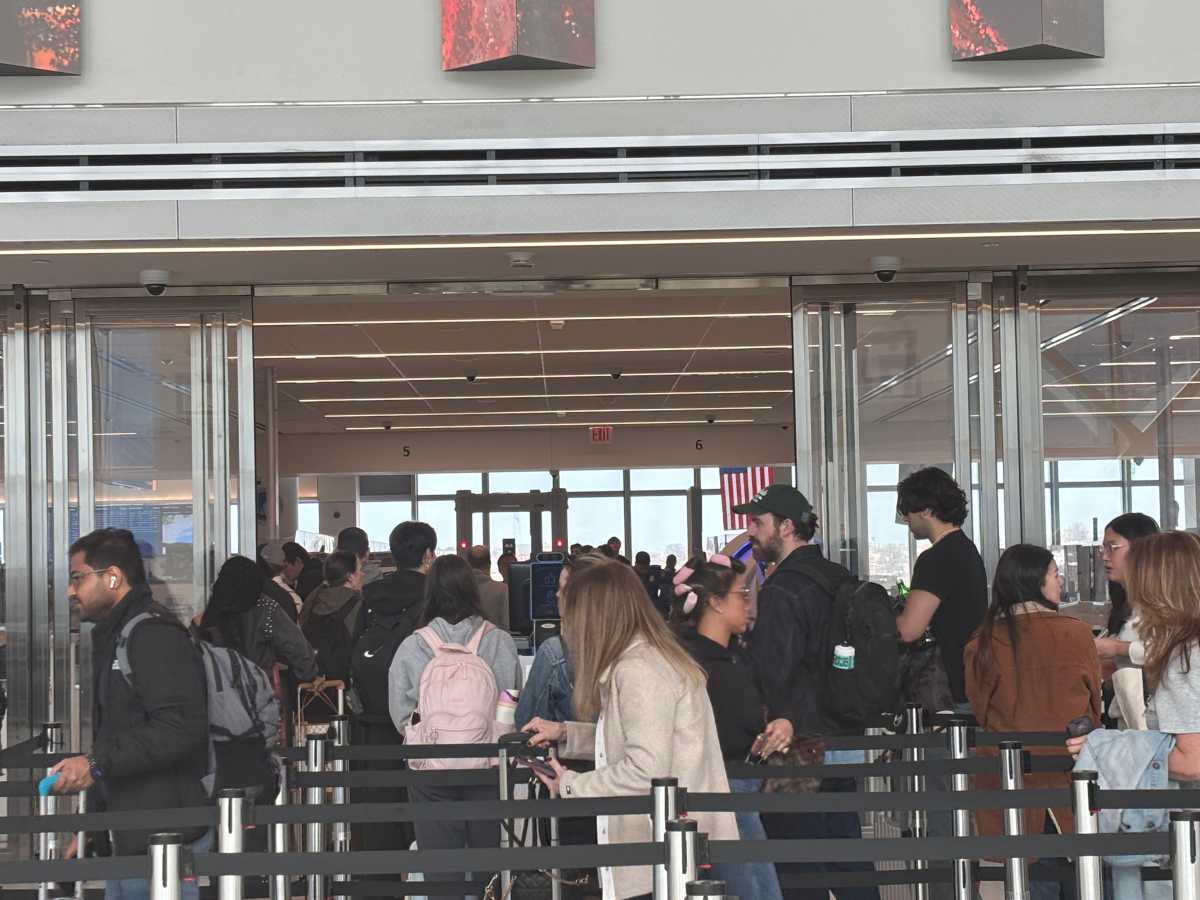
Travelers at New York City airports have been running into long waits at stalled Transportation Security Administration (TSA) screening lines, with fewer workers during peak travel times, while at other times moving through more quickly during lulls.
The TSA said that amid a government funding gridlock — leaving TSA and Customs workers unpaid until their budget is passed — as many as 10% of workers called in sick, up from a typical 2%.
Crowds at LaGuardia Airport on Friday filled terminals, with waits of more than an hour, before subsiding. John F. Kennedy International Airport also saw long waits at certain peak travel times.
“Due to the federal funding lapse, security wait times may be longer during certain periods,” airport websites warned. “Conditions can change quickly based on passenger volumes and staffing, so please allow significantly more time.”
Social media was filled with images of crowded airports as passengers waited to be processed, before lines lessened. An Instagram post set to Frank Sinatra’s “New York, New York” showed hundreds of people milling about at LaGuardia waiting to go through security.
“You missed the big crunch around 12:40,” one airport worker said at LaGuardia during an afternoon lull.
Many tourists monitored wait times at airport websites before deciding when to travel.
“We noticed that earlier today, it said the lines were longer. That’s why we changed our plans,” said Bill Guidice, a Florida resident who arrived two and a half hours early for his flight home. “We’ve been watching the lines at the airport. I’ve noticed that the line fluctuates based on the time of day.”
Fewer TSA workers doing the job without pay
Formed in the wake of 9/11, the TSA is the first line of defense at the nation’s airports, responsible for screening passengers and their bags to guard against potential acts of terrorism.
Port Authority spokesperson Amanda Kwan said shutdowns “of federal agencies do not directly impact the Port Authority’s ability to operate our airport terminals,” but do impact the “federal workforce our airports rely on every day, including TSA and CBP (Customs and Border Protection).”
“Over the last several days we’ve begun to see that translate into long wait times at security checkpoints during certain periods,” Kwan said, “depending on passenger volumes, TSA shift changes and staff breaks, and the number of TSA staff who come to work for each shift.”
Ha Nguyen McNeill, a senior official performing the duties of TSA administrator, told Congress the agency screened 906.7 million passengers in 2025, along with 480 million checked bags and 2.1 billion carry-on bags — continuing to screen around 3 million passengers on peak days even during shutdowns.
“Around 95% of TSA employees are deemed essential and must continue working and protecting the traveling public during a shutdown, while not getting paid,” McNeill said. About 61,000 workers operate across more than 430 commercial airports nationwide, though more are calling in sick amid delays in payment.
“Higher call-outs can result in longer wait times at checkpoints, leading to missed or delayed flights,” McNeill added, “which has a cascading negative impact on the American economy.”
The agency hasn’t fully recovered from a previous 43-day government shutdown, during which many workers faced late fees, eviction notices, and lost childcare arrangements. Since then, 1,110 Transportation Security Officers left the TSA in October and November 2025, up more than 25% from the same period in 2024, due to “uncertainty, stress, missed paychecks, and financial hardships.”
“Some are just now recovering from the financial impact of the 43-day shutdown,” McNeill said, “while many are still reeling from it.”
Kwan said the Port Authority “deployed additional customer care staff into terminals to help manage queues, assist passengers, and keep people moving as efficiently as possible,” and advised travelers to check airport websites and airline apps before heading out. She also pointed to tools like TSA PreCheck and TSA’s touchless ID as ways to speed up screening.
“We are grateful to our federal employees who continue working during this challenging time,” Kwan said. “We thank those who work each day without a paycheck, helping to keep our airports running.”
Political standoff contributes to TSA woes
Many travelers expressed sympathy.
“I think it’s just everybody’s working for free right now,” said Ron Pink, a tourist from North Dakota transferring from JFK to LaGuardia after a trip to Rome. “They’re going to get paid in the future, but right now they still got to feed their families.”
Pink placed blame on both parties. “I think the people that are making the voting decision should not be getting paid no matter what side of the aisle,” he said. “They’re holding America hostage.”
The political standoff has centered on competing funding priorities.
Senate Democratic Leader Chuck Schumer said Democrats have repeatedly introduced bills to fund the TSA separately from ICE, the agency responsible for a brutal immigration crackdown across America.
“America will see the matter crystal clear,” Schumer said. “Which senators want to open up TSA, pay TSA workers, and end the chaos at our airports, and which senators are going to block TSA funding yet again.”
Republicans have pushed to approve funding for ICE alongside TSA, while Senate Majority Leader John Thune has said, “This needs to be fixed.”
New York’s junior Senator Kirsten Gillibrand called the repeated refusals to fund TSA separately “sheer dysfunction with unnecessary delays at our airports, placing added stress on travelers and undermining the very security systems that Americans rely on every day.”
“We should be working together to support these workers and keep our country moving safely,” she said, “not playing political games at their expense.”
Meanwhile, the chaos has had at least one unintended consequence: a surge in TSA PreCheck enrollment.
“Ever since the whole shutdown came in, especially with the high amount of videos on TikTok and other social media sites of those lines going out everywhere, people have been coming in to try to get TSA PreCheck in hopes of getting on the shorter of the two lines,” said one employee at a kiosk at an office supply store. “A lot of people have been coming in either making appointments or just kind of walking in and hoping for the best.”
