

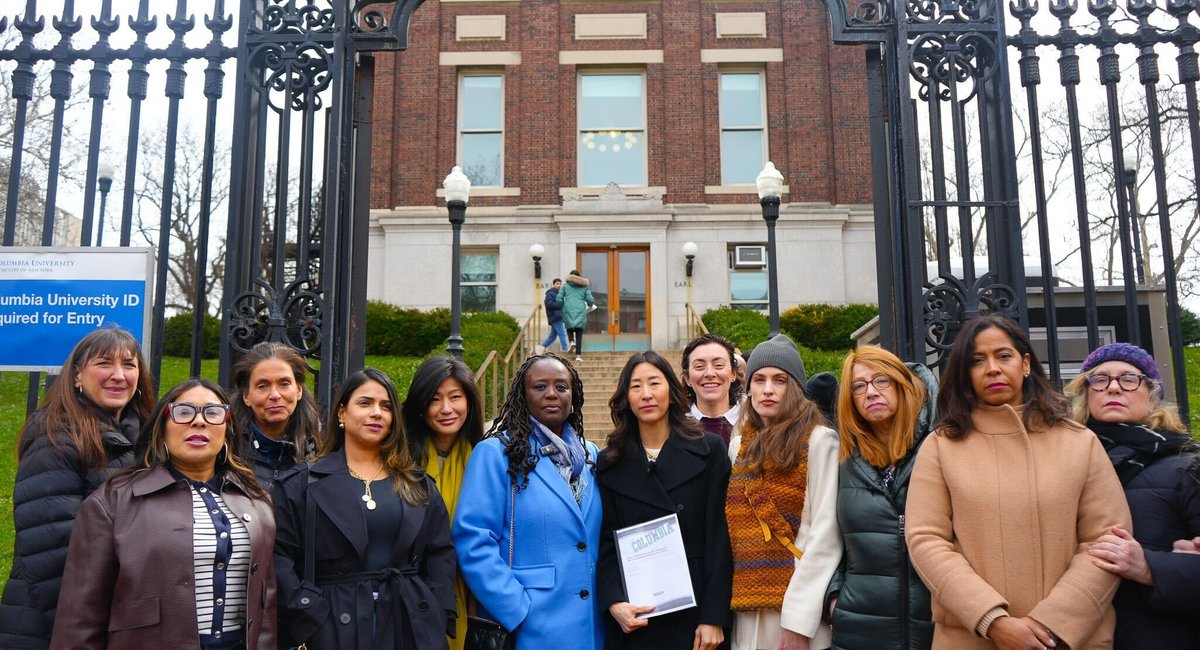
Survivors of convicted gynecologist Robert Hadden fought for years to get prosecutors to take their allegations against him seriously, and for Columbia University and NewYork-Presbyterian Hospital to reform the institutional failings that protected him.
It’s now more than 14 years after survivors began to speak out, and Hadden is finally behind bars. But some of the women who endured his assaults say Columbia and NewYork-Presbyterian Hospital are far from demonstrating accountability — or reforming the practices that allowed his crimes to flourish.
A report commissioned by Columbia and NewYork-Presbyterian, meant to examine those institutional failings, was released this week. Survivors say it comes too late, falls woefully short of reform, and fails to acknowledge Columbia’s years-long quest to deny survivors’ justice.
“There were something like eight or nine law firms that have fought against us on their behalf over the years,” said Marissa Hoechstetter, who was among the first to publicly accuse Hadden. “There were very intentional choices to try to bury, mislead and discredit the story and us as survivors, and this report does nothing to address any of those choices.”
Columbia and NewYork-Presbyterian have settled claims by 1,000 women for about $1 billion so far. The report this week comes just days after the state Attorney General’s Office acknowledged it started its own investigation into Columbia’s handling of allegations against Hadden.
Hadden pleaded guilty in state court in 2016 to abusing two women, but under former Manhattan District Attorney Cy Vance, he was able to avoid jail time. It wasn’t until 2023, when Hadden was convicted of sex crimes in federal court, that he was sentenced to 20 years in prison, more than a decade after Hoechstetter first came forward.
The school’s report — commissioned in 2023 and authored by Joan Loughnane, a partner at Sidley Austin LLP — includes interviews with about 120 witnesses, many of them survivors. It determined that the institutions’ prestige discouraged patients from filing complaints, and a hierarchical professional culture left staff wary of raising issues about doctors.
It also found that when the institutions did receive complaints, decision-makers responded in “ad hoc” fashion. The report says the deferential environment at Columbia was partly to blame for the Ivy League university allowing Hadden to return to work after a first arrest in 2012. He was forced out later that year.
Survivors and advocates say the investigation was too limited in its scope, and that most of the information in the report has been publicly known for years.
Hoechstetter has been one of the loudest voices demanding institutional accountability. She said the investigation’s mandate to only examine the period of Hadden’s employment allowed Columbia to avoid blame for the 14 years since when the university fought accusers and tried to skirt blame.
“What’s in there is sort of obvious lower-level procedural failures but doesn’t get at the heart of what accountability we’re still hoping to see,” Hoechstetter said.
Columbia declined to answer specific questions from Gothamist, instead referring to a joint statement from acting president Claire Shipman and Columbia University Irving Medical Center CEO Dr. Katrina Armstrong issued this week. The statement described the findings and emphasized the steps the school has taken over the last several years to improve patient safety or support survivors, including better training for medical chaperones and strengthening of anti-retaliation policies.
The institution leaders say improvements have also included “proactive communication to patients of information about reporting misconduct.” Survivors note Columbia first officially notified Hadden’s former patients of his crimes just 10 days before the end of a “lookback window” created by New York’s Adult Survivors Act, which would have allowed them to sue after the statute of limitations ran out.
Hadden was arrested in 2012 after a patient reported him to the police, but was allowed to return to work for several days before going on an extended leave. The leave became permanent when he refused to be interviewed by Columbia, the school’s report recounts.
Hadden was charged in 2016 with forcible touching and committing a criminal sex act, and lost his medical license in a deal with Vance’s office that spared him a prison term. Vance later became a symbol of institutional failure during the #MeToo movement and faced withering accusations that he shielded wealthy and powerful predators like Harvey Weinstein and Jeffrey Epstein from serious punishment.
In their statement Tuesday, Shipman and Armstrong said two high-ranking doctors were stepping down from their leadership roles.
Dr. Mary D’Alton was chair of the obsterics and gynecology departments at Columbia University Vagelos College of Physicians and Surgeons. She defended Hadden’s character after he was accused in 2012, but in a statement announcing her departure this week said she cannot “adequately express the sorrow I feel for the suffering Robert Hadden inflicted on so many women.”
Dr. Lee Goldman, a former school dean and chief executive of the Medical Center, signed off on Hadden seeing patients after his arrest. Goldman, 78, is retiring.
“It’s a joke,” Hoechstetter said. “I read a statement that [D’Alton] can’t adequately express the sorrow for the suffering that Hadden inflicted on us. Sorry, but you could find a way, and you’ve had many, many years to find a way, and you are only saying this now when there’s been a spotlight shown on you very specifically in this report.”
She added, “It’s not meaningful, it’s kind of the bare minimum and it’s very, very late.”
Neither Goldman nor D’Alton could be reached for comment.
The investigation that led to this week’s report was part of a number of commitments Columbia made following a 2023 ProPublica investigation that detailed how the institutions failed to stop Hadden’s abuse. In early 2024, Columbia also established a $100 million settlement fund, which the school says has been extended until June 15 of this year.
Assemblymember Grace Lee echoed the survivors’ sentiment and said the report didn’t deliver the transparency they have been waiting for. During a rally Friday, Lee’s office noted the report only identifies 21 complaints against Hadden, with just five escalated to leadership.
“After more than two years, the findings read less like a full investigation and more like a book report,” Lee said this week in a statement, adding the investigation leaves central questions unanswered “about the decades of inaction and institutional failures in the years that followed Robert Hadden’s removal from the university.”
Attendees at Friday’s rally demanded the school apologize for expressing appreciation for D’Alton and Goldman without describing them as culpable. They also want Columbia to explain who decided to limit the investigation’s scope to events before 2012.
Hoechstetter said she hopes the AG’s investigation “really looks at the institutional response, suppression of information and other people who need to be held accountable.”
