
NEW YORK CITY (WABC) — The commute in and out of New York City can be stressful, and no one knows that better than the thousands of people commuting by train from New Jersey.
Delays and cancellations have become a way of life for many, including a major transit mess for NJ Transit and Amtrak on Friday.
The most recent data available shows an increase.
Among the many questions being asked by passengers of New Jersey Transit; What’s being done about it, and when will it end?
Dan Krauth has more on the transit investigation.
To start, the 9 miles of train track from New York Penn Station to Newark Penn Station are among the most traveled rails in the country. It’s also home to the most transit delays.
Doug Matthews is more familiar with that stretch of his commute than most. He’s been riding NJ Transit to work every weekday for three decades.
We met him at the start of his commute in Morristown, NJ. Matthews knows every nook and cranny of his daily trip.
“This is my chip right here,” said Matthews, as he pointed out a small missing chunk of cement on the train platform. It’s a marker for him, telling him exactly where to stand and wait.
“It means exactly where the door is going to open,” Matthews said, referring to the train soon to approach.
He’s well aware of how much he depends on the train service.
“It’s a necessary evil,” he said. Adding, “New Jersey Transit really needs to fix things.”
But Matthews is also brutally honest about it.
“New Jersey Transit has always been consistent. Consistently good and consistently bad,” he said, with a bit of humor to his voice.
“I think that’s fair, from the rider’s perspective,” said Zoe Baldwin, who is the Vice President of State Programs at the Regional Plan Association. The nonprofit promotes the efficient use of transit in the tri-state.
Not only is Baldwin an expert on NJ Transit, but relies on it as a frequent commuter.
“Up to this point, we have largely been putting band-aids on a gaping wound,” Baldwin said.
For example, NJ Transit spent more than $2 Billion to buy 374 new railcars, but they’ll connect with a foundation that’s over 100 years old in many parts of New Jersey.
“It’s very old infrastructure,” Baldwin admits. Adding, “When you put a band-aid on something, it doesn’t mean it’s fixed.”
Over time, the aging infrastructure has led to more cancellations. Since 2021, there’s been a 38% increase and the majority of those are due to “mechanical” failures. Among the common culprits is when the train can’t connect with the overhead wiring – called a catenary – to get power.
https://datawrapper.dwcdn.net/pI3Xs/1/
https://datawrapper.dwcdn.net/KEMxT/1/
https://datawrapper.dwcdn.net/QC64g/1/
New Jersey Transit’s data shows the second biggest cancellation category is “unpreventable.” The weather is a prime example.
But Baldwin raises a more poignant question.
“Is it the weather or is it our aging infrastructure?” she asks. “In extreme heat, the wires sag. In extreme cold, they get extra tough, a little bit more brittle.”
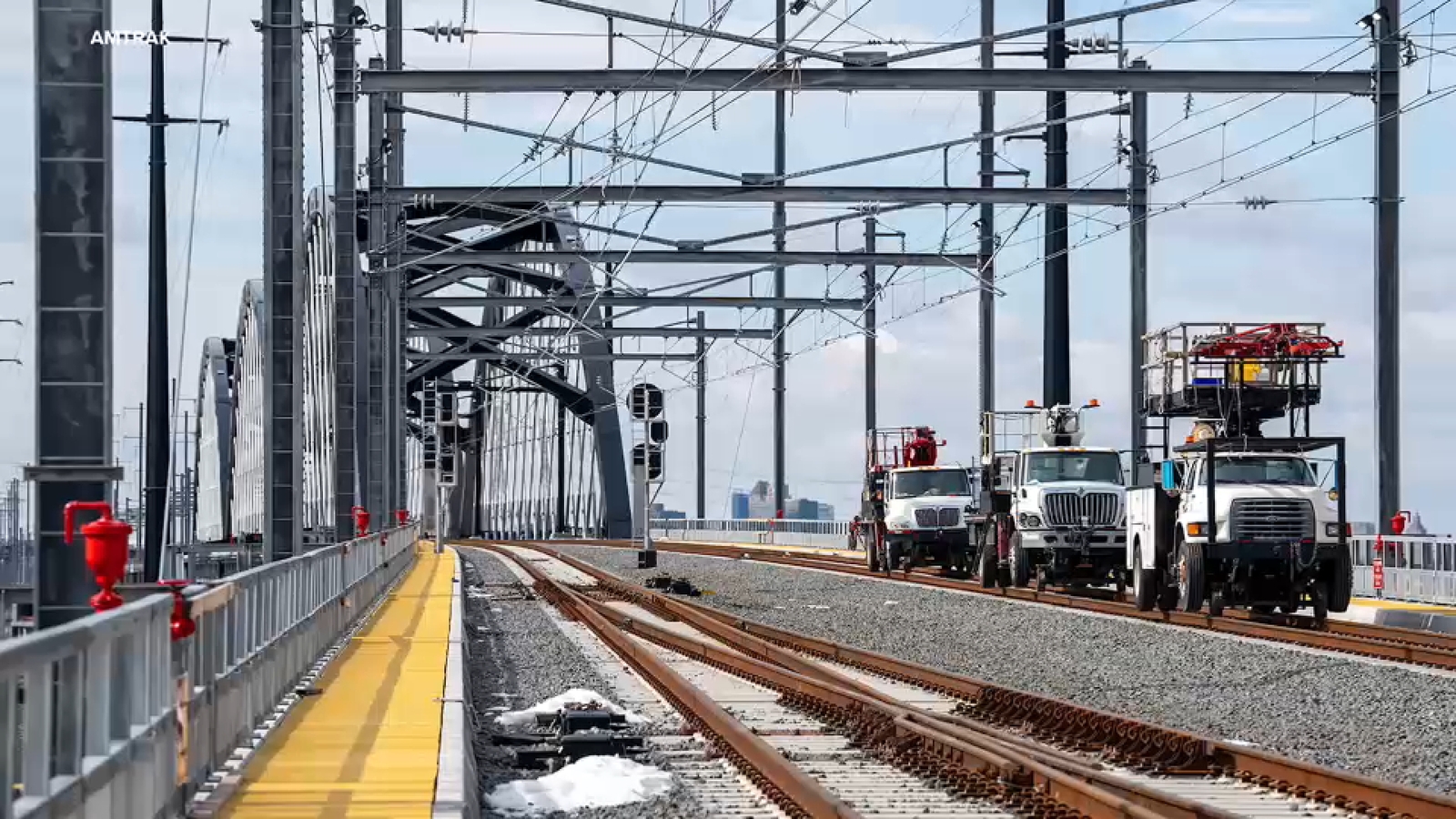
Baldwin says the electrical system, or the catenary, is the number one thing that needs to be replaced. But that includes the pantograph, the electric arms on the train that connect to the wires. In many parts of the system, Amtrak owns the catenary, while NJT clearly own the pantograph on their trains.
The new Portal Bridge project includes a new catenary, but that’s less than three miles of tracks.
“It’s a lot of track to replace and it’s not cheap for sure,” said Baldwin.
Jurisdiction is also a major challenge. There can be more than one agency in charge of train tracks at the same time.
Amtrak, NJ Transit and even freight lines can all use them and all are involved in the decision-making
“When you have shared track, it’s always going to take longer and be less straightforward,” said Baldwin.
Fully modernizing the system takes money, a lot of it, for a transit system that has been underfunded for years.
Amtrak estimates it will cost $120 billion to fix the entire Northeast Corridor.
In New Jersey, a spokesperson to Governor Miki Sherill said, “The Sherrill Administration is exploring all options to improve New Jersey’s transit infrastructure. This issue is personal for the Governor – the First Gentleman has relied on mass transit for years, and Governor Sherrill knows firsthand just how much delays can impact both work and family.
The Governor is committed to addressing this issue with urgency. Massive infrastructure investments already underway – such as Gateway, Portal North, and the New York Penn Station redesign – are critical elements of our plans to increase capacity and remove bottlenecks to overcome the systemic causes of reliability issues. Additionally, major improvements at our transit hubs here in the state, like at Walter Rand Transportation Center or Newark Penn Station, will provide accessible multimodal transit service across New Jersey. Taken together, these projects represent a roadmap to improved transit service and rider experience.”
As for Baldwin, she believes services will improve in the next year or two. But there are other issues that need long-term investment. NJT’s system includes crumbling train stations and damaged old bridges.
There’s a new Raritan Valley Bridge under construction. The nearly $600 Million project will replace the original, built in 1908. It was severely damaged by Superstorm Sandy. Completion of the new bridge is scheduled for 2030.
At the Roselle Park train station, exposed rebar can easily be seen. The platform is depleted and partially closed off to commuters. According to NJ Transit, the elevated station was built in 1967 and is obsolete, both structurally and aesthetically.
In an official comment to Eyewitness News, NJ Transit said, “…we’ve purchased 374 new multilevel railcars since 2018 for an investment of $2.5 billion, the first of which will go into passenger service this year. We are also nearing completion of the largest capital project in our history on time and on budget, the $2.3 billion Portal North Bridge – a project of national significance that will transform reliability on the Northeast Corridor. That’s just one of the many capital projects advancing over the last 8 years – more than $6 billion in all, with an estimated $8 billion over the next three years.
NJ Transit is now on pace to have a fully modernized fleet by 2031 for the first time in our history. Having modern rail cars and buses will provide far greater reliability, on-time performance, additional capacity and amenities for customers.”
Amtrak says it has numerous ongoing infrastructure projects, all part of a 2040 Northeast Corridor plan. Amtrak’s spokesperson said that, “Based on current schedule assumptions, the plan costs an estimated $120 billion in 2025 dollars, or $163 billion in year-of-expenditure dollars over the next fifteen years to substantially address aging infrastructure, improve service reliability, and meet future demand and service goals. While this investment is critical to advancing the corridor’s long-range vision, the immediate focus is on securing approximately $34 billion from a variety of funding sources between FY26 and FY30.”
As for Doug Matthews, improvements can’t come soon enough.
“When we have delays, they’re bad,” he said. Adding, “You have to constantly be on your guard and constantly be ready to run.”
Construction on the $16 Billion Gateway Tunnel Project recently resumed after the Trump administration temporarily froze funding. Once complete, Baldwin believes it will improve transit between New Jersey and New York.
———-
DO YOU NEED A STORY INVESTIGATED? Dan Krauth and the 7 On Your Side Investigates team at Eyewitness News want to hear from you! Call our confidential tip line 1-877-TIP-NEWS (847-6397) or fill out the form BELOW.
You can also contact Dan Krauth directly:
Email your questions, issues, or story ideas to 7OnYourSideDan@abc.com
Facebook: DanKrauthReports
Twitter: @ DanKrauthABC7
Instagram: @DanKrauth
Copyright © 2026 WABC-TV. All Rights Reserved.
