

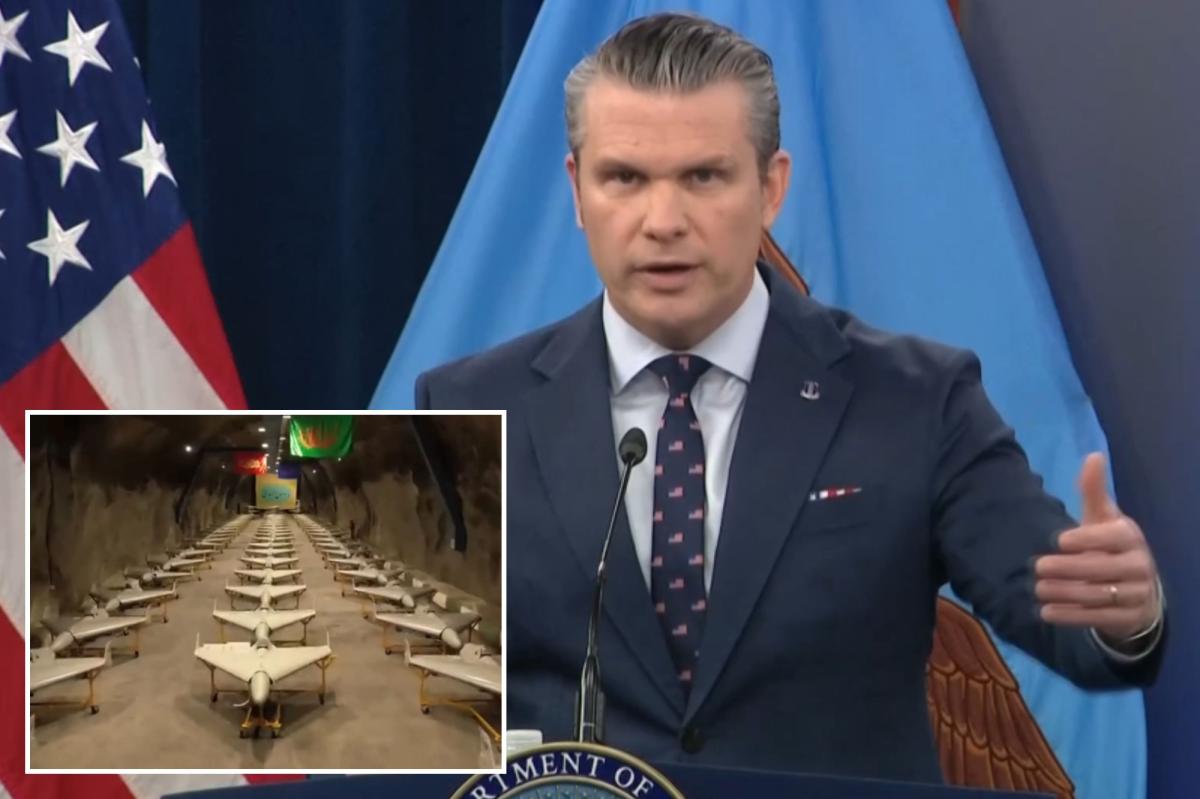
WASHINGTON — Secretary of War Pete Hegseth said Friday that Iran’s missile volume is “down 90%” from the beginning of Operation Epic Fury and that its one-way suicide drone attacks have decreased by 95%.
“Iran has no air defenses. Iran has no air force. Iran has no navy. Their missiles, their missile launchers, and drones are being destroyed or shot out of the sky. Their missile volume is down 90%. Their one-way attack drones yesterday, down 95%,” Hegseth said at a Pentagon press conference.
“As of two days ago, Iran’s entire ballistic missile production capacity — every company that builds every component of those missiles — has been functionally defeated, destroyed,” he said.
Follow The Post’s live coverage of President Trump and national politics for the latest news and analysis
“Buildings, complexes, and factory lines all across Iran, destroyed. So we’re shooting down and destroying what missiles they still have in stock, but more importantly, ensuring that they have no ability to make more. Their production lines, their military plants, their defense innovation centers, defeated.”
Hegseth’s declaration came after Tehran released footage Thursday of a massive underground “missile city” filled with attack drones, sea mines, and anti-ship missiles. It was unclear when that video was recorded.
President Trump has repeatedly said the Iranian military has been defanged since the war started Feb. 28, telling supporters in Kentucky Wednesday that “we’ve won” without saying when the mission might end.
Officials identified four initial war aims, including destroying Iran’s nuclear and missile programs, sinking its navy, and ending Tehran’s support for proxies such as Hezbollah in Lebanon.
‘Tactically complex environment’
Hegseth and Gen. Dan Caine, chairman of the Joint Chiefs of Staff, acknowledged Friday that the Strait of Hormuz remains too vulnerable to Iranian forces for the US Navy to offer escorts to oil tankers.
“It’s a tactically complex environment,” Caine told reporters.
Follow The Post’s coverage of the United States’ airstrikes on Iran:
“Before I think we want to take anything through there at scale, we want to make sure that we do the work pursuant to our current military objectives to do that safely and smartly.”
The strait, through which about a fifth of the world’s oil flows, has emerged as a key point of leverage for Tehran — with Supreme Leader Mojtaba Khamenei calling it a “tool to pressure the enemy” in a statement released in his name Thursday.
Energy Secretary Chris Wright said Thursday that US military escorts may not start until April — a full month after the war halted traffic through the crucial energy bottleneck.
“As the world is seeing, they are exercising sheer desperation in the Straits of Hormuz — something we’re dealing with. We have been dealing with it and don’t need to worry about it,” Hegseth said.
“We’re on plan to defeat, destroy, disable all of their meaningful military capabilities at a pace the world has never seen before.”
The war secretary added that “we want to do it sequentially in a way that makes the most sense for what we want to achieve, and ensure that we’re sending the right signals to the world when we do so.”
Hegseth said US airstrikes on Iran are due to increase by 20% Friday over any prior day in the conflict and that “it’s our job to have a plan for it, which we do, to address it, and ensure that the president has options.”
He also blasted a CNN report that the Trump administration underestimated the war’s potential impact on the Strait of Hormuz, calling it “patently ridiculous” and “fundamentally unserious.”
“For decades, Iran has threatened shipping in the Strait of Hormuz. This is always what they do, hold the strait hostage. CNN doesn’t think we thought of that,” he scoffed.
“Another example of a fake headline that I saw yesterday: ‘War Widening.’ Here’s a real headline for you, for an actual patriotic press, how about: ‘Iran shrinking, going underground’ … The only thing that is widening is our advantage.”
