
Mayor Zohran Mamdani is getting praise for presenting a budget that estimates expenses more accurately than his predecessor, Mayor Eric Adams. But his plan to balance that budget — which anticipates a Wall Street-driven boost to tax revenues, possible draw-downs of the city’s reserves and an across-the-board property tax hike — is getting panned.
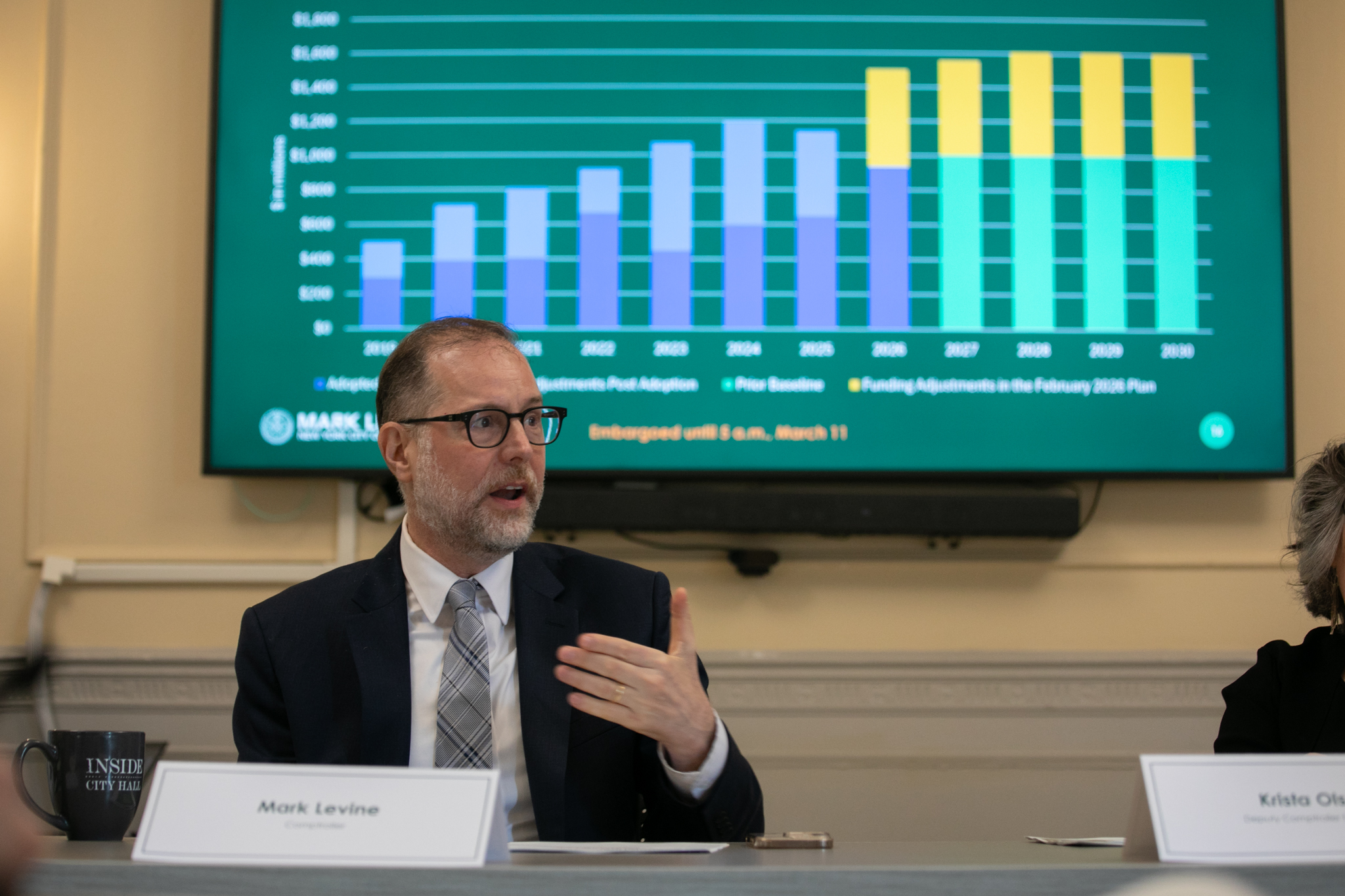
Both city Comptroller Mark Levine and the Independent Budget Office said Wednesday that betting on a continuation of gravy from Wall Street is risky. Levine added that the city’s rainy-day reserves are for emergencies and should not be used this year, and that a property tax hike would merely exacerbate inequalities.
“The Wall Street boom may continue, and I hope it does,” Levine said at the Council’s first hearing on the mayor’s proposal. “But we should not count on it.”
This week’s scrutiny of the mayor’s $127 billion proposal comes as the legislature and Gov. Kathy Hochul are in the final weeks of negotiating a state budget that will determine how much money the city will receive and whether Albany will agree to Mamdani’s demand to raise corporate and income taxes on wealthy New Yorkers.
Both the state Assembly and Senate last week included tax hikes in their own proposals. But Hochul remains opposed to the increase. Both houses in recent years have included tax hikes in their initial proposals — without winning them in the final budget.
Also on Wednesday, Moody’s, the bond rating agency, changed its outlook on the city from stable to negative for the first time since the pandemic because the city’s projected spending over the next four years exceeds likely revenues. While the move has no immediate effect on the city’s overall rating or its cost of borrowing, it is a sign that the city will be under pressure to close major budget gaps.
In setting the stage for debate on the mayor’s proposal, Levine and the IBO took particular aim at the administration’s decision to increase its estimate of expected revenue for the 2027 budget by more than $4 billion.
Wall Street profits last year are estimated to hit a record $60 billion, which will translate into big increases in bonuses this year and which will in turn increase both state and city income taxes receipts.
But the war with Iran has led to wide swings on Wall Street with the S&P 500 index down 6% so far this year, a key warning signal. And if the downtrend turns into a bear market, the city could face steep tax revenue declines in the next fiscal year.
The Mamdani administration is also projecting a major increase in Wall Street hiring, which Levine noted is problematic if markets fall. He also noted that the only job growth in the city in 2025 were in low-paid home health care jobs with employment in all other sectors dropping by 35,000.
“We are living in unpredictable times and we see economic hesitancy because of many uncertainties on tariffs and the war in the Mideast that has caused global market movement and causes instability in our local economy,” said Louisa Chafee, IBO executive director.
The mayor labeled his decision to include a property tax increase and use of reserves in his budget as a “last resort” as a way to pressure Albany to pass a tax increase. Both are generating widespread opposition.
The current property tax system is considered extremely unfair, putting the highest tax burden on rental buildings and overtaxing homeowners in neighborhoods predominately of color while undertaxing homeowners in areas with sharp increases in values. The mayor agrees with that diagnosis and has promised to offer a reform proposal in the coming weeks.
Chafee noted that a large portion of the hike would wind up being paid by renters, who she noted tend to be lower income. Numerous Council members echoed that position Wednesday with Nantasha Williams saying given how unfair the system is, it was the wrong approach to talk about increases before reforms were instituted.
The city’s reserves stand at $8 billion, a record in dollar terms but a declining percentage of the budget. The city has not added funds to its rainy day fund since fiscal year 2022. Levine opposed any use of those funds. And the city has no rules on how to use that money.
“The rainy day fund exists for some time of shock like a pandemic and that’s not what we have now,” he said Wednesday.
Meanwhile advocacy groups continue to battle over probably the key issue: Is the city spending too much or not enough?
The progressive Fiscal Policy Institute issued a report on the city budget calling for an increase of $5 billion in city taxes, noting that tax revenue had fallen to 5.4% of the city’s economy from 6.5% in 2020. State spending has kept pace with the state economy.
The Citizens Budget Commission, a business-backed watchdog group, said the mayor’s proposal presented a “false choice” between raising different types of taxes and noting spending had increased by $16 billion more than to offset inflation.
“New York City doesn’t have a revenue problem. It has a spending problem,” said CBC President Andrew Rein. “Despite revenues continuing to flood in, the city is on pace to spend $5.8 billion more than it has taken in since fiscal year 2022 — the result of layering on programs without any effort to make them affordable by eliminating spending that’s not improving New Yorkers lives.”
