
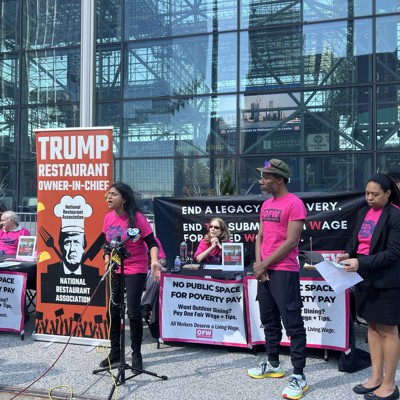
Actor and longtime left-wing activist Susan Sarandon teamed up with organizers of the “One Fair Wage” campaign and restaurant workers to serve meals outside of the New York Restaurant Show convention on Monday. Their message to lawmakers? Pass legislation to gradually raise the minimum wage to $30 per hour for all workers – tipped workers included. The protest specifically took aim at the New York City Hospitality Alliance, which has lobbied against efforts to raise the minimum wage, citing the burden it would impose on small businesses and employers. Currently, the city’s minimum wage is $17 an hour, although tips earned by restaurant workers are often factored into that calculation.
With the New York City Council looking to expand the city’s outdoor dining program – potentially to once again be available year-round – Sarandon and advocates are seeking to tie that to a wage increase. Council Member Sandy Nurse also recently introduced legislation to raise the minimum wage to $30 by 2030. This is something New York City Mayor Zohran Mamdani called for on the campaign trail.
In a statement, the New York Hospitality Association and two other restaurant groups said eliminating the tip credit is a “failed policy.” “If One Fair Wage has its way, restaurant workers will make less, menu prices will go up and restaurants will close. On top of that, the vibrant streetscapes created by an expanded outdoor dining program will be gone forever.”
City & State caught up with Sarandon and One Fair Wage President Saru Jayaraman for a few minutes to discuss their efforts to increase the minimum wage for tipped workers in New York. This interview has been edited for length and clarity.
Efforts to increase the minimum wage for restaurant workers has been a fight here in New York City for years. How does the prospect of outdoor dining’s year-round return add urgency to the fight? Why tie the two together in your advocacy work?
Sarandon: It’s just a good time as we talk about profits and expanding the profits in a public space to bring this issue up, because it hasn’t changed. There are states that have voted independently and have raised the minimum wage for servers. Here in New York though, strangely we think of ourselves as being so progressive, but we also have very strong lobby groups that don’t want that taken out of their profits. This is the job that most single mom households work – so I particularly think it’s an emergency situation for so many women. It makes them very vulnerable because they are held hostage in a way, in a job that they can’t afford to lose so they experience a high percentage of harassment for instance.
Jayaraman: A lot of other states have already done this – in fact, since the pandemic, as a result of all that happened, we got this passed in D.C., Chicago, Michigan and Arizona. New York has not done this, and it’s because of the New York City Hospitality Alliance. Democrats, sadly, like Gov. Kathy Hochul, have been rolling over to the restaurant association. Now we have a new mayor here in New York City. He is supposedly for the people, not for profit, so we really need him to stand up to the restaurant association and say, “if you’re going to take over the sidewalk like you did during the pandemic, this time, we can’t repeat the same mistake.” We need one fair wage with tips.
To that point, there’s a lot of conversation right now about affordability, fueled in large part because of Mamdani’s rise. How does this help the legislation’s chances?
Jayaraman: We have a really good shot – more than ever before. It’s not just the mayor, it’s also the Deputy Mayor for Economic Justice Julie Su. She has been a champion of restaurant workers and tipped workers for a very long time – from California to becoming interim secretary of labor, to coming here. There’s people in and out of the Mamdani administration who stand with us. We know we can get this done. We’re asking for the mayor to pass an executive order that would require any restaurant that wants an outdoor dining license to pay for one.
Sarandon: That’s the difference. It’s not up to the governor who did not allow a vote. It can be done with an executive order so that is a very, very encouraging moment.
Susan, you’re involved in such a broad spectrum of advocacy work – be it broader sweeping issues like the treatment of Palestinians, and then, of course, economic justice issues here in New York. How do you decide where to focus your efforts?
Sarandon: Well, they all seem to have the same bad guys. I guess a lot of it has to do with where people need me and if I’m able to help in any way. That’s how I choose them. I think that they all have to do with preserving the dignity of life. People, no matter where they are or how big or small an issue, that’s what it goes down to. Usually something that needs a voice that isn’t getting it in mainstream media or is being subject to misinformation, I feel like that with my platform – despite not being someone who wants to be in office or anything like that – I can get information to people. I can help create pressure so people can vote responsibly. We’re often not getting really important information from a lot of these groups that have no voices.
