

How can people possibly afford to live in one of the most expensive cities on the planet? It’s a question New Yorkers hear a lot, often delivered with a mix of awe, pity and confusion.
We surveyed hundreds of New Yorkers about how they spend, splurge and save. We found that many people — rich, poor or somewhere in between — live life as a series of small calculations that add up to one big question: What makes living in New York worth it?
Sara Robinson boarded a Greyhound bus from Oregon to New York City to attend Hunter College in the early 2000s, bright-eyed and eager to pick up odd jobs to fuel her dream of living there.
For a long time, she made it work. But recently, that has been more challenging than ever.
Right around her 40th birthday, Ms. Robinson began to feel financially squeezed in Brooklyn, where she had lived for years. Ms. Robinson (no relation to this reporter) was also feeling too grown to live with roommates.
“As a child,” she said, “you don’t think you’re going to have a roommate at 40.” She decided to move into a place of her own: a one-bedroom apartment in the Tompkinsville neighborhood of Staten Island.
After she moved, the preschool where she’d worked for over a decade closed. Now, she works two jobs. She is a seasonal employee for the state Office of Parks, Recreation and Historic Preservation, working from Tuesday to Saturday. And on Monday nights, she sells concessions at the West Village movie theater Film Forum, which pays $25 an hour plus tips.
Ms. Robinson, now 45, loves her job as an environmental educator at a state park on Staten Island. Her team runs the park’s social media accounts and comes up with event programming, like a recent project tapping maple trees to make syrup.
But the role is temporary. Her last stint was from June 2024 to January 2025. Then she was unemployed until August 2025. Ms. Robinson’s current contract will be up in April, unless she gets an extension or a different parks job opens up.
Ms. Robinson’s biweekly pay stubs from the parks department amount to about $1,300 before taxes. She barely felt a difference, she said, while she was out of work and pocketing around $880 every two weeks from her unemployment checks. (Her previous parks gig paid $1,100 a check.)
Living in New York’s Greenest Borough
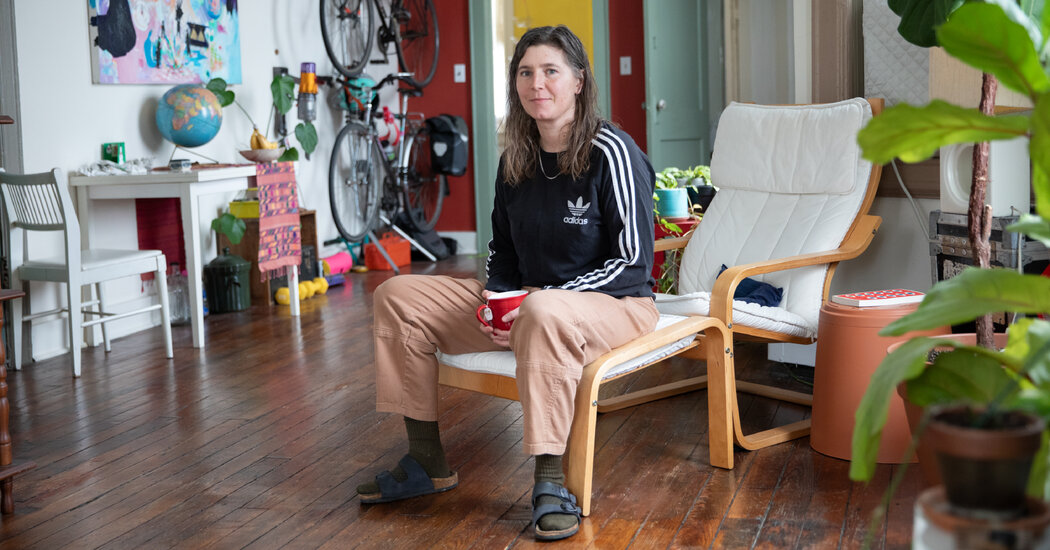
“It used to be, ‘There’s no way I’m moving to Staten Island,’” Ms. Robinson said. “But the place is close to the water. I’m three minutes from the ferry. The rest is history.” She lives on the third floor of a multifamily house, above an art studio and another tenant. Her rent is $1,600 a month, plus $125 in utilities, including her phone bill.
“If my situation changes, I don’t know if I could find something similar,” she said. “So much of my New York life has been feeling trapped to an apartment. You get a place for a good price, and you’re like, ‘I can’t leave now.’”
Staten Island is convenient for Ms. Robinson’s parks job, but it’s become harder to justify living in a borough where she knows few people. It takes more than an hour to get to friends in Brooklyn, an especially hard trek during the winter. After four years of living on Staten Island, Ms. Robinson feels somewhat isolated.
“All my friends on Staten Island are senior citizens,” she said. “It’s great. I love it. But I do want friends closer to my age.”
One of Ms. Robinson’s friends, Ray, took her on nature walks and taught her about tree identification, sparking an interest in mycology, the study of mushrooms. This led to a productive — and free — fungi foraging hobby during unemployment. She has found all sorts of mushrooms, including, after a month of searching, the elusive morel.
The Budgeting Game
Ms. Robinson doesn’t update her furniture often, but when she does, she shops stoop sales in Park Slope or other parts of Brooklyn.
“It’s like a treasure hunt,” she said. “You could make a whole apartment off the street, off the stuff that people throw away.”
She also makes a game out of grocery shopping, biking to Sunset Park in Brooklyn or Manhattan’s Chinatown to go to stores where there are better deals. She budgets about $300 for groceries each month.
Ms. Robinson bikes almost everywhere, sometimes traveling a little farther to enter the Staten Island Railway at one of the stations that don’t charge a fare. She spends $80 a month on subway and ferry fares, and $5 a month for a discounted Citi Bike membership she gets through a credit union, though she usually uses her own bike. She is handy and does repairs herself.
There are certain splurges — Ms. Robinson drops $400 once or twice a year on round-trip airfare to Seattle, where her family lives. She also spent $100 last year to see a concert at Forest Hills Stadium in Queens.
She said she has many financial saving graces. She has no student loans and no car to make payments on. She doesn’t get health insurance from her jobs, but she qualifies for Medicaid.
She mostly eats at home, though sometimes friends will treat her to dinner. She repays them with tickets to Film Forum movies.
Nothing Beats the Twinkling Lights
Ms. Robinson’s friends often talk about leaving the city — and the country.
Two friends have their eyes set on Sweden, where they hope to get the affordable child care and social safety net they are struggling to access in New York.
Ms. Robinson can’t see herself moving elsewhere in the United States, but she is entertaining the idea of an international move if she can’t hack it on Staten Island.
Yet the pull of the city is hard for her to resist.
“I just get a rush when I’m riding the Staten Island Ferry across the bay,” she said. “You see all the little twinkling lights. It’s this feeling of, ‘everything is possible here.’”
That feeling, plus the many friendly faces Ms. Robinson sees every day — the ferry operators, the conductors on the Staten Island Railway, her co-workers at Film Forum — are what tie her to New York.
“My savings are not increasing, so there’s that,” she said. “But I’ve been OK so far. I think I’m going to figure it out.”
