

This column originally appeared in On The Way, a weekly newsletter covering everything you need to know about NYC-area transportation.
Sign up to get the full version, which includes answers to reader questions, trivia, service changes and more, in your inbox every Thursday.
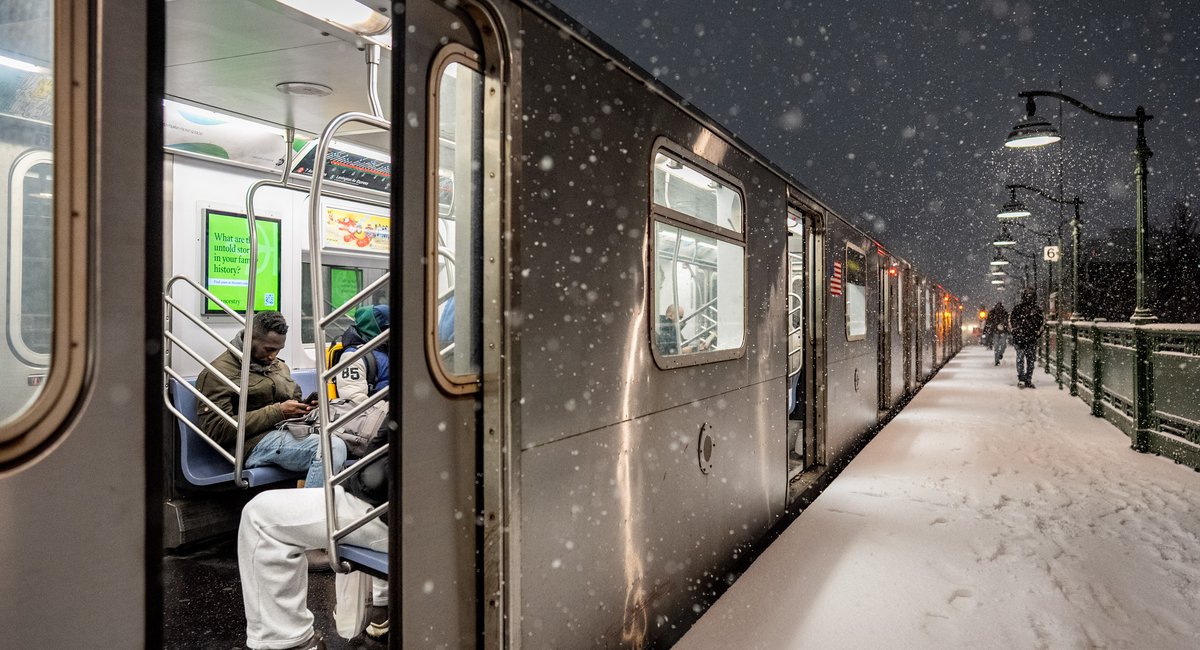
New York City’s subway system kept moving — albeit slowly and with severe delays — during Monday’s blizzard, which buried the five boroughs in more than 20 inches of snow.
MTA Chair Janno Lieber repeatedly laughed in the face of Old Man Winter this week, chastising other transit agencies like NJ Transit that shut down due to the snow. But his decision to keep service running represents a departure from previous MTA leaders, who were quick to close aboveground subway service during snowstorms.
As the largest snowstorm ever recorded in the city began in 2016, then-Gov. Andrew Cuomo ordered the MTA to close aboveground subway service due to equipment and icing issues. He also suspended aboveground service in 2017 ahead of Winter Storm Stella, which was expected to dump up to 30 inches of snow to the five boroughs — but only brought about 7 inches. And in 2021, nearly a year into the pandemic, Cuomo drove to the city from Albany in a white Ford Bronco in the middle of a blizzard to issue a last-minute announcement that aboveground service would shut down due to the weather.
Lieber and Gov. Kathy Hochul have taken a different approach by maintaining aboveground service during a pair of massive snowstorms this winter.
Subways were technically running — but service was rough. Commutes were still miserable after this week’s blizzard passed. On Tuesday, riders across the city endured severe delays — and even a smoke-filled train — as they returned to work and school.
An internal MTA document from last November obtained by Gothamist shows the MTA told transit workers that maintaining service during inclement weather is a top priority.
“It is important that all employees make every effort to come to work during emergencies or inclement weather conditions which include, but are not limited to, snowstorms, hurricanes and tropical storms, and to report to their assigned work locations on time,” the document stated.
Suspending aboveground service comes with a number of drawbacks beyond the obvious inconvenience to riders. The MTA’s “Winter Operations Master Plan” shows suspending aboveground service is a massive operation that takes at least six hours.
Lisa Daglian, executive director of the Permanent Citizens Advisory Committee to the MTA, said the agency is more competently run under Lieber and Hochul than it was under Cuomo.
“The former governor was not a transit operator, he was a governor,” Daglian said. She said Hochul and Mayor Zohran Mamdani want to keep service running even during worsening weather conditions.
“[The MTA] came to this conclusion [to keep aboveground service running] with not just political will, but with management skill and with a strong understanding that they have an excellent workforce that could get them through this too,” she said.
Lieber said investments in “amazing snow-fighting equipment” helped the MTA run aboveground service in the storm.
“Aboveground stations are operating,” Lieber declared on WNYC’s “Morning Edition” earlier this week as the storm raged on. “They’re operating in the boroughs, both the aboveground stations that are on elevated structures and all the outdoor stations in what we call cut, those depressed below grade areas around the city.”
While New York City’s subway system is largely known as an underground network, it also includes 220 miles of elevated and aboveground tracks. That’s more than all of Chicago’s subway system, which is known as the “El” because it’s almost entirely elevated.
According to the transit agency, staff assembled and prepared six de-icer trains, two debris-clearing trains and five “snow throwers,” which are essentially snowblowers on rails. MTA spokesperson Michael Cortez said crews also added ice scrapers onto trains to prevent buildup on the third rail and heaters on the system’s tracks, switches and signals.
“On Monday, when the rest of the world was pretty much shut down, we carried a million people on our subway, which is more than any other subway system in the United States carries on a normal day,” Lieber said during a news conference on Wednesday.
Curious Commuter
Question from Dana in Queens
Why is the Queensboro Bridge entry coming from uptown tolled, which is not in the zone? Leaving Queens for Uptown Manhattan is easily done via the upper bridge, but returning is tolled?
Answer
This is a major quirk of congestion pricing. The toll zone, by law, covers all of Manhattan below 60th Street (excluding the FDR Drive and West Side Highway). But the Queensboro Bridge ramps spill across the zone.
We wrote about this, and have a handy guide here.
Here’s a TL;DR: The only ramp coming into Manhattan on the Queensboro Bridge that won’t charge you is the upper one, which puts you safely out of the toll zone at 62nd Street. But returning to Queens from Manhattan will cost you, even if you start north of the zone. The ramps to the Queensboro are in the zone. It’s essentially a way to toll the bridge, and reduce the number of trips people take into Manhattan.
