

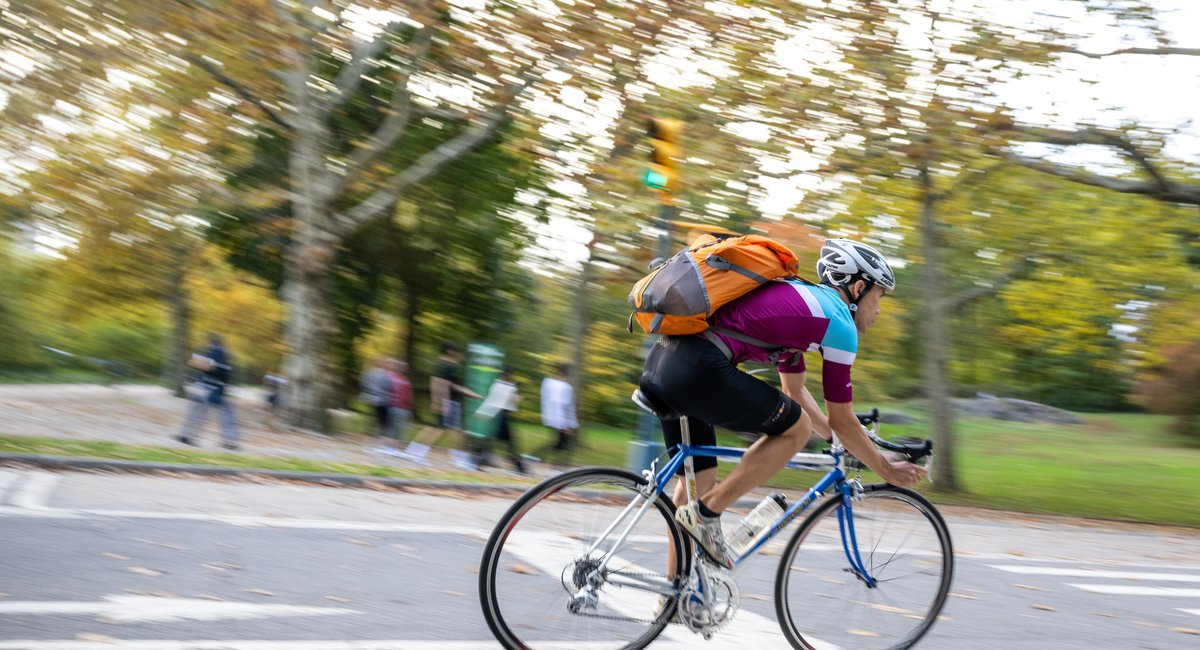
A New York City cycling club argues in a new lawsuit that the city has implemented a 15 mph speed limit in Central Park through the “perversion” of a new law meant to reduce car crashes.
Just before leaving office, former Mayor Eric Adams’ administration reduced the speed limit on the Central Park Drives from 20 to 15 miles per hour. In a lawsuit filed last week, New York City Cycling Club writes that the new limit will force competitive cyclists who normally train in the park out onto the roads. Two seasoned competitive cyclists state in sworn declarations that the new speed limit unfairly prevents them training for races by eliminating “one of the few safe areas in the entire city for high-intensity bicycle training.”
“Training for cycling requires me to ride at speed for various intervals of time; there is no way to develop strength and fitness required to race competitively without that. This requires me to be extremely alert to my surroundings at all times, just as I would be in a race,” Sarah Chubb Sauvayre, who has ridden in the park for 42 years, said in a legal filing.
The cycling club’s legal argument, which was first reported by Streetsblog, centers on the administration’s use of Sammy’s Law to lower the speed limit. The law, named after a young boy who died after being hit by a car on Prospect Park West in 2013, gives New York City the power to reduce the speed limit to 20 mph on most streets and 15 mph in school zones. The law was passed in 2024 after years of advocacy led by people whose loved ones died in traffic.
The cycling club argues the law only applies to motor vehicles. The city Law Department, which did not respond to a request for comment, wrote in a legal filing that Sammy’s Law is “broadly applicable to vehicles, e-mobility devices, and bicycles.”
“Particularly, this affects those who are doing training and exercise rides… 15 mph would put the kibosh on that,” said Peter Beadle, the attorney representing the cyclists.
Colin Taber, president of the New York Cycling Club, said in a legal filing that cyclists already protect safety in the park by following a “Central Park Protocol,” which instructs them to train at high speeds when the park is least crowded, in the early mornings and late evenings.
A January report from the Department of Transportation that tracked average bike speeds in Central Park showed that average biker speeds exceed 15 mph only before 9 a.m.
“[Cyclists] would be immediately and negatively affected if they were forced out of the safety of the park and out onto city streets or stayed [and] risked traffic tickets — often now in the form of criminal summons – to train at the level they require for the sport,” Taber said.
In a legal filing, Taber called the city’s use of Sammy’s Law “a perversion of the purpose of that law.”
Beadle emphasized that the lawsuit is not an attempt for cyclists to avoid following the law.
“There should be rules, and there are rules and they can be enforced,” he said. “But what we mustn’t do is follow an unfair process specifically targeted to punish one population.”
Betsy Smith, the president and CEO of the Central Park Conservatory, backed the reduced speed limit when it was announced.
“A clear, consistent speed limit helps to reduce conflicts between pedestrians and motorists and makes the Drives safer and more predictable for everyone,” she wrote.
Crowding on Central Park’s drives has been a growing concern in recent years. The conservancy also backed a proposed ban of horse carriages, which cruise the park.
