

On a typical Tuesday morning, hardhats would have been at work on the Manhattan gateway to the country’s largest infrastructure project — and not caught in the middle of a political fight between President Donald Trump and New York and New Jersey.
“Pouring concrete, digging, excavating, a little of everything,” said Guido Rivieccio, 49, of Laborers’ Local 731, the largest union that is working on building a new Hudson River rail tunnel.
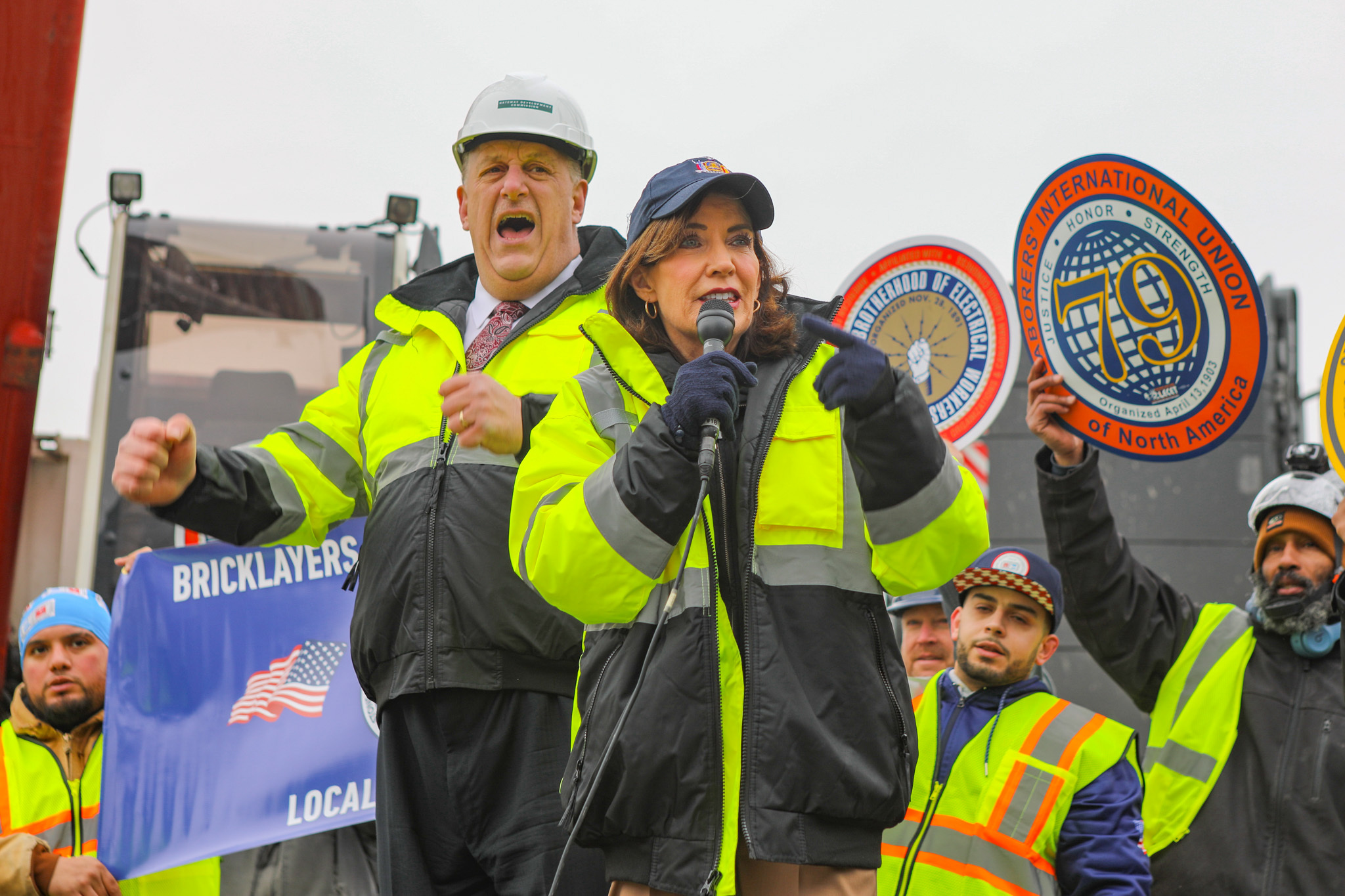
Instead, workers who were laid off last week from several construction sites on the $16 billion project known as Gateway found themselves rallying alongside Gov. Kathy Hochul and union leaders who pressed Trump to restore full funding for work on a vital link along the East Coast rail corridor that extends between Washington, D.C. and Boston.
“I’m hoping they can release the funds and that we can all get back to work,” said Giulio Petroni, a Local 731 general foreman who last April was among the first workers on the Manhattan site near Hudson Yards. “That we can get back to providing for our families, get everybody off the couch and back in their boots.”
The tunnel is being built to replace one that carries more than 200,000 Amtrak and New Jersey Transit travelers daily, and which is more than a century old and prone to breakdowns. But work on the centerpiece to a series of rail improvements in New York and New Jersey has been frozen since Feb. 6, with Hochul charging that workers — many of whom backed Trump — are now political pawns.
“These people supported you,” Hochul said. “How can you throw them out of their jobs, how can you tell them to go home?”
Gary LaBarbera, president of the Building and Construction Trades Council of Greater New York, acknowledged that Trump’s “America First” pledge connected with many workers on the project that the president trashed on Monday as a “future boondoggle.”
“He said, ‘America first, we’re going to put America first,’” LaBarbera said. “You know how you put America first? You build a strong middle class, because don’t ever forget it: We’re the ones that built this country.”
A federal judge last Friday released $30 million to the Gateway Development Commission and the federal government on Tuesday doled out another $77 million toward the $200 million owed to the project by the Trump administration.
“DOT is following the court order,” said a spokesperson for the U.S. Department of Transportation.
Senate Minority Leader Chuck Schumer said Tuesday he expects the remainder of the federal funding for the tunnel project to be distributed this week. That could set the stage for crews “getting back to work in a few days,” Schumer said, and potentially ending what he called “the senseless Trump fund freeze.”
The lawsuit filed last week by New York and New Jersey came on the heels of the Gateway Development Commission suing the federal government for an alleged breach of contract that led to 1,000 workers losing their jobs.

“This isn’t a Republican tunnel or a Democratic tunnel, right?” LaBarbera said. “This should not be a political tug of war.”
“We’re not red, we’re not blue,” added Petroni. “We’re boot brown over here, that’s what we are.”
Work at sites in New Jersey, Manhattan and beneath the Hudson River remains stalled and Hochul said it will not resume without the federal government fully coming out of arrears on the project.
“This is not out of the goodness of their hearts that we’re seeing money come right now, I want to be clear about that,” Hochul said. “They’re doing this because they were ordered by a judge.”
A top official from the Gateway Development Commission, the public authority created in 2019 to carry out the rail improvements, said the fallout comes with heavy consequences. James Starace, Gateway’s chief of program delivery, said the multiple components of the project will have to rebuild what was lost by the pause on the project, including skilled workers who have now left to work elsewhere.
“We had good momentum on this program, with active construction on both sides of the river,” Starace said. “We lost that momentum and that goes with the institutional knowledge that we had from the men and women of labor that were on these projects that are gone now.”
Petroni, the Local 731 general foreman, said some workers are still coming to the site a few days a week to ensure its safety. But he told THE CITY that the longer the shutdown goes, the more laborers will look for other employment, potentially impacting the work further.
“I was always told, good workers don’t stay home for long,” he said. “They’ll find another opportunity, they’ll find another job and the hard part is getting back those good guys.”
