

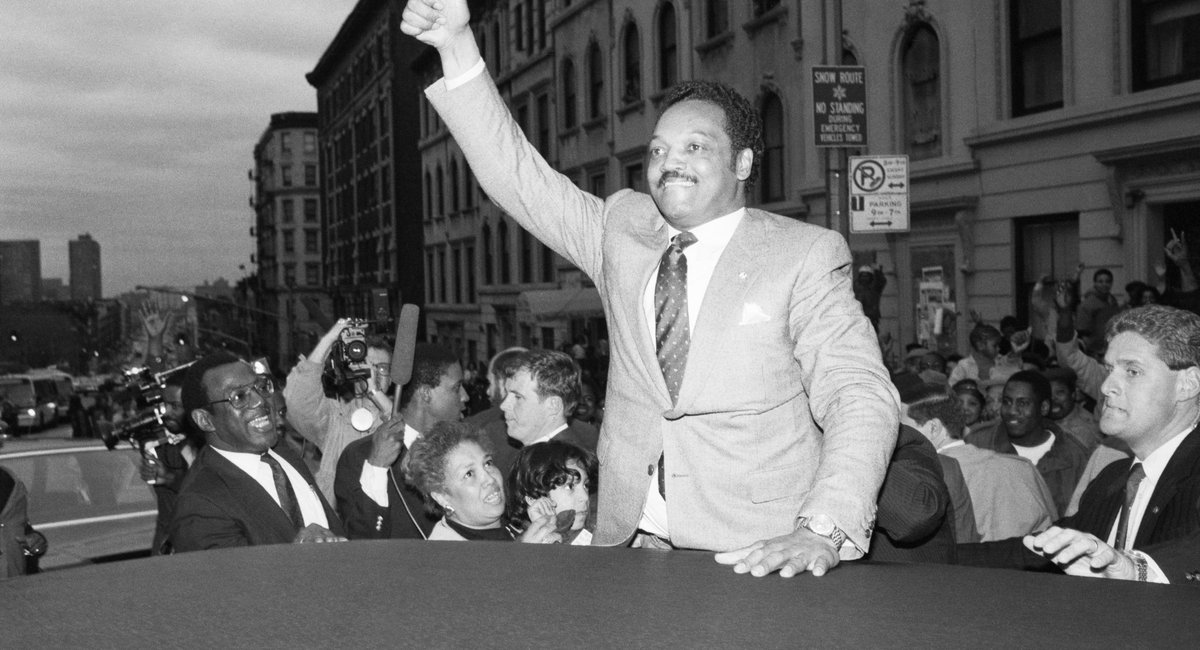
The Rev. Jesse Jackson, the national civil rights leader who died Tuesday, had a long and storied history in New York City.
Political experts said his 1988 presidential run paved the way for the election of New York City’s first Black mayor, David Dinkins, the following year.
They also recalled his many acts of civil disobedience here, which ended more than once in his arrest. President Donald Trump even recalled gifting Jackson’s Rainbow PUSH Coalition office space on Wall Street.
Among many national leaders, the Rev. Al Sharpton, founder of the Harlem-based National Action Network civil rights organization, paid tribute to Jackson.
“Today, I lost the man who first called me into purpose when I was just 12 years old,” Sharpton said in a statement. “And our nation lost one of its greatest moral voices.”
“He kept the dream alive and taught young children from broken homes, like me, that we don’t have broken spirits,” Sharpton added on X.
Here are some key moments in Jackson’s history in New York City:
A barrier breaker for New York City politics
Political scientists said it’s no coincidence that Dinkins was elected mayor a year after Jackson’s second presidential campaign in 1988.
“ When I think of Jesse Jackson, I think of David Dinkins and how Jesse Jackson helped deliver the first African American mayor to New York City in 1989,” said Christina Greer, an associate professor of political science at Fordham University.
Greer said his presidential runs inspired other African Americans to run for, and win, mayoral contests in cities across the country.
“It wasn’t just about Black engagement, it was about bringing in a whole new cadre of voters into the democratic process,” Greer said.
An anti-Jewish slur
One of Jackson’s lowest points as a public figure came during his 1984 presidential run, when he made remarks in the Washington Post referring to New York City as “Hymietown,” an antisemitic slur that generated national outrage and nearly caused his campaign to collapse.
Jackson later admitted he had been wrong to use the slur.
In a column published in Jewish community publication VINNews after Jackson’s death, Rabbi Yair Hoffman recalled an episode in Forest Hills in 1984, in the wake of the controversy, when three young people threw a bottle at him, using the same slur Jackson had used.
“The connection between rhetoric and violence was not theoretical for me that day — it was visceral and personal,” Hoffman wrote.
In the years to come, Jackson sought to repair the damage. Speaking at the 1992 World Jewish Congress, he called Zionism a “liberation movement” and repeatedly condemned the stereotyping of Jews, a process that earned him the approval of Jewish leaders worldwide, including Hoffman.
A string of civil disobedience arrests
Jackson frequently engaged in civil disobedience and was arrested on many occasions in New York.
This included a 1971 arrest at 420 Lexington Ave., where he and 11 others conducted a sit-in in the lobby of an office building. Jackson and his fellow demonstrators accused the A&P grocery store chain of engaging in discriminatory hiring practices.
“The demonstrators, led by the Rev. Jesse Jackson, head of what the conference calls Operation Breadbasket, refused to leave after slowing lunch‐time traffic in the lobby considerably,” an article in the New York Times reads. “They walked out of the building into three police vans at about 1 p.m. and were charged with trespassing and disorderly conduct.”
In another incident in 1993, he joined demonstrators who blocked Fifth Avenue in protest of the Clinton administration’s policy of operating a detention camp for HIV-positive Haitian political refugees.
He was also arrested in 1999 for blocking the entrance to NYPD headquarters in response to the police shooting of Amadou Diallo, an unarmed Guinean immigrant.
Jackson’s legendary Sesame Street appearance
In 1972, Jackson appeared on Sesame Street, where he led a crowd of young New Yorkers in a chant about self-worth.
“I am somebody! I may be poor, but I am somebody,” they shouted. “I may be on welfare, but I am somebody.”
Jeanne Theoharis, a distinguished professor of political science at Brooklyn College who is working on a book about the Chicago Freedom Movement, said the episode “is so heartwarming” and offers a particular sensibility.
“ That sensibility, that kind of combines joy with recognition,” she said, “and that our difference is, like, beautiful.”
Donald Trump gave him free office space
In the wake of Jackson’s death, President Donald Trump noted on Truth Social that he’d once given Jackson free office space in one of his buildings.
The story checks out. In 1999, Jackson himself acknowledged that Trump had provided space at 40 Wall St. for Rainbow PUSH Coalition’s Wall Street Project conference, which sought to help people of color gain access to corporate America.
Trump said it was “always his pleasure” to help Jackson out.
“He came to our business meeting here in New York, because he has the sense of the curious and the will, the risk to make things better,” Jackson said at the time. “He’s a serious person who is an effective builder of buildings and a builder of people.”
Paving the way for Bernie, and for Zohran
Theoharis said something that Jackson effectively did was demonstrate to other Democrats then and now that they could speak out on important issues that other politicians avoided without necessarily losing public support.
“ You can talk about kitchen table issues and you can also talk about racial justice,” she said. “You can also talk about trans and queer people. You can also talk about Palestine. We don’t have to sacrifice these other things.”
She said Jackson was “the Bernie Sanders of the ’80s,” and helped pave the way for today’s political stars.
“One of the shoulders that Zohran [Mamdani] was able to stand on is Jesse Jackson,” she said.
Greer said Jackson’s gift was creating a multiracial coalition that would be adopted by various New York City mayors, including Bill de Blasio, Eric Adams and Mamdani.
“He was able to resonate with a lot of different communities,” Greer said. “Immigrant communities, poor communities, Black communities, Latino communities, white communities who were in the middle class, and sort of feeling stuck as well.”
