

Green-Wood Cemetery is going green on death.
This week the Brooklyn burial ground announced a new option for leaving this world: composting corpses into nutrient-rich dirt. The nearly 200-year-old cemetery will be the first on the East Coast to offer ”natural organic reduction,” an environmentally friendly alternative to a traditional burial or cremation. The nearly 500-acre graveyard is partnering with German-based funeral company Meine Erde to sustainably send-off the dearly departed starting in 2027.
“People are more interested in sustainable ways of going through that process,” said Green-Wood Cemetery President Meera Joshi.
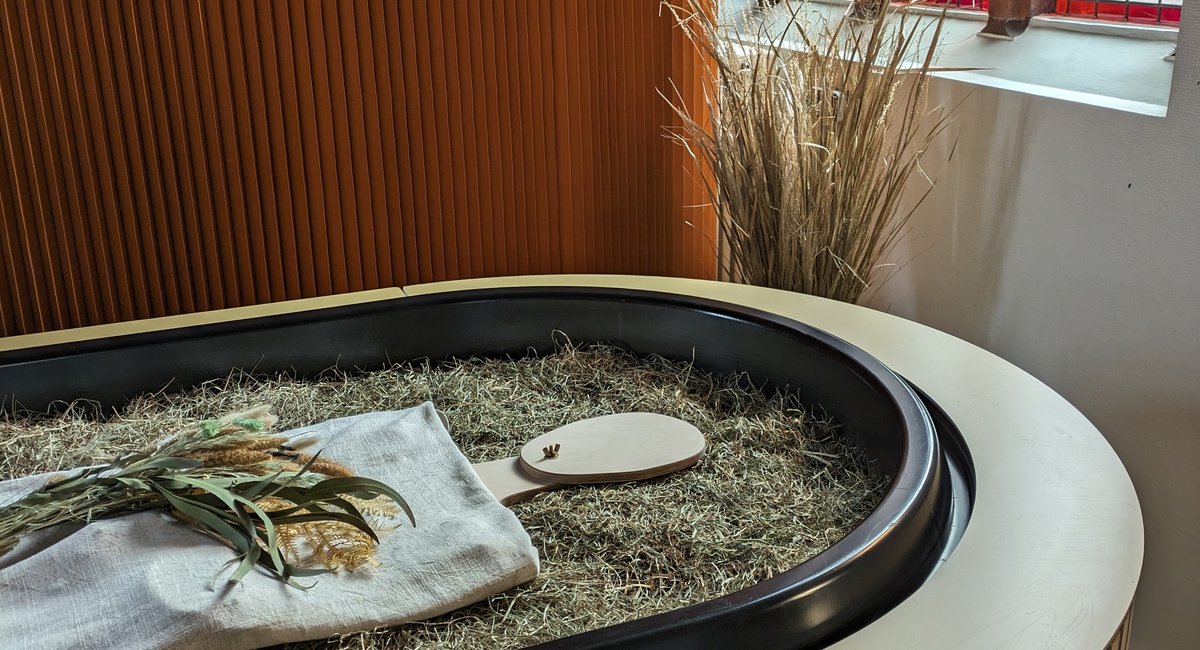
According to Meine Erde, the form of human composting, or “terramation,” is a fossil-free process that converts corpses into dirt. An unembalmed body is enclosed in a high-tech casket, which controls humidity and ventilation and also rocks back and forth to accelerate decomposition. Organic materials such as clover, wood chips, straw and alfalfa are added to the casket. After 40 days, the whole pile turns into a a 200-gallon batch of fertile soil.
Courtesy Meine Erde
“It’s basically the same process as when a tree falls in the woods and slowly becomes earth over time,” Joshi said.
The dirt cannot leave the cemetery ground, per the New York state law that legalized human composting in 2023. The composted human remains can be added to the cemetery grounds and even used for tree planting.
“We’ve gone back to earth. We’ve gone back to where we came long ago. That circular part of it answers that call,” Joshi said. “All of Green-Wood becomes that space for people whose loved ones go through the terramation process here.”
Green-Wood has not yet announced how much the process will cost, but similar services in California and Washington state range from $5,000 to $7,000. That’s far cheaper than a traditional burial at Green-Wood, where a gravesite is priced at $21,000 and a mausoleum for one goes for $50,000. People who want their corpses to be composted can put in an inquiry on the cemetery’s website.
Roy Rochlin/Getty Images
Customarily, there are two solutions for corpses: cremation, or 6 feet under in a coffin. But both of those options come with adverse environmental impacts.
Cremation requires 10.5 to 16.5 gallons of propane gas per corpse, according to American Mortuary, a company that sells cremation equipment. That’s roughly enough fuel to drive a car about 300 miles.
The cremation process creates air pollution including nitrogen oxides, carbon monoxide and particulate matter, which all have adverse health impacts. A typical cremation releases about 534 pounds of greenhouse gas into the atmosphere.
According to a 2022 National Institute of Health study, conventional burials cause significant environment pollution through the release of embalming fluids and metals that contaminate soil and groundwater.
Terramation may also allow for more people to be buried at Green-Wood, which Joshi said will eventually “run out of space for new graves.“
“Everybody wants to be and stay in New York City, and that includes when you lose your loved one so that you can visit them and that you have a sense of community because it’s got the, your family history,” Joshi said. “If cemeteries are confined only to land sales and lot sales, at some point you run out of space.”
