

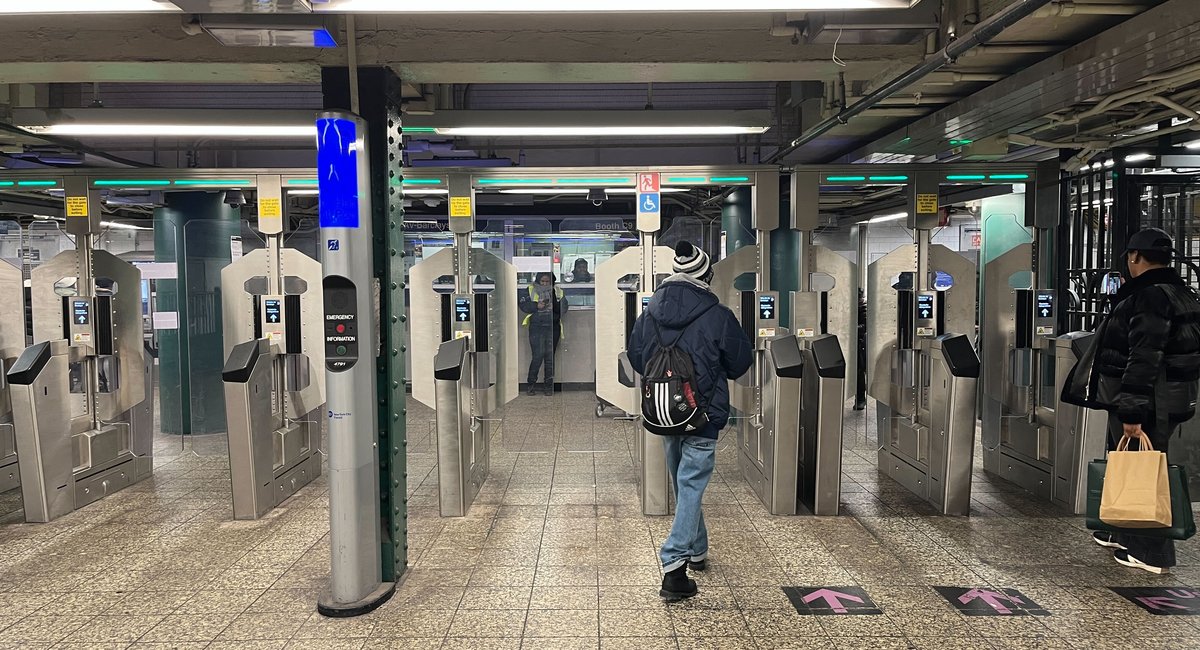
Three companies are duking it out to win a $1.1 billion contract to redesign New York City’s subway turnstiles, which transit officials have for decades blamed for rampant fare evasion.
The firms have installed new fare gate designs — each with tall doors instead of waist-high turnstiles — at 10 subway stations over the last two months, where they’re being tested as part of a pilot program.
The program is set to expand to 20 different subway stations in “the coming weeks,” MTA Chair Janno Lieber said while testifying at a state budget hearing in Albany on Tuesday.
At least two of the companies touted their designs as having some form of artificial intelligence technology that tracks fare evaders.
Cubic, which designed the now-retired MetroCard system and the existing subway turnstiles, also constructed most of the modern fare gates currently installed in the subway. But the company has come under fire from MTA officials and straphangers alike for delays and bugs with the rollout of the MTA’s OMNY tap-to-pay system, which it also designed.
“Cubic has not been a perfect partner and software develop[er] and we ride them every day, all day,” MTA Chair Janno Lieber said during the hearing. “So we think most of it has been worked out, but there’s a couple of kinks we’re still working through, to be honest.”
Anthony Louh, Cubic’s director of business development, said the hiccups with the OMNY rollout have better prepared the company to take on the massive fare gate redesign contract.
Cubic’s new gates are currently being tested at busy stations like Atlantic Terminal, Port Authority and Hoyt-Schermerhorn. The company reported plans to add them to the 125th Street station on the A, B, C and D lines next week.
The gates have surveillance technology that are automatically supposed to issue an alert whenever someone evades the fare. Officials said the equipment has cameras that record a five-second clip when someone goes through without paying, which then uses artificial intelligence to write a physical description of the suspected fare beater. The information is automatically sent to the MTA.
But two other companies, Conduent and STraffic, are also vying for the same contract and have installed their own modern fare gates in subway stations as part of the MTA’s pilot.
Conduent installed similar modern fare gates in Philadelphia’s subway system last year. Like Cubic, the company touts its own form of AI technology that uses sensors to collect data on riders who evade the fare.
A spokesperson for STraffic did not immediately respond to a request for comment about its own proposals.
“The pilot program continues and results will be reviewed at the appropriate time, with the vendors selected to supply fare gates for the future,” MTA spokesperson Eugene Resnick wrote in a statement.
The MTA aims to reach a deal to install the new entry points at 150 of the subway’s 472 stations.
The MTA is seeking other ways to deploy AI technology in the subways. Last year, the agency said it’s working with AI companies to deploy software that can detect “problematic behavior” among riders.
